
&imwidth=800&imheight=600&format=webp&quality=medium "AI-driven renewable energy: Interview with Drumil Joshi on VIBRIS")
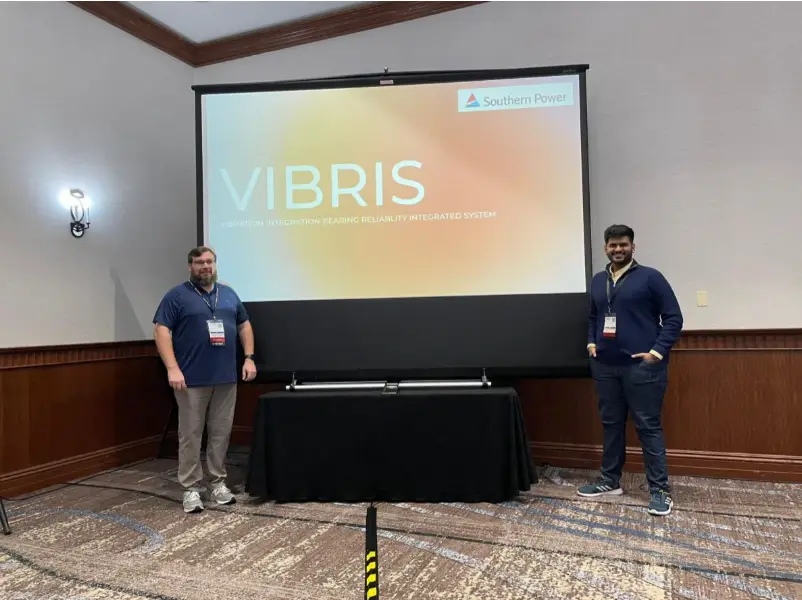
Drumil Joshi is recognised as an expert in the field of AI for renewable energy. As an M&D Analyst at Southern Power Company, he holds an MS in Data Science and has patents, research papers, and a textbook to his credit. He prefers speaking at top conferences and has appeared on Authority Magazine and several other platforms. In 2025, Drumil Joshi and his team launched the VIBRIS project, one of the foundations for predictive maintenance for wind turbines.
The full name of VIBRIS is Vibration Intelligence Bearing Reliability Integrated System next-generation condition monitoring platform. VIBRIS takes the data generated from the turbine sensors, saves it through tokenised pipelines and HEX-encoding, and passes it down to a powerful ensemble of anomaly detection algorithms (Isolation Forest, Local Outlier Factor, One-Class SVM, K-Means) for processing. The results at the turbine end are: early faults detected with precision, fewer false alarms, and transition from reactive turbine maintenance to proactive turbine maintenance.
We spoke with Drumil about VIBRIS' origins, the technology behind it, and the bigger picture of AI in sustainable infrastructure.

From idea to impact
Q: What inspired VIBRIS?
Drumil Joshi: An ideation from wanting AI for something meaningful. Most wind farms were operating in a reactive manner-maintain turbines after failures had already occurred. I wanted to look at the same thing from a different perspective-ahead of-time problem forecast, and avoid costly outages of turbines and hence unblocked renewable energy generation. I borrowed insights from finance and health care and had to rethink turbine monitoring via AI.
Trending Stories
)
US vs China over South China Sea: Washington backs Philippines, Beijing hits back
)
Bigg Boss 20: Isha Rikhi evicted after three weeks in Salman Khan’s show
)
Musk plans to more than double xAI's chips to over 1.2 million Nvidia GPUs by year-end
)
After JU, clash erupts at SRFTI: BJP’s ‘Dimagi Naxal’ jibe sparks political firestorm after students protest RSS-linked event
)
‘Anti-social elements spreading false rumours’: LPU issues statement amid massive unrest over alleged rape
)
LPU students go on rampage, vandalise campus amid widespread protest: What's happening
)
Trump asked Xi to pressure Iran. China did not say yes — here’s what Beijing wants
)
US Treasury Secretary Scott Bessent hails global crackdown on Iranian banks and airlines
)
An OpenAI agent escaped its locked test cage again, by hiding questions in DNS lookups
)
'Our video was trimmed': LPU girls who featured in rape-denial video make U-turn
)
3 males killed, four others injured in shooting after fight at strip club in Detroit
)
'Victory for low-budget consumers': Raghav Chadha hails 30-day telecom recharge rules
)
Claude rebuilt the 1989 game 'Prince of Persia' by reusing the original's own code
)
Beyond metros: How Tier-2 and Tier-3 cities could drive India’s next AI wave
)
Tesla builds first Cybertruck with its own refined lithium: Elon Musk's $1 billion Texas bet pays off
)
IndiGo flight suffers tail strike in Bengaluru while landing; DGCA to probe incident
)
The US and China set up an AI 'red telephone', but skipped the rulebook
)
‘Terror suspects arrested near UK air base were looking to do big damage’: Trump
)
Russian envoy claims US tactics to contain India were revealed in ‘Freudian slip’
)
IND vs WI 1st ODI: Kohli breaks Sachin's most runs in one country record with unbeaten 139 as India thump West Indies by 8 wickets
)
Researchers rebuilt exactly how 700 AI agents hacked Hugging Face: a 900-link chain trick
)
‘Olympic inclusion is our major target’: WPA President Ishaun Singh on pool’s global ambitions
)
Nations League: Spain sink England at Wembley; Modric shines for Croatia
)
Why has Iran released no proof of life of Mojtaba Khamenei? Araghchi reveals...
)
'What kind of confession is this?': Pakistan PM Shehbaz Sharif’s 'terrorists would be roaming New York' remark goes viral, raises alarm online. Watch
)
South Korea demands apology from Ukraine over North Korean prisoners' transfer
)
Beyond BrahMos: India targets Rs 50,000 crore in defence exports with unmatched price edge
)
Sri Lankan Tamil migrant worker gets death sentence in Saudi Arabia, help sought from India
)
Muslim marriage cannot shield sex with minor wife from prosecution under POCSO: Delhi HC
)
'Can't help but draw painful parallels to Nirbhaya case': SC on latest incidents of rape cases in Delhi-NCR
)
99.9% more powerful - Scientists find boy who can recall memories from just 3 months of age
)
'FIRST LOOK from inside Noah’s Ark': Researchers share video from inside mysterious mound in Turkey
)
UNSC reform momentum grows: Russia, Portugal, Mauritius push for India's permanent seat bid
)
8 US marines injured in Iranian missile attack on vessel in Strait of Hormuz: Report
&im=FitAndFill=(700,400))
New OTT releases this week (September 28-October 4, 2026): Dupahiya 2, Pooja Meri Jaan, Ohh My Dog- 5 titles coming on Netflix, Prime Video and more
)
Afghanistan says 28 fighters killed in clash near Pakistan border, Islamabad denies
)
Ceuta migrant crisis: Protesters take to streets as Spain grapples with migrant challenge
)
LPU suspend classes, postpones exams as violence escalates over rape claims: What's happening
)
New York City wants a 'kill switch' on every AI, and will pay whistleblowers who report violations
For me, this is not about personal accolades; rather, failure prevention and cost minimisation with improved clean-energy reliability would embody the milestones of success. VIBRIS could stand for either very good technical prowess or bright purpose: smarter green operations.
Why Did It Choose the Ensemble AI Approach?
Q: The VIBRIS takes advantage of a four-model ensemble. Why not just one algorithm?
Joshi: In a noisy turbine environment, no single model catches everything. Each does its own:
Isolation Forest: very good at spotting extreme outliers, such as sudden vibrations in the readings.
The Local Outlier Factor (LOF) method tries to detect slight local irregularities.
One-Class SVM tries to learn the normal behaviour from history and then raises abnormalities.
K-Means Clustering: cluster normal patterns outside the subsets of interest.
All four methods are combined in tandem to produce the composite anomaly score, which help to reduce false alarms and at the real time catch real issues. Think of it as an ability to distinguish between an occasional gust of wind and an actual gearbox fault.
Data Security First
Q: Why do you stress the pipeline's security?
Joshi: Energy data is sensitive data. Without good security in place, the whole operation would be a failure. Hence, VIBRIS runs on token-based auth, meaning that no raw passwords are ever transmitted but only short-lived tokens. Data is provided stepwise, minimising data exposure.
Each sensor reading is HEX encoded and compressed so that no spies ever get a chance to read the stream. Encryption coupled with endpoint obfuscation and multiple-layer validations will be the most heavily secured monitoring pipeline ever for renewables.
Clean, trusted data improves the accuracy of the model. It is not just about cybersecurity. Where there is security, the performance shall follow.
Lessons from real deployment
Q: What have you learned from deploying VIBRIS on real turbines?
Joshi: AI is not enough; you need domain expertise.
Senior vibration analyst Christopher Harrison ensured AI-flagged anomalies were mechanically relevant; his expertise kept us from chasing phantoms.
M&D manager Andrew Riley pushed for fleet-wide scalability and integration to SCADA/PI systems; he consistently reminded us that an alert is only good if it culminates in real maintenance.
Another lesson learned was correct calibration; if false alarms were generated in excess (say, coming from high winds), the crews merely ignored it; hence, the main thing was the management of
sensitivity and precision. The key lesson from all this was that for a predictive maintenance plan to work well, there has to be a perfect mix of AI and human judgment, trust, and scalability.
Democratising Data in Renewables
Q: Your organisation frequently talks about democratizing data. What does that term mean?
Joshi: The idea is to make insights available not only to data scientists but also to engineers, accountants, or even to the lay public if that is at all possible. For VIBRIS, that meant intuitive dashboards and alerts that virtually anyone is capable of acting on.
So breaking down those silos is also part of it. Sharing insights securely across teams-from one wind farm project-in fact, between wind farms worldwide-faster learning. Federated learning allows for turbines in different countries to contribute towards an AI model without giving away their own original data. So a failure pattern in a gearbox found in Texas may very well avert its occurrence in Denmark.
The more inclusive and accessible the data is to everyone, the faster our innovation becomes.
Beyond Wind: Expanding AI Predictive Maintenance
Q: Can VIBRIS concept be extended to other renewable assets?
Joshi: Yes, the approach of secure pipelines + ensemble anomaly detection port well to anywhere where there are rich sensor datasets. BESS and solar PV plants are definitely next on the VIBRIS radar. We can really improve VIBRIS to forecast inverter failures or battery degradation or anything from cell imbalances.
Predictive capabilities in AI will adapt themselves instantaneously. Models will be incrementally tuned during their progression into old age, needing human intervention for adjustment only in unusual cases. Through federated learning, whatever is learned from a site will inherently help to enrich systems worldwide.
Soon, predictive AI will become a backbone of the renewable industry, interfacing automatically with maintenance systems to facilitate spare part ordering and dispatching technicians and ensuring that downtime rarely happens on a routine basis.
The Large Vision: Intelligent Infrastructure
Q: How do you see AI and clean energy laying the foundation for another level of reality at an even larger scale?
Joshi: I see a world where renewable energy is not only green but intelligent. Imagine winds, solar, batteries, and EV chargers all communicating through an AI-powered network to:
Balance supply and demand in real time.
Detect faults and reroute power immediately.
Getting affected by an event or disasters and restoration of energy capabilities, to put it simply, is creating resilient grids.
I call these intelligent, resilient energy systems that are mostly low carbon, operating reliably, and adaptive. AI will promote real-time optimisation, be it letting people know a storm's impact on a wind farm or routing solar power to the masses and emergencies of a city.
Sustainable AI will be used to optimise storage, grid operations, and climate modelling. If done properly, transparently, and responsibly, it will serve to ensure the fastest possible pace in building a sustainable society-governed by more intelligent approaches and greener means coupled with equity.
Key Points
It carries much more than just technology paramount: Drumil Joshi's VIBRIS project holds the blueprint for how AI can intervene more and more into making renewable energy generation reliable, secure, and collaborative. With increasing investments being poured into renewable assets worldwide, systems like VIBRIS may become infrastructure for infrastructure itself-thinking that it generates power while contemplating it intelligently, resiliently, and sustainably on its own.