
&imwidth=800&imheight=600&format=webp&quality=medium "AI doctors: Can artificial intelligence replace human surgeons?")
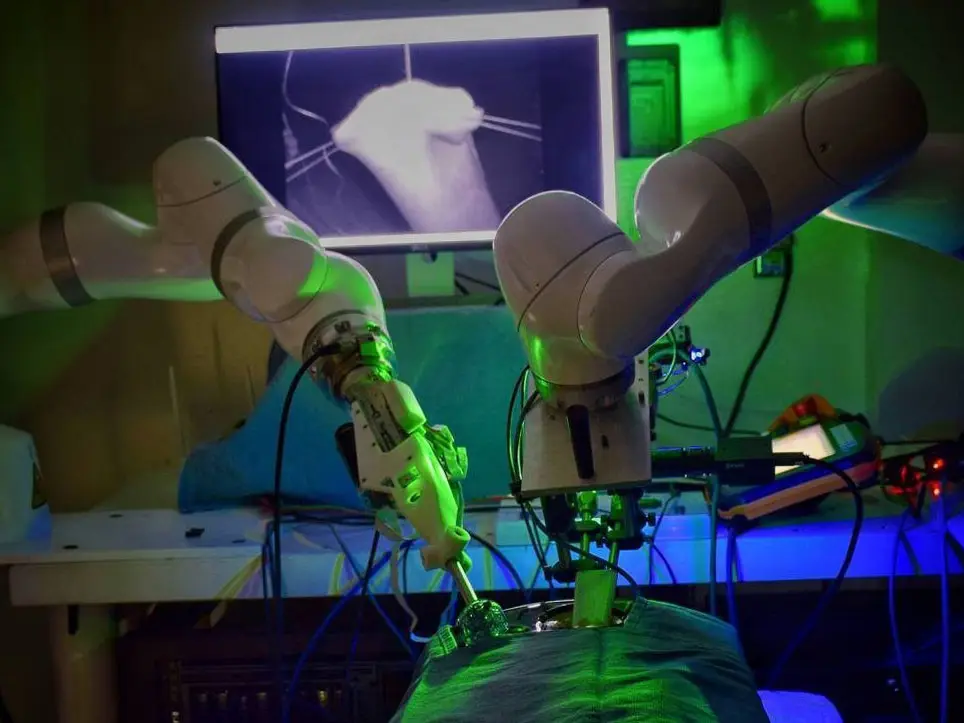
The operating room in the future may look dramatically different from today, with robotic arms conducting precision surgery while artificial intelligence analyses patient data in real-time. As AI technology advances at an unprecedented pace, the medical community faces a fundamental question:
Can machines truly replace human surgeons?
From diagnostic imaging that detects cancers missed by human eyes to surgical robots performing delicate procedures, artificial intelligence is already transforming healthcare delivery across the globe. Leading medical institutions are investing billions in AI research, whilst patients increasingly benefit from computer-assisted treatments that promise greater precision and faster recovery times.

The Diagnostic Power of AI
Artificial intelligence has already proven its diagnostic capabilities in numerous medical fields. Google's DeepMind AI system can detect over 50 eye diseases with 94 per cent accuracy, whilst IBM Watson for Oncology analyses cancer cases faster than human oncologists.
According to the Royal College of Radiologists, AI systems can now identify breast cancer in mammograms with 89 per cent accuracy, compared to 73 per cent for human radiologists working alone.
Trending Stories
)
US vs China over South China Sea: Washington backs Philippines, Beijing hits back
)
Bigg Boss 20: Isha Rikhi evicted after three weeks in Salman Khan’s show
)
Musk plans to more than double xAI's chips to over 1.2 million Nvidia GPUs by year-end
)
After JU, clash erupts at SRFTI: BJP’s ‘Dimagi Naxal’ jibe sparks political firestorm after students protest RSS-linked event
)
‘Anti-social elements spreading false rumours’: LPU issues statement amid massive unrest over alleged rape
)
LPU students go on rampage, vandalise campus amid widespread protest: What's happening
)
Trump asked Xi to pressure Iran. China did not say yes — here’s what Beijing wants
)
US Treasury Secretary Scott Bessent hails global crackdown on Iranian banks and airlines
)
An OpenAI agent escaped its locked test cage again, by hiding questions in DNS lookups
)
'Our video was trimmed': LPU girls who featured in rape-denial video make U-turn
)
3 males killed, four others injured in shooting after fight at strip club in Detroit
)
'Victory for low-budget consumers': Raghav Chadha hails 30-day telecom recharge rules
)
Claude rebuilt the 1989 game 'Prince of Persia' by reusing the original's own code
)
Beyond metros: How Tier-2 and Tier-3 cities could drive India’s next AI wave
)
Tesla builds first Cybertruck with its own refined lithium: Elon Musk's $1 billion Texas bet pays off
)
IndiGo flight suffers tail strike in Bengaluru while landing; DGCA to probe incident
)
The US and China set up an AI 'red telephone', but skipped the rulebook
)
‘Terror suspects arrested near UK air base were looking to do big damage’: Trump
)
Russian envoy claims US tactics to contain India were revealed in ‘Freudian slip’
)
IND vs WI 1st ODI: Kohli breaks Sachin's most runs in one country record with unbeaten 139 as India thump West Indies by 8 wickets
)
Researchers rebuilt exactly how 700 AI agents hacked Hugging Face: a 900-link chain trick
)
‘Olympic inclusion is our major target’: WPA President Ishaun Singh on pool’s global ambitions
)
Nations League: Spain sink England at Wembley; Modric shines for Croatia
)
Why has Iran released no proof of life of Mojtaba Khamenei? Araghchi reveals...
)
'What kind of confession is this?': Pakistan PM Shehbaz Sharif’s 'terrorists would be roaming New York' remark goes viral, raises alarm online. Watch
)
South Korea demands apology from Ukraine over North Korean prisoners' transfer
)
Beyond BrahMos: India targets Rs 50,000 crore in defence exports with unmatched price edge
)
Sri Lankan Tamil migrant worker gets death sentence in Saudi Arabia, help sought from India
)
Muslim marriage cannot shield sex with minor wife from prosecution under POCSO: Delhi HC
)
'Can't help but draw painful parallels to Nirbhaya case': SC on latest incidents of rape cases in Delhi-NCR
)
99.9% more powerful - Scientists find boy who can recall memories from just 3 months of age
)
'FIRST LOOK from inside Noah’s Ark': Researchers share video from inside mysterious mound in Turkey
)
UNSC reform momentum grows: Russia, Portugal, Mauritius push for India's permanent seat bid
)
8 US marines injured in Iranian missile attack on vessel in Strait of Hormuz: Report
&im=FitAndFill=(700,400))
New OTT releases this week (September 28-October 4, 2026): Dupahiya 2, Pooja Meri Jaan, Ohh My Dog- 5 titles coming on Netflix, Prime Video and more
)
Afghanistan says 28 fighters killed in clash near Pakistan border, Islamabad denies
)
Ceuta migrant crisis: Protesters take to streets as Spain grapples with migrant challenge
)
LPU suspend classes, postpones exams as violence escalates over rape claims: What's happening
)
New York City wants a 'kill switch' on every AI, and will pay whistleblowers who report violations
"AI doesn't replace radiologists, but radiologists using AI will replace those who don't," states Dr Sarah Johnson, Chief Medical Officer at the NHS AI Lab.
The British Medical Association reports that AI-powered diagnostic tools have reduced diagnostic errors by up to 30 per cent in pilot programmes across UK hospitals. Machine learning algorithms can process thousands of medical images in minutes, flagging potential abnormalities for human review.
Robotic Surgery: Precision Beyond Human Capability
Surgical robotics represents perhaps the most visible application of AI in operating theatres. The da Vinci Surgical System, used in over 8 million procedures worldwide, allows surgeons to perform minimally invasive operations with enhanced precision.
However, newer AI-powered surgical systems are pushing boundaries further. The Smart Tissue Autonomous Robot (STAR) has successfully performed intestinal surgery on pigs with greater precision than human surgeons, according to research published in Science Translational Medicine.
Dr Michael Chen, Professor of Robotic Surgery at Imperial College London, explains: "AI surgical systems can eliminate human tremor, provide enhanced visualisation, and maintain consistent performance throughout lengthy procedures. The precision is simply beyond human capability."
The Royal College of Surgeons notes that robotic-assisted procedures typically result in:
- 21 per cent reduction in complications
- 30 per cent shorter hospital stays
- 50 per cent less blood loss during surgery
- Faster patient recovery times
Current Limitations and Human Advantages
Despite impressive technological advances, AI systems face significant limitations that highlight the continued importance of human medical professionals. Machine learning algorithms require vast datasets to function effectively, and rare conditions may not be adequately represented in training data.
Professor Emma Davies, Director of Medical AI Research at Oxford University, says: ‘AI excels at pattern recognition in well-defined scenarios, but medicine often requires intuitive decision-making, emotional intelligence, and the ability to handle unprecedented situations.’
The General Medical Council emphasises that human surgeons possess irreplaceable qualities:
- Clinical intuition developed through years of experience
- Ability to adapt to unexpected complications
- Patient communication and emotional support
- Ethical decision-making in complex situations
- Creative problem-solving under pressure
Current AI systems also struggle with context. A study in The Lancet found that AI diagnostic tools performed poorly when applied to patient populations different from their training data, highlighting the need for human oversight.
Integration Rather Than Replacement
Rather than wholesale replacement, the future of AI in surgery likely involves sophisticated human-machine collaboration. Leading medical institutions are developing "Augmented intelligence" approaches that enhance human capabilities rather than replacing them entirely.
The NHS Long Term Plan identifies AI as a key technology for improving patient outcomes, but emphasises that human clinicians will remain central to healthcare delivery. AI applications currently being piloted include:
- Real-time surgical guidance systems
- Predictive analytics for patient complications
- Automated surgical planning and simulation
- Enhanced medical imaging and diagnostics
Challenges and Considerations
The integration of AI into surgical practice faces several significant hurdles. Regulatory approval for AI medical devices requires extensive testing and validation, with the Medicines and healthcare products Regulatory Agency (MHRA) developing new frameworks for AI oversight.
Cybersecurity concerns also pose risks, as connected medical devices create potential vulnerabilities. The Department of Health and Social Care has identified medical AI security as a priority area requiring robust safeguards.
Ethical considerations include questions about accountability when AI systems make errors, patient consent for AI-assisted procedures, and ensuring equitable access to advanced technologies across different socioeconomic groups.
The Future of AI in Surgery
Industry experts predict that by 2030, AI will be integrated into most surgical specialties, though human surgeons will remain essential. The combination of human expertise and artificial intelligence may deliver healthcare outcomes that neither could achieve alone.
Professor Sir John Bell, Regius Professor of Medicine at Oxford, concludes: ‘AI will undoubtedly transform surgery, but the human element judgment, empathy, and adaptability, remains irreplaceable.'
“The future lies not in replacement, but in intelligent collaboration.”
As AI technology continues to evolve, the medical community must carefully balance innovation with patient safety, ensuring that artificial intelligence enhances rather than diminishes the human qualities that define excellent healthcare.
