
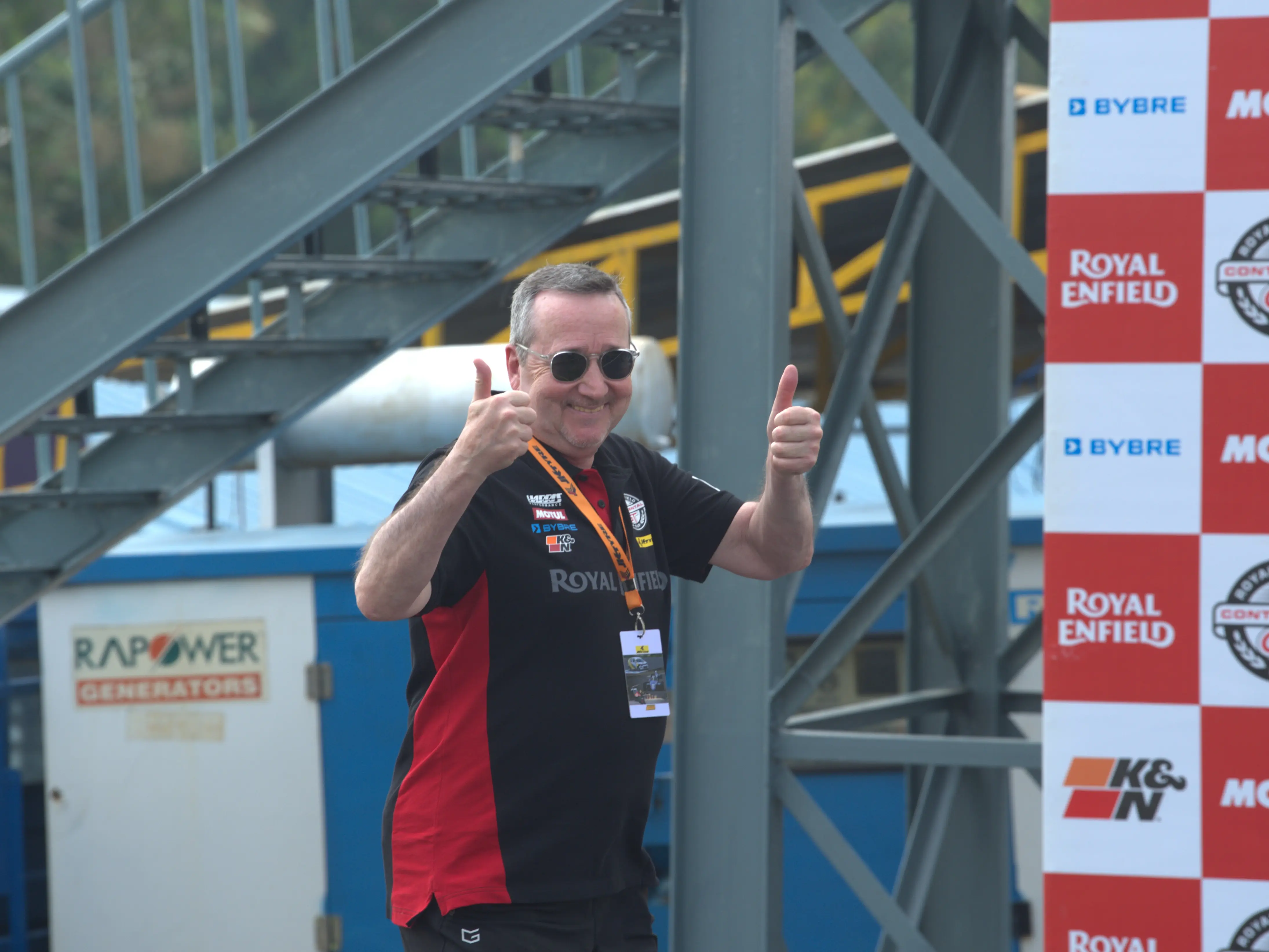
&imwidth=800&imheight=600&format=webp&quality=medium "WION Exclusive: Three-time MotoGP champion Freddie Spencer reveals the 'SECRET' behind the cornering technique that changed motorcycle racing")
There are legends in motorsport, and then there is Freddie Spencer, the American prodigy who reshaped the very grammar of motorcycle racing. A three-time world champion, the youngest premier-class title-winner of his era, and the only man to win the 250cc and 500cc World Championships in the same year, Spencer’s name sits in a rarefied league of its own. Now, standing trackside in India, a country he says is “brimming with potential”, Spencer reflects on his journey, on today’s MotoGP, and for the first time, breaks down the thought process behind the revolutionary cornering technique that defined his legacy.
“I turned the bike before the tyres were ready, that was the breakthrough," he revealed while exclusively speaking to WION. Ask Spencer, who was in India for the 28th JK Tyre FMSCI National Racing Championship, about what made him different, and he answers with the calm clarity of someone who knows exactly what he changed in the sport. “One of the things that I brought to Grand Prix racing was on corner entry, actually initiating the direction change over the traction level, over the grip level,” he explains.

What sounds almost counterintuitive was, in the early 1980s, groundbreaking. Riders typically waited for maximum grip before committing to direction change. Spencer chose the opposite. “When I got to maximum lean angle, the speed was still too high and the rear tyre would break traction, then re-grip and push it back to the front. That allowed me to turn the bike as I was applying lean angle — and pick up the throttle three or four feet sooner than the other guys.”
Those few feet were enough to beat world champions. Enough to define an era.
Today, he says, only a handful of riders have mastered the same instinctive feel. “Marc Marquez is same way. Marc’s ability on corner entry — to feel the drift of the rear, to rotate the bike around the front, that’s what I was known for.”
Trending Stories
)
2,000-foot tube, laser tests and more: China builds towns to expand nuclear arsenal, satellite images show
)
Xi Jinping's 'special plane' vs Trump's Air Force One: What's the difference?
)
US judge questions Trump’s decision to ban CNN, MS NOW and Politico from White House
)
Scientists detect first radio signals directly from faraway planet
)
Meet Adrian Abraham: 9-year-old Indian-origin guitar prodigy aiming for a Guinness World Record
)
WION Iconic Tourism Summit: How local tourism MSMEs must upskill for AI integration
)
Forget the smartphone: This tiny gadget could be Meta’s answer to the post-smartphone era
)
'What kind of confession is this?': Pakistan PM Shehbaz Sharif’s 'terrorists would be roaming New York' remark goes viral, raises alarm online. Watch
)
IIT Bombay CCTV footage emerges: Sahil Wakode seen looking at phone in examination hall
)
Shah Rukh Khan is India's richest actor, Amitabh Bachchan is second: Hurun List 2026
)
Report: UK using ground-based system to jam hostile satellites
)
Russia likely to target Spain, France and Italy in drone attacks, warns CIA: Report
)
For the first time, the UN Security Council sat US and Chinese AI makers at the same table
)
Welcome actor Mushtaq Khan dies at 56 after battling cancer
)
Trump-Xi state dinner 2026: Who is invited? Full guest list of tech CEOs, business leaders and officials
)
Hours before Xi-Trump meeting, US announces visa curbs targeting birth tourism: What is it?
)
What’s on the menu? Inside Trump’s lavish White House state dinner for Xi
)
What’s in a name? Trump’s 'Lake America' move gets a tit-for-tat response from Canada
)
Property registration becomes faster, convenient as model sub-registrar offices open in Maharashtra
)
WATCH | China President Xi Jinping lands in US as Trump greets him ahead of high-stakes summit
)
Mumbai Indians appoint Luke Williams as head coach for Women’s Premier League
)
China to test supersonic jet that moves at Mach 2, double the speed of sound
)
Winter coat, gloves in September? Trump’s Xi welcome sparks social media buzz
)
Australian PM Anthony Albanese calls OpenAI AI incident 'unacceptable' after restricted data access
&im=FitAndFill=(700,400))
Netanyahu at UN: Mass walkout, attack on Mamdani and Iran threats | In Pics
)
Israeli envoy to US Yechiel Leiter’s son critically injured in West Bank ramming attack
)
Who is Peng Liyuan? Xi Jinping's singer wife and China's most visible First Lady
)
Trump’s Board of Peace unveils $2.45bn Gaza plan,66 projects: But where’s the money?
)
'There will be elections': Venezuela's interim leader Delcy Rodriguez makes big announcement at UN
)
EC appointment law: Why is the 2023 act controversial, and what happens next? WION explains
)
WION Iconic Tourism Summit: Is India's travel boom outrunning its airports, airlines and hotels?
&im=FitAndFill=(700,400))
Trump welcomes Xi Jinping in rare airport gesture: Photos from Chinese President's arrival in US
)
WION Iconic Tourism Summit 2026: Union Minister Shekhawat on 'experiential travel', peace diplomacy
)
'AI got into my speech': Prince Harry jokes after teleprompter failure at event in New York
)
250-pound WWII bomb found in Falmouth harbour in England
)
'Partners rather than rivals': Xi Jinping's first message after landing in US for Trump summit
)
'We would all be dead': Netanyahu defends decision to strike Iran's nuclear facilities in his UN speech
)
‘Both will lose in confrontation’: Xi says US and China should ‘coexist in peace’
)
Italy hit by floods in the north, drought in the south
India has talent, but needs opportunity
In India as part of Royal Enfield’s racing development program, Spencer is effusive about what he sees. “Royal Enfield’s involvement is very important,” he says. “They’re providing a great platform for riders of all levels. Some of the riders today, I can tell by their style and approach, have the potential to race championships outside India.” But the caveat is clear, exposure is scarce, opportunity even scarcer. “You have to take advantage of the opportunities you’re given. It may not give you exposure immediately, but it gives you experience, and that’s what improves your riding capability.”
He points to a rider he spoke with earlier in the day, someone racing a 600cc machine in the US. “He wants to run more events there. But it’s the opportunity here that’s giving him the chance.”
The MotoGP that was and the MotoGP that must return
Spencer was chairman of the stewards panel during MotoGP’s debut in India, an event that impressed him immensely. “To me, the racetrack is incredible. I loved the layout. Loris Capirossi and I were talking about how we would’ve loved to race on that circuit.” But he’s equally candid about wanting MotoGP back. “We provided some incredible racing. Hopefully it will come back. It’s important — that visibility brings interest to racing locally.” “Electronics help everyone — but they take away the great rider’s advantage.” Having raced in the era of vicious 500cc two-strokes, Spencer has a unique vantage point on MotoGP’s technological explosion.
“With electronics and aerodynamics, it makes it easier for riders with less ability to perform at a higher level,” he says. “But it takes away your strengths as a top rider.” His example is unambiguous: Marc Marquez. “With the Honda, he made that bike what it was. His natural talent defined the machine. Put him on the Ducati — the best bike — and he wins the championship.” That, Spencer says, is exactly why MotoGP is rewriting its rulebook for 2027. “No start device, no ride-height device, lower displacement. It will leave it up to the rider again.”
The man behind the machines: Precision, crew, and an unforgettable double title
Spencer’s 1985 season, the historic “double”, remains one of motorsport’s greatest achievements. But the behind-the-scenes story reveals the brutal complexity of switching between two radically different machines. “The 250 was 90 kilos and 70 horsepower — all corner speed and art. The 500 was heavier, faster, more of a V-shaped line on entry.”
But the real difficulty? “I had to adapt from one bike to the other on the warm-up lap. I couldn’t afford to take five or six laps to adjust.”
With back-to-back practice sessions, his crew barely had time to debrief. “I’d keep the information in my head and debrief after both practices. We fine-tuned the bike down to 50 RPM. One kilometre here, one kilometre there — that’s the level we worked at.”
The lap that defined a champion
For all the talk of technique and titles, Spencer is open about the moments that nearly broke him, particularly the injury after his 1985 triumph. “I lost feeling in my hand. I couldn’t feel the front brake. That was when I felt most vulnerable. Riding was my comfort zone — and suddenly I couldn’t rely on it.” Still, he fought back. And he remembers the greatest lap of his life with the fondness of an artist recalling the moment of a masterpiece.
“The last lap of the Spanish GP in 1983. No grip, brakes faded, the bike slowing down. And I ran my fastest lap — the only lap I led. I won by two bike lengths. It doesn’t get any better.”
Advice to the Indian dreamers
For young Indian riders hoping to break through, Spencer’s advice is equal parts practical and philosophical. “You have to take the risk to try. You have to be willing to risk losing. And you have to make effort beyond what you think you're capable of.” He pauses, then adds: “That mindset — that’s what creates the opportunity.”
Why Freddie Spencer Keeps Coming Back to India? His answer is disarmingly simple. “My relationship with Royal Enfield. And I’ve always liked big adventures.” Four years into his India journey, Spencer is no longer just a visiting legend, he is part of India’s motorsport story, helping shape the next generation of riders who may one day challenge the world just as he once did.

