
&imwidth=800&imheight=600&format=webp&quality=medium "FIFA World Cup 2026: What the new 48-team tournament means for teams, fans and host cities")
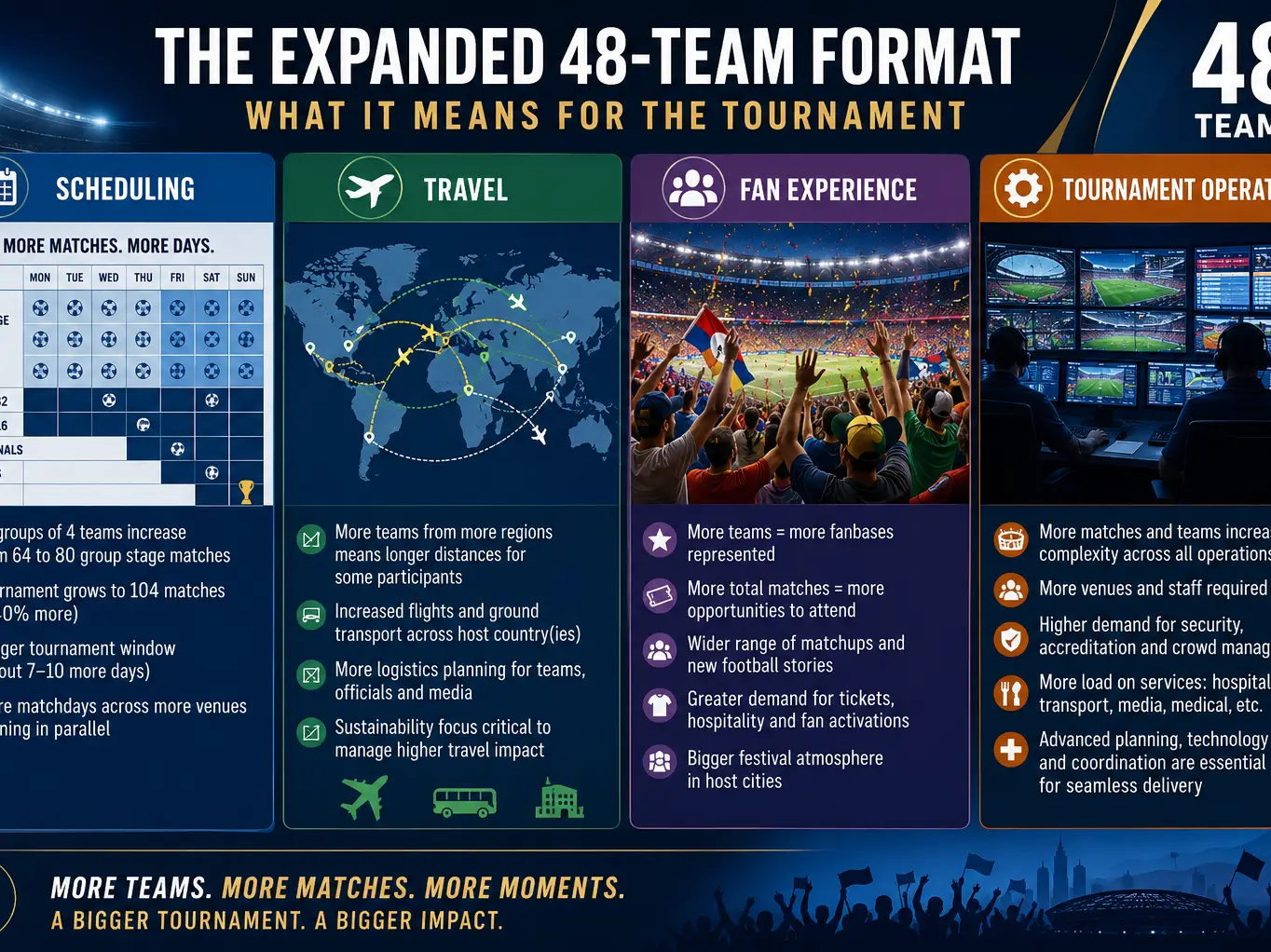
The FIFA World Cup 2026 is set to become the largest and most ambitious edition of the tournament in football history. For the first time, 48 national teams will compete for the sport's biggest prize, marking a significant expansion from the 32-team format used since 1998. Co-hosted by the United States, Canada, and Mexico, the tournament will introduce more matches, more venues, and more fans than ever before.
While the expansion promises greater global representation and excitement, it also presents unprecedented challenges in scheduling, travel logistics, fan management, and tournament operations. From coordinating 104 matches across three countries to ensuring a seamless experience for millions of supporters, FIFA and local organizers are preparing for a World Cup unlike any before it.
FIFA World Cup 2026 format: More teams, more matches, more opportunities

The most significant change to the 2026 tournament is the expansion from 32 to 48 participating teams. Under the new structure, teams will be divided into 12 groups of four nations each, creating a larger and more competitive group stage.
As a result, the total number of matches will jump from 64 at the 2022 FIFA World Cup in Qatar to 104 matches in 2026. The group stage alone will increase from 48 to 72 matches. FIFA has also introduced a new Round of 32, adding another knockout phase before the traditional Round of 16.
The expanded format is expected to provide more nations with an opportunity to participate in football's biggest stage, helping grow the game in emerging football markets while increasing global viewership and commercial opportunities. However, the additional matches create a far more complex scheduling challenge. Tournament planners must coordinate hundreds of training sessions, team arrivals and departures, media commitments, and stadium operations while maintaining competitive fairness and adequate recovery time for players.
Trending Stories
)
The Early Spring is proof not everyone can talk about their real feelings, and it is perfectly OK
)
UN votes to ‘correct the map’ as India backs fairer world view
)
Nigerian Navy discovers 99,000 litres of suspected stolen, illegally refined products as it intensifies anti-crude oil theft operations
)
Who is Aditi Paudel? 17-year-old becomes Japan's first literacy ambassador
)
Bengaluru: Officials find 40 kg expired chilli at chairman's club
)
Jaishankar rejects trade link to ending Ukraine war
)
Israeli strikes on Lebanon kill three, injure 23 despite truce
)
Alpine glacier was covered with sheep wool sheets to prevent melting. It worked
)
South Korea mulls deploying military assets to Strait of Hormuz
)
World's fifth-largest economy, British army can't afford to train
)
Breaking | Vance takes the podium: First White House briefing since Leavitt's exit
)
Taiwan raises 'concerns' over China's missile test
)
BRICS 2026: $1 trillion sovereign capital set to converge in Delhi for first iBRICS Summit
)
What is Iran's Pickaxe Mountain that Trump has again threatened to bomb?
)
UN votes to correct world map that visually shrank Africa for 450 years
)
Former NewJeans member Danielle launches YouTube channel, hints at new solo journey
)
Bangladesh batter Towhid Hridoy creates history with 350 not out in South Africa
)
Brendan Fraser’s transformation fuels The Mummy 4 excitement as fans welcome back Rick O’Connell
&im=FitAndFill=(700,400))
Krishna Janmashtami 2026: From Dhaniya Panjiri to Makhana Kheer- 5 best sweet dishes perfect for celebrating Lord Krishna’s birth
)
Donald Trump plans to travel to Ireland on Qatari-donated jet amid security concerns
)
Nazi-looted art to return to Jewish heirs
)
Eight killed in Kerala’s Thrissur after car rams into lorry parked on highway
&im=FitAndFill=(700,400))
Why Russian fighter jets use bulky, low-pressure tyres compared to US jets
)
FBI-wanted fraud accused arrested in Jalandhar over $600,000 scam
&im=FitAndFill=(700,400))
Why US tanks weigh over 20 tons more than Russian tanks
&im=FitAndFill=(700,400))
New Friday OTT releases (September 4, 2026): GDN, Dhamaal 4, Jagamae Sangeetham- Watch 6 new movies and TV shows on Netflix, Prime Video and more
)
Killing the Himalayas slowly: Human urine is melting a glacier on Mount Everest
World Cup 2026 travel challenges: How FIFA is preparing for a three-country tournament
Unlike previous tournaments hosted within a single nation or a relatively compact geographical area, the 2026 World Cup will stretch across 16 host cities in three countries. The vast distances between venues will make travel one of the tournament's biggest logistical considerations. Teams may need to travel thousands of kilometers between matches, while supporters following their national teams could find themselves crossing international borders multiple times during the competition.
Media organizations, tournament officials, and commercial partners will also face complex travel schedules as they move between host cities. To address these challenges, FIFA is expanding travel-support services through FIFA Pass and official travel programs. Fans will have access to travel guidance, accommodation recommendations, and transportation information designed to simplify movement between venues.
Host-city information channels are also being enhanced to provide real-time updates on transportation, local services, traffic conditions, weather alerts, and event-related information. These digital platforms are expected to play a critical role in helping visitors navigate one of the most geographically expansive sporting events ever organized. The tournament is also expected to generate significant demand for hotels, airports, public transportation systems, and tourism infrastructure throughout North America. Cities hosting matches are already investing in upgrades to ensure they can accommodate the expected influx of visitors.
Fan experience and tournament operations: Managing the biggest FIFA World Cup ever
The scale of the FIFA World Cup 2026 goes far beyond the number of participating teams. Organizers must prepare for a dramatic increase in operational requirements across every aspect of tournament management. The event will involve 48 national teams, thousands of accredited media personnel, expanded security operations, larger volunteer programs, and increased staffing across stadiums, training sites, and transportation hubs. Coordinating these moving parts across three countries represents one of the most complex logistical exercises in sporting history.
Technology will play a central role in ensuring smooth operations. FIFA has expanded its digital infrastructure to provide real-time information to fans, teams, and stakeholders. Enhanced communication platforms will deliver updates on schedules, transportation services, venue access, ticketing information, and local activities. For supporters, the expanded tournament could offer an even richer experience. More teams mean more matches, greater cultural diversity, and increased opportunities to witness historic moments.
Host cities are expected to organize fan festivals, entertainment events, and community activities that extend beyond the matches themselves, turning the tournament into a month-long celebration of global football. At the same time, organizers must balance excitement with efficiency. Managing crowd flows, transportation networks, accommodation availability, and security operations will be critical to ensuring a positive experience for millions of visitors.
Economic impact and legacy of FIFA World Cup 2026
Beyond football, the expanded World Cup is expected to deliver substantial economic benefits to host cities and countries. Increased tourism, hospitality spending, transportation demand, and infrastructure investments could generate billions of dollars in economic activity. Local businesses, hotels, restaurants, retailers, and tourism operators are likely to benefit from the arrival of fans from around the world. The tournament also provides an opportunity for host cities to showcase themselves on a global stage, potentially attracting future tourism and investment.
For FIFA, the expanded format represents a strategic move to increase participation, global engagement, and commercial growth. By welcoming more nations and reaching new audiences, the organisation hopes to strengthen football's worldwide appeal while creating a more inclusive World Cup experience.
As preparations continue, one thing is clear: FIFA World Cup 2026 will be more than just a football tournament. It will be a massive international event that tests the limits of sports organization, transportation planning, and fan engagement while setting a new benchmark for future World Cups. With 48 teams, 104 matches, and 16 host cities spread across three countries, the tournament is poised to redefine the scale of the world's most-watched sporting event and deliver an unforgettable experience for players, fans, and host communities alike.

