
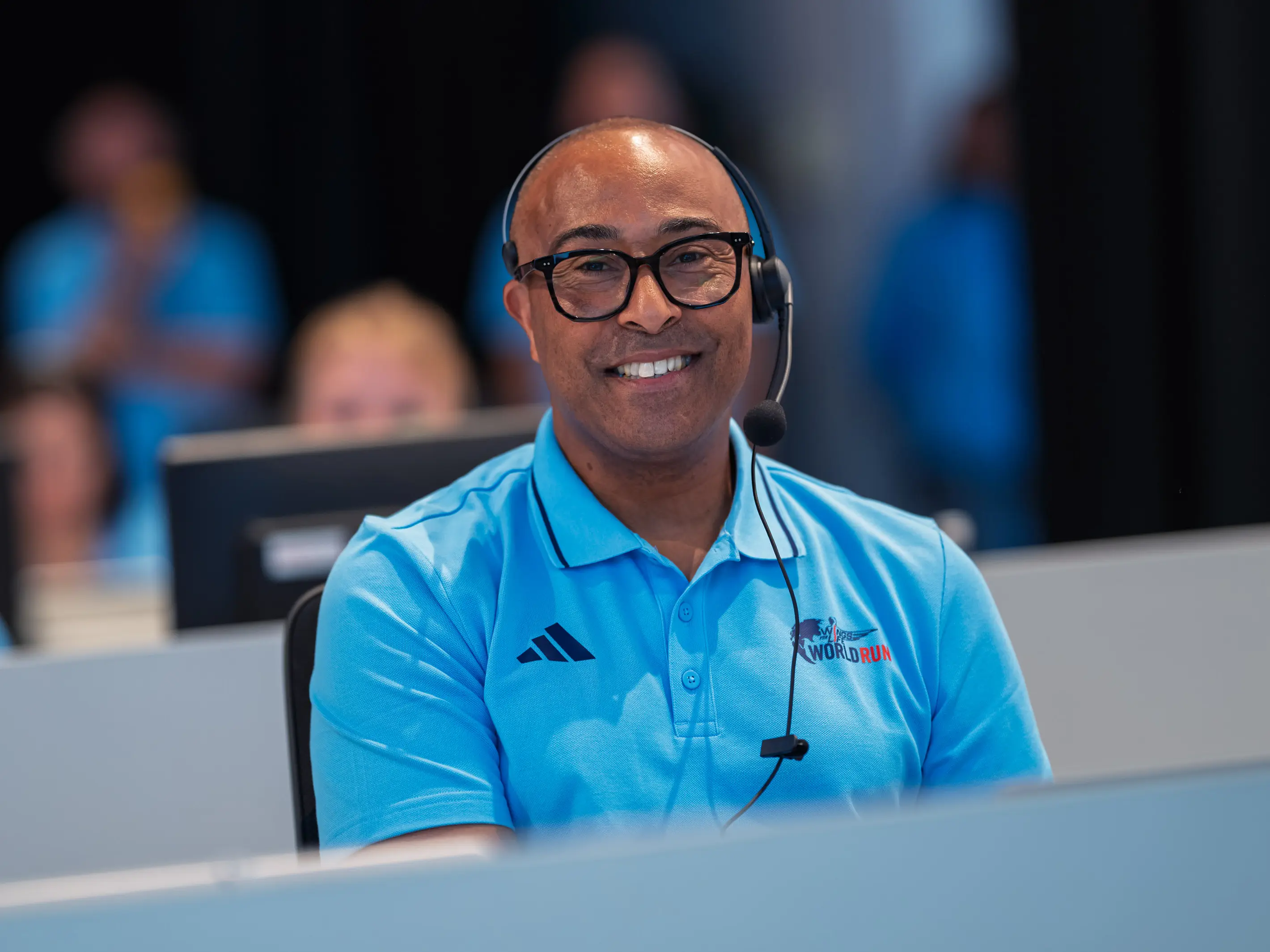
&imwidth=800&imheight=600&format=webp&quality=medium "'I was excellent, not perfect and I am happy to live with that': Colin Jackson on missing Olympic gold")
For an athlete who built a career on rhythm, precision, and near-flawless execution, it is striking that Colin Jackson chooses to define his legacy not by perfection, but by acceptance. There is no bitterness when he speaks about the one medal that eluded him. No sense of something missing. Instead, there is clarity, almost calm, when he reflects on a journey that brought him 25 medals, multiple world titles, and a place among the greatest hurdlers the sport has seen.
“I was excellent,” he said, while speaking to WION exclusively, pausing just enough to let the word settle. “Not perfect. And I’m happy with that.” It’s an outlook shaped as much by setbacks as by success. At 21, Jackson stood on the Olympic podium with a silver medal, an achievement most athletes spend a lifetime chasing. But for him, it came with an unintended consequence. “When you’re that young, you assume gold will come eventually,” he admits. “And I became complacent. In elite sport, there’s no space for that.”
That realization became a turning point. What could have lingered as regret instead became fuel. In the years that followed, Jackson sharpened his focus, building a career defined by consistency and dominance across global competitions. If there is one thread that runs through his journey, it is balance, not just in hurdling, but in how he approached improvement. He never saw the sport as a sum of isolated skills. Sprinting, jumping, strength, flexibility, each element had to evolve together. “You have to sprint like a sprinter, jump like a long jumper, lift like a shot putter, and move like a gymnast,” he explains. “You can’t ignore any part of it.”

What set him apart, though, was not just the willingness to fix weaknesses, but the discipline to preserve strengths. It’s a subtle distinction, but one that often separates good athletes from great ones. “A lot of people focus only on what they’re bad at,” he says. “But keeping your strengths strong is just as important.” That mindset extended beyond training. Jackson credits the environment around him, rotating training partners, a driven coach, and, as he jokes, “very good genetics” from his parents, for sustaining his hunger over a long career.
Today, as both a broadcaster and mentor, his perspective has widened. Watching the current generation, he sees individuality more than evolution. “Every hurdler has their own style, it’s like a fingerprint,” he says. “You can recognise them instantly.” What has changed, he adds with a laugh, is their physical presence. “They’re so much taller now. I feel like I’m in the land of giants.”
Trending Stories
&im=FitAndFill=(700,400))
New OTT releases this week (July 20-26, 2026): Musafir Cafe, Adarsh Baal Vidyalaya, 72 Hours- 5 new titles coming on Netflix, Prime Video and more
)
US strikes Iran, sirens heard in Kuwait, one American soldier killed in Iraq: What's happening in West Asia
&im=FitAndFill=(700,400))
Why the F-22’s tail fins are canted to minimize its radar footprint
)
Truck loaded with stones, metro stations closed: What's happening at Jantar Mantar now
&im=FitAndFill=(700,400))
Why the S-400 uses solid rocket fuel instead of liquid fuel
)
Argentina's racism problem: How football chants reflect a deeper historical legacy
)
'George Soros playbook': Understanding the foreign funding network around Sonam Wangchuk
)
Xi Jinping's new AI bloc: China launches 'World AI Body' with Pakistan and Russia in, India out
&im=FitAndFill=(700,400))
FIFA World Cup 2026 awards race: Who are Golden Boot, Golden Ball and Golden Glove contenders ahead of the final
)
Student union leaders call off hunger strike at Jantar Mantar after civil society appeal, but protest continues
)
'Chalo Sansad' march today: Section 163 in force, Delhi Police remove barricades; unfazed Dharmendra Pradhan meets NEET topper
)
Did Iran secretly ship 70 million barrels of oil to China? Report claims $6 billion crude exported before blockade restored
)
Salman Khan breaks silence on health concerns after viral Mumbai appearance
&im=FitAndFill=(700,400))
Why US fighter jets use seamless bubble canopies compared to Russian jets
)
'What is wrong...': Anna Hazare breaks silence on Sonam Wangchuk's protest, makes an appeal to Centre
)
Imran Khan's sister links India-Pakistan 2025 conflict to Israel recognition plans
&im=FitAndFill=(700,400))
Global air power ranking 2026: India surpasses China
)
Karoline Leavitt to be US Vice President when Usha Vance gives birth? JD Vance says...
)
'Could be bombed at any moment': What Iran's Araghchi told Trump envoy Witkoff during negotiations
&im=FitAndFill=(700,400))
2026 FIFA World Cup awards: Full list of Golden Boot, Golden Ball, Golden Glove and every major winner
&im=FitAndFill=(700,400))
FIFA World Cup 2026: 5 football stars who went viral on social media during the tournament
)
'There is no need for...': PM Modi takes a veiled dig at Rahul Gandhi, sends big message amid Parliament March
)
Tulsi Gabbard's brother Batarti accused of luring children to hotel room in Hawaii
)
Older than Himalayas: 85mn-year-old Kewra plant reached India 24mn years ago, fossil discovery in Assam shows
)
Sonam Wangchuk's connection with George Soros and Ford Foundation explained!
&im=FitAndFill=(700,400))
Why the F-22’s cockpit glass is thicker than a standard fighter jet
)
JD and Usha Vance welcome fourth child: Who serves as acting US vice president during Vance's paternity leave?
)
Maha CM Wife Amruta Fadnavis' Yoga Day appearance sparks social media debate over attire | Watch
But if the technical side of the sport hasn’t dramatically shifted, the role he plays in it certainly has. And it is here, away from the track, that Jackson finds a different kind of fulfillment. Analyzing races may come naturally, but helping shape athletes, being part of their journey, offers something deeper. “That’s how I give back,” he says. “Working with athletes, seeing them grow, that’s more satisfying.” His honesty also extends to the myths surrounding elite sport. The idea that top athletes live perfectly disciplined, hyper-healthy lives is one he quietly dismantles.
“I drank a lot of coffee, ate sweets, didn’t always sleep well,” he admits. “It wasn’t perfect.” It’s a reminder that excellence is rarely as polished as it appears from the outside. Growing up, Jackson found inspiration in figures like Daley Thompson, whose dominance on the global stage made greatness feel tangible. In another sporting life, he might have pursued cricket, idolising fast bowler Michael Holding. Today, he watches the sport he once ruled with the same admiration, pointing to athletes like Grant Holloway and the depth of talent across disciplines.
Beyond competition, his focus has also shifted toward purpose. Through his association with the Wings for Life World Run, organised by Red Bull, Jackson is part of a global effort to fund spinal cord injury research, an initiative he speaks about with genuine conviction. “When people run, they’re helping change lives,” he says. “That’s powerful.” And then there is the quieter side of Colin Jackson, the part that exists away from stadiums, cameras, and crowds. After years of constant interaction, he has come to value solitude in simple forms: a walk, a run, a coffee with a close friend.
In those moments, there are no medals to chase, no records to break. Just the space to pause, reflect, and reset. Because in the end, his story is not about the absence of Olympic gold. It is about what came after, the lessons learned, the standards set, and the understanding that greatness does not require perfection. Sometimes, being excellent is enough.

