The Capitals: Dhaka's tryst with PM Sheikh Hasina-styled democracy

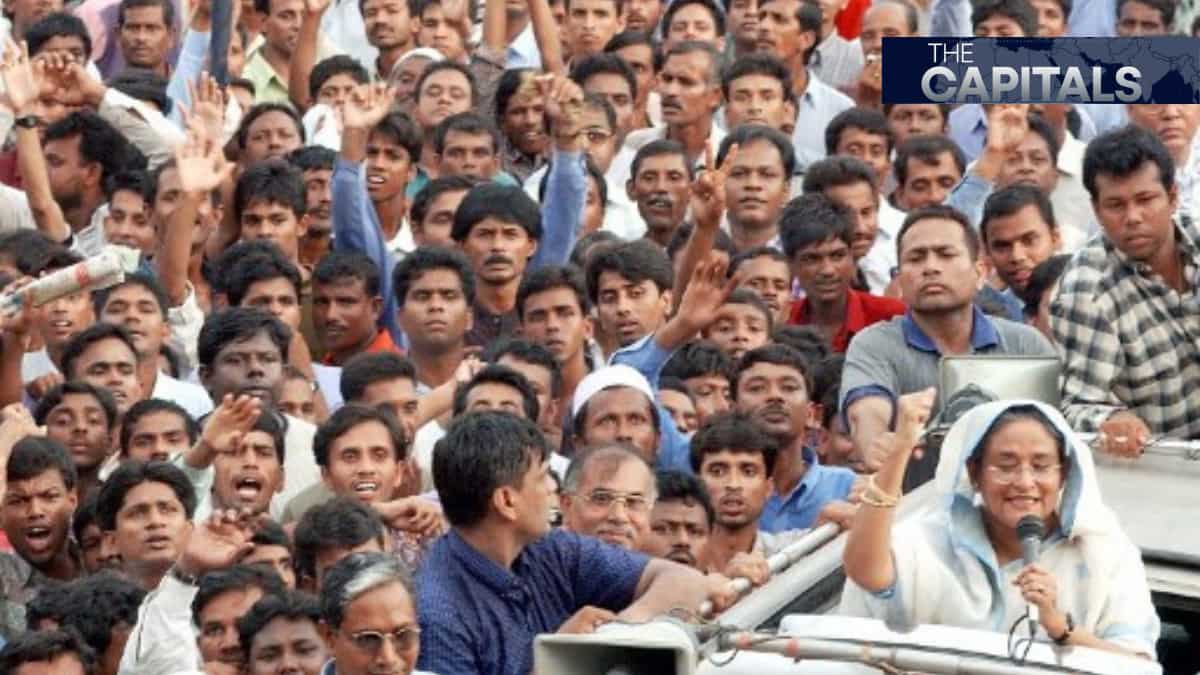
File photo of Bangladesh's current PM Sheikh Hasina during an election rally in 2002
For the latest tenure of Dhaka's Jatiya Sangsad, Bangladesh's supreme legislative body, while the numbers are not entirely in, the verdict is already out. Prime Minister Sheikh Hasina's Awami League (AL) party looks set to win the country's twelfth parliamentary polls after the conclusion of the voting process on Sunday (Jan 7).
This will be Hasina's fourth term in a row and fifth prime ministerial term in total, following a nationalelection boycotted by the principal opposition Bangladesh Nationalist Party (BNP) and reports of voter suppression, and vote-rigging tactics by Hasina'sruling party. In boycotting elections, Hasina's party has accused the BNP of adopting fundamentalist tactics.


Bangladesh held its 12th parliamentary election on Sunday, Jan 7, 2023 | Agencies
On the voting day, the website of a newspaper critical of the Hasina government was blocked for several hours. A prominent daily from Dhaka reported on alleged obstruction to the voting process by using indirect euphemisms: 'Three Boat supporters jailed for obstructing voters', the publication reported with the boat being the election symbol of Sheikh Hasina's Awami League (AL) Party.
WhileKazi Habibul Awal, the Chief Election Commissioner in Dhaka requested the media to highlight the purported transparency in the voting process, he ended up pointing out that he could see only Awami League's polling agents in the voting centres he visited in the Bangladesh capital. Note that a total of '28 registered parties' were in the fray with some 1,900 candidates vying for 300 seats of the Jatiya Sangsad.
&imwidth=180&imheight=135&format=webp&quality=medium)
Premier League: Haaland wants Manchester City to 'try to enjoy the situation and win the game'
&imwidth=180&imheight=135&format=webp&quality=medium)
'Nidal Hasan's firing-squad execution to be livestreamed', says Pentagon; first US military execution since 1961
&imwidth=180&imheight=135&format=webp&quality=medium)
Trump's naked 23-karat gold statue unveiled near European Parliament
&imwidth=180&imheight=135&format=webp&quality=medium)
Musk doubles down on Starlink India licence allegations; Rahul Gandhi says ‘wait till...’
&imwidth=180&imheight=135&format=webp&quality=medium)
Thai Actors Fourth Nattawat, Gemini Norawit face racism accusations from Indian fans over viral Bollywood act
&imwidth=180&imheight=135&format=webp&quality=medium)
Nigeria govt rolls out 30-day NNPC petrol discount, insists it is not a subsidy
&im=FitAndFill=(700,400)&imwidth=180&imheight=135&format=webp&quality=medium)
Fastest-growing Asian economies in 2026: Who tops the chart? Where does India rank?
&imwidth=180&imheight=135&format=webp&quality=medium)
24-year-old Sri Lankan man sentenced to death for blasphemy in Saudi Arabia
&imwidth=180&imheight=135&format=webp&quality=medium)
A Love Other Than Yours: The temptation to cheat and what pushes people over the edge
&imwidth=180&imheight=135&format=webp&quality=medium)
Russia president Putin promises to 'do everything' to help settle Middle East conflict as US-Iran negotiations stall
&imwidth=180&imheight=135&format=webp&quality=medium)
‘Wait till you discover the other guy’: Rahul Gandhi takes a swipe as Musk's 'Ambani real boss of India' remark triggers X subscription cancellations
&imwidth=180&imheight=135&format=webp&quality=medium)
BTS agency HYBE announces first-ever Weverse Con Festival in India
&imwidth=180&imheight=135&format=webp&quality=medium)
Trump has a new 'enemy': Anyone who calls it 'artificial intelligence'. Here's what we wants instead
&imwidth=180&imheight=135&format=webp&quality=medium)
India at UN: Pak allows terror groups to operate from its soil
&imwidth=180&imheight=135&format=webp&quality=medium)
Air India, Air India Express increase fuel surcharge on domestic, international flights amid rising ATF costs
&imwidth=180&imheight=135&format=webp&quality=medium)
'Something truly catastrophic will happen': Former OpenAI researchers sound the alarm, claim they were fired for prioritising AI safety
&im=FitAndFill=(700,400)&imwidth=180&imheight=135&format=webp&quality=medium)
From Kramatorsk buses to Yandex fire: Russia-Ukraine war in the last 48 hours
&imwidth=180&imheight=135&format=webp&quality=medium)
Pakistan denies reports of PAF jets being used in attacks against Iran-backed Houthis in Yemen
&imwidth=180&imheight=135&format=webp&quality=medium)
New York ICE shooting sparks protests as Mamdani to call on Trump to halt ICE operations
&imwidth=180&imheight=135&format=webp&quality=medium)
Atlantic hurricane Isaias could make landfall as a strong Category 2 storm, tornado warnings issued
&imwidth=180&imheight=135&format=webp&quality=medium)
Nana Patekar's #MeToo controversy: From Tanushree Dutta’s allegations to court ruling
&imwidth=180&imheight=135&format=webp&quality=medium)
Who is Nana Patekar's wife Neelakanti? The bank officer who earned Rs 2,500 when he earned Rs 50
&imwidth=180&imheight=135&format=webp&quality=medium)
KATSEYE’s Sophia Laforteza to return in 2027 after hiatus, agency issues statement
&imwidth=180&imheight=135&format=webp&quality=medium)
French students light European bonfire, protests erupt in Belgium, Italy & Greece | Gravitas
&imwidth=180&imheight=135&format=webp&quality=medium)
France student protests: Over 500 arrested, govt promises 3,000 substitute teachers
&imwidth=180&imheight=135&format=webp&quality=medium)
Arizona congressional candidate claims she was sexually assaulted while repairing signs
&imwidth=180&imheight=135&format=webp&quality=medium)
New Cold War: Why is China buying more gold? Explained
&imwidth=180&imheight=135&format=webp&quality=medium)
OpenAI shuts down Russian, Iranian influence operations using ChatGPT to spread propaganda
&imwidth=180&imheight=135&format=webp&quality=medium)
'Understood consequences of a few mistakes': Ishan Kishan reflects on journey back to India team
&im=FitAndFill=(700,400)&imwidth=180&imheight=135&format=webp&quality=medium)
435 House seats, 35 Senate races: The numbers behind US midterms 2026
&imwidth=180&imheight=135&format=webp&quality=medium)
Zendaya gives The Odyssey white lace jacket a stylish twist at Paris Fashion Week 2026
&imwidth=180&imheight=135&format=webp&quality=medium)
SC asks Centre to frame mechanism against unethical pharma marketing practices
&imwidth=180&imheight=135&format=webp&quality=medium)
US suspends Microsoft, Infosys, Tata, Wipro from green card programme over alleged H-1B abuse
&imwidth=180&imheight=135&format=webp&quality=medium)
Trump honours Microsoft CEO Satya Nadella with top technology honour amid immigration scrutiny
&imwidth=180&imheight=135&format=webp&quality=medium)
Flydubai flight attack: Indian pilot Smit Machchhar to receive Israel's highest civilian bravery award for saving 174 lives
Foreign observers from various capitals of the world, including New Delhi, Canberra, Oslo, and Washington DC, will report on their assessment of the credibility of the elections. But until then, a 40 per cent voter turnoutspeaks a story on its own.
Why does SheikhHasina matter for New Delhi and Beijing?
But Hasina's return to power is expectedto keep the semblance of geoeconomic stability in the region. The question of who serves from Dhaka's Prime Minister's Office has had several ambitions to play out in recent times. From New Delhi's buffer state priorities to Beijing's Belt & Road vision, as well as the strategic interests of Washington and Moscow's bid to partner with Dhaka in Bangladesh's infrastructure revamp projects.
Fifty-two years after Bangladeshcame into being following a bloodied war for independence from present-day Pakistan, the country remains at an inflection point.
Its $400 billion economygrew at 7.1 per centin 2022.
Hasina in power in Dhaka has been seen as pivotal toBangladesh's growth and stability by New Delhi and Beijing, who see heras crucial to advancing their strategic interests in South Asia and the Indo-Pacific region.
Since coming to power in 2009, Prime Minister Sheikh Hasina'sapproach towards New Delhi and Beijing reflects a strategy to assort Bangladesh'snational interests over zero-sum strategic affairs.
While pursuing an ambitious goal to achieve developed nation status for Bangladesh by 2041, Sheikh Hasinahas strategically harnessedthe strengths of both India and China with visits to New Delhi and Beijing aimed atbalancing ties.
Dhaka is pursuing a modernisation project for Mongla port under Beijing's ambitiousBelt and Road Initiative.
New Delhi'sBangladesh-China-India-Myanmar Corridor (BCIM) initiative too is another stride in the country'sregional connectivity goals.

File photo of Bangladesh PM Sheikh Hasina with her Indian counterpart Narendra Modi | Reuters
The continuity of investments by both New Delhi and Beijing depends on Hasina's return to power.
The fundamentalism in Afghanistan following the Taliban's takeover of Kabulhas already challenged New Delhi's investments in Afghanistan. While Beijing's ambitious China-Pakistan Economic Corridor (CPEC) has also come under attack by Pakistani fundamentalists.
Bangladesh's economic success story under Hasina has given the region a semblance of stability. Both Beijing and New Delhi, therefore, view Sheikh Hasina's return as a sign of continued stability in the region.