Redefining 'open spaces' in university campuses

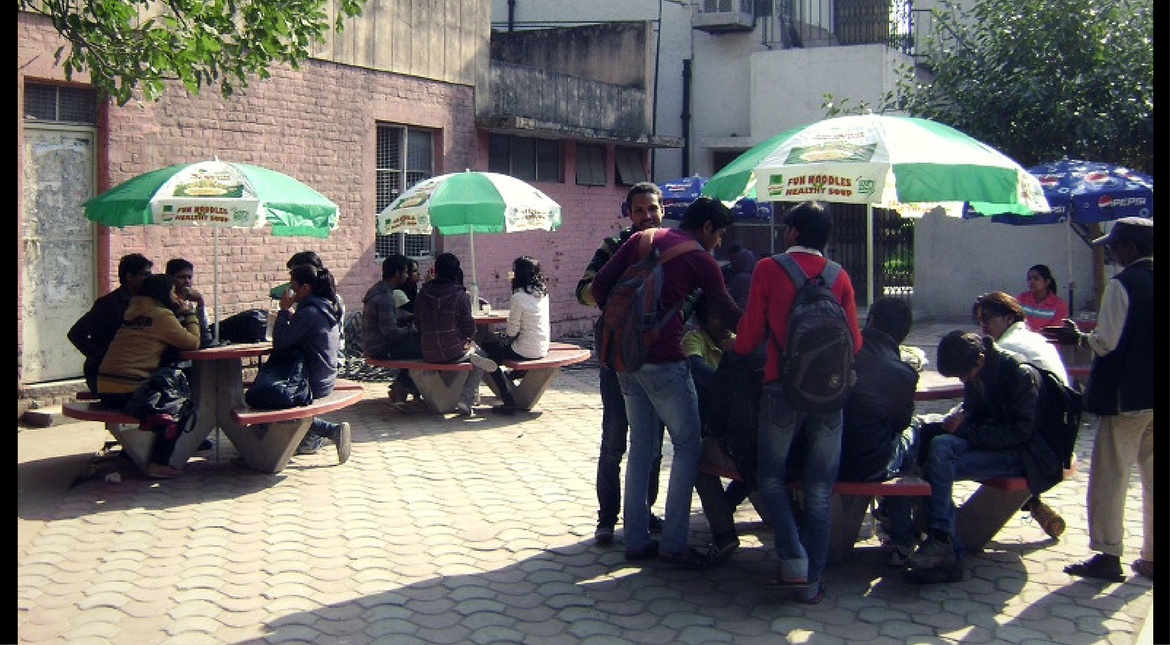
Students seen enjoying in a canteen at Jamia Millia Islamia university
It is in these 'open spaces' that students indulge in meaningful interactions outside of the regular classroom work ?
A place of education, like a university, is often revered for both the space it provides to developnewer ideasand to let existing ones to thrive. Many students say the spaces outside the classroom iswhat really impactstheir lives, where theyindulge in meaningful non-academic interactions.
In search of these open spaces, Iexploredthe famous canteens at one of India's most prestigious universities, Jamia Millia Islamia.
A prominent women-only canteen, Dastarkhwan, is where you get everything from biryani (a rice and meat preparation) to savoury snacks to feed on. The word Dastarkhwanin Urdu means a table spread where a variety of food is served.The canteen is run exclusively by women and is operated by Ekta Self Help Group with a mission to provide employment to underprivileged women of the neighbourhood who can support their families with theirearnings. It was started in 2015.

When it began there were problems. Apart from difficultiesprocuring funds and finding employees who fit mission's criteria, thefemale employeesfacedthe"explicit disapproval of the society". Boys who came to order food wouldabuse and threaten them. They would belittle the girls and make them feel guilty for coming out to earn. Also women working here would be tortured day in, day out by their husbands for stepping outside the homes, coming late from work, not taking care of the kids among many other things.
Dastarkhwan was started with a promise to build a synergy between the university and its surroundings.Two years later, have these open spaces changed?
Anjum, a final year master's student at Jamia, discusses the changing power equations here. She says, “Many things that were not okay a few years back are now easily seeping into the social system. Although issues like sexual harassment are at the fore, men are also equally participating in dialogues centred around women. They want to be a part of the change now more than ever.”
Now when around 40 womenare seen walking into the campus to work--the society does not flinch. These women are accepted--they don'tseem odd or out of place and are easily absorbed within the social fabric.
Shabana, who heads the Dastarkwhan, believesthings have changed for the better.“Now when people come to order food, the idea of a girl working does not perturb them. They are more accepting. Even the families of these women have become more open, more accommodating than before. The women are not tortured by the families too. Thus, this open space is the epicentre of changing social dynamics.”
Dastarkhwan isopening up dialogue between men and womentobreakstereotypical Indian social narratives, but another canteen on campushas an interesting tale to tell.
The Castro Cafe isnamed afterFidel Castro, one of the most famousanti-imperialist leaders of modern times.Castro Cafe not only has the best tea in the campus but promisesa good, long talk while feeding on snacks.
Part liberal and part conservative, the canteen has grown to play an important part in the lives of the students: Students from different religions and cultural backgrounds mayget exposed to concepts and ideas that arehardor sensitive to discussin a classroom, but aren'tin an informal setting like a canteen.
The commitee tasked with supervising the renovation at the canteenaffirms that they consciously created a space like Castro Cafe with certain values in mind.
“By creating a modern eating facility with a sleek look, we wanted to project a progressive image of Jamia,” a committee member said.He adds, “Jamia was built out of the anti-colonial movement and Castro Cafe reminds us of the anti-imperialist cause.”
With indoor and outdoor seating, students come to these “open spaces” to let down, share memories and opinions and hope to make a difference while exploring themselves in the process.
Both Dastarkhwan and Castro Cafe complement each other in offering a space for a “different kind of a dialogue”, one that we must cherish and encourage.
After all, what is a university campus without a healthy exchange of ideas over a cup of tea and samosas?
(WION)

