More than 10,000 Nepali migrant workers have died in Gulf countries

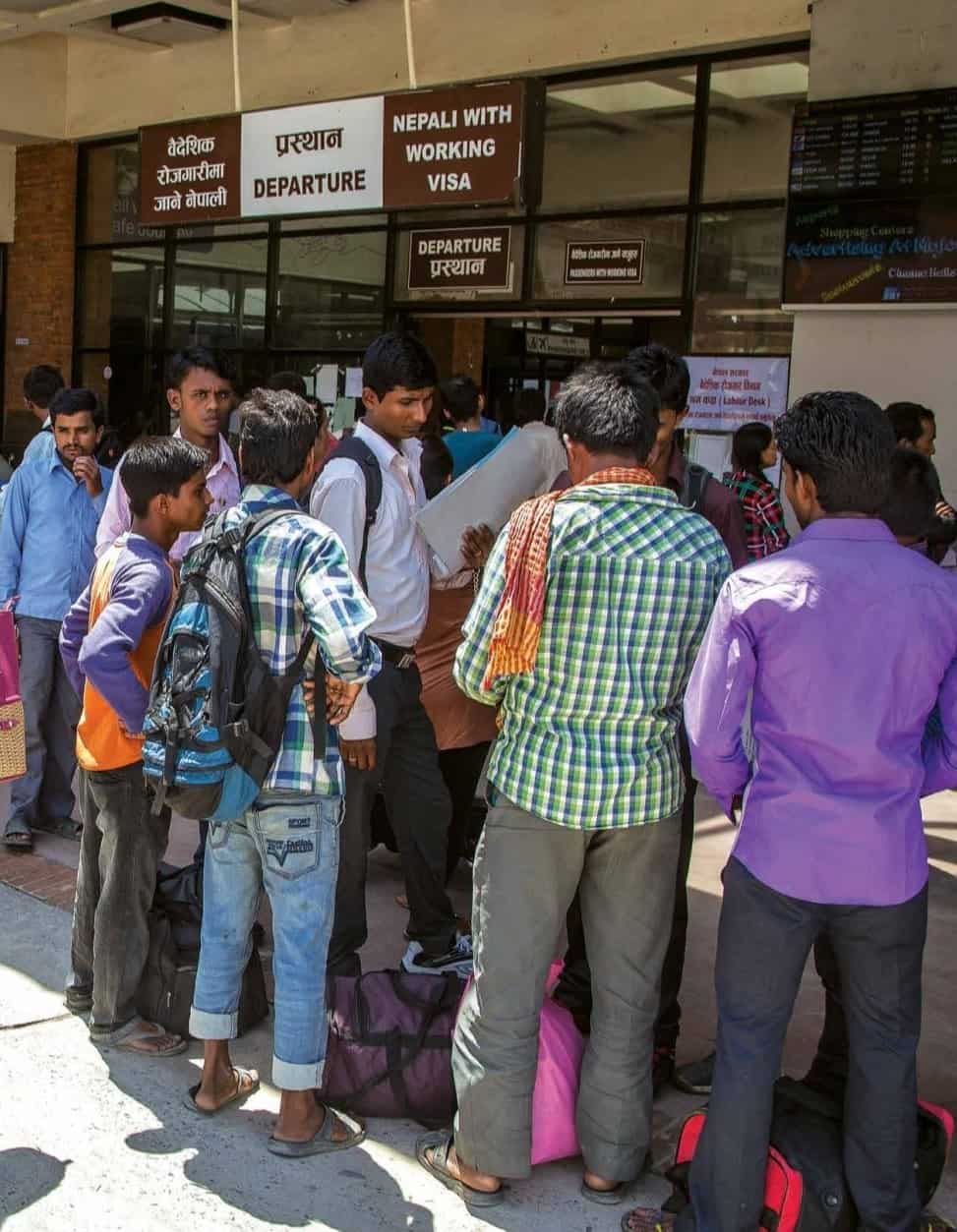
Nepali workers face harsh working condition in Gulf countries
Over 10,000 Nepali migrant workers have died in Gulf countries due to inadequate supply of drinking water, food, and long hours of manual labour in searing temperatures.
As per the records of the Nepal government, the second-largest group of deaths is in the category of ‘natural death’. The government has not defined what it means.
Nepal has witnessed 900 deaths of workers every year, primarily due to cardiovascular diseases.

Since 2008, as many as 2,123 Nepali migrant workers have died due to cardiac arrest alone and 1,878 deaths have been put under 'natural death’.
Director-General of Foreign Employment Office Rajan Prasad Shrestha said the ‘natural death’ cases are under investigation.
“Nepal is one of the major labour sending countries in South Asia. On average, we are sending 5 lakh Nepalis yearly overseas. There is a significant number of Nepalis, especially in the Gulf region and Malaysia,” Shrestha told WION.
)
Trump-Xi Summit: Trade, Taiwan and the red lines shaping US-China talks | Race To Power
)
Trump signs Greenland security deal with Denmark, paving way for two new US military bases
)
IND vs JPN T20I: How an overturned wide became point of difference between India's win and a tie
)
IIT Bombay CCTV footage emerges: Sahil Wakode seen looking at phone in examination hall
)
Cyclone Arnab: Landfall expected before midnight tomorrow as IMD issues orange alerts across six states
)
TMC revives impeachment push against CEC Gyanesh Kumar after report of internal dissent
)
ICC plans T20I expansion and fewer ODIs in 2027–2031 FTP cycle: Report
)
WION Iconic Tourism Summit: Minister Kapil Mishra shares Delhi tourism future, invites industry to be partners
)
'AI got into my speech': Prince Harry jokes after teleprompter failure at event in New York
)
WION Iconic Tourism Summit: South African envoy pushes for direct air connectivity with India
)
WION Iconic Tourism Summit: Seychelles envoy says India partnership is important for Seychelles
)
Scientists detect first radio signals directly from faraway planet
)
China to test supersonic jet that moves at Mach 2, double the speed of sound
)
Forget apps: Qualcomm CEO says AI agents will change how we use smartphones
)
Xi-Trump meeting: China’s human rights red line and past protests explained
)
Bomb scare in New York amid UNGA: Suspicious suitcase found near UN headquarters
)
WION Iconic Tourism Summit: Is India's travel boom outrunning its airports, airlines and hotels?
)
WION Iconic Tourism Summit and Awards 2026: Key voices to discuss India’s tourism future
)
Trump-Xi state dinner 2026: Who is invited? Full guest list of tech CEOs, business leaders and officials
)
American manufacturing is reshoring faster than its factory floors can absorb
&im=FitAndFill=(700,400))
New OTT releases this week (September 21-27, 2026): Shaque: Trust No One, Hunkkaar, Don’t Be Shy- 5 new titles coming to Netflix, Prime Video and more
)
WATCH | China President Xi Jinping lands in US as Trump greets him ahead of high-stakes summit
)
Trump calls on nations to quit ‘rogue’ and ‘out-of-control’ International Criminal Court, rips UN
)
UP farmer kills wife, 2 priests during ‘spirit possession’ ritual, shoots 9yo son
)
'What kind of confession is this?': Pakistan PM Shehbaz Sharif’s 'terrorists would be roaming New York' remark goes viral, raises alarm online. Watch
)
Elephants hide behind trees, stage surprise attack on poachers targeting rhinos in South Africa
)
Pilot recreates Mona Lisa in sky over Oklahoma and Arkansas in four-hour flight: VIDEO
)
IIT Bombay professor Suryanarayana Doolla sent on leave amid Sahil Wakode death probe
)
'Putin is patient zero': Zelensky slams Russian president at UNGA, accuses him of using fighters from 47 countries
&im=FitAndFill=(700,400))
National Film Awards 2026: Kartik Aaryan, Mammootty, Yami Gautam, Randeep Hooda and other key winners
)
El Niño 2026 heats up to become strongest in 1,000 years
)
Israeli envoy to US Yechiel Leiter’s son critically injured in West Bank ramming attack
)
Anne Hathaway to run in supporting race for Nolan's epic
)
From Gaddafi tearing up UN Charter to Trump’s ‘escalatorgate’: Most unforgettable UNGA moments
)
'Taiwan and human rights are red lines': China warns US ahead of Xi-Trump visit
)
US spy satellite from Cold War shatters 775 km above Earth
“Most deaths are occurring in Malaysia, Saudi Arabia, Qatar, UAE, numbers are really high. In which, natural death and heart attack are topping the list of cause of deaths,” he added.
Looking at the record, for instance, since 2008, 2,938 Nepali migrant workers have died in Saudi Arabia, and 3,533 in Malaysia.
The migrant worker deaths have been classified broadly into categories of cardiac arrest, natural cause, traffic accident, suicide, and workplace death.
Currently, there are 400,000 Nepalis working in Saudi Arabia and 300,000 in Qatar.
Apart from cardiovascular diseases, the number of migrant workers diagnosed with kidney failure is also increasing, especially from Gulf countries.
Of labours working overseas, only 5 per cent are skilled laborers, while 74 per cent are unskilled and 21 per cent semi-skilled.
After talking to returnee Nepali migrant workers, it was found that the majority of them were working under extremely harsh conditions, with no access to proper clean drinking water and food.
Lal Singh Ghatri Morga, a 38-year-old migrant labour, has been diagnosed with kidney failure and visits the hospital twice a week to receive his dialysis treatment.
For several years, Morga has worked at construction sites in Saudi Arabia and Dubai.
“Within eight months in Dubai, while I was at the construction site, my body started to feel weak, and then I fainted and hit the ground. There was not much help from my boss at work, so I returned home. This happened maybe because I used to work for a minimum of 10 hours a day, and there was heat stress, with no proper drinking water and food,” Morga shared his experience with WION.
In just the last eight months, Nepal has already seen the deaths of 1,029 people working overseas, with 213 people returning back with injuries, illnesses and long-term disabilities.
From June 2008 to February 2022, a total of 10,482 Nepali workers abroad have died.
Gulf countries are the major destinations for Nepali migrant workers in the construction trade. They are exposed to various occupational hazards, including excessive heat.
Before a migrant worker leaves, several mandatory requirements include submission of valid documents, a visa along with proof of medical tests, orientation training, and term life insurance.
Speaking to WION, Dr Ratna Mani Gajurel, Cardiologist, Hams Hospital, said, the reason behind healthy people coming back as patients is still unknown and should be ‘investigated’.
“Before leaving for the destination country, they undergo medical screening test in Nepal and get clearance for travel. After reaching the destination country, a preliminary examination is again carried out on the person. That means healthy people are cleared for work. Once they start working, they sustain different kinds of diseases like cardiovascular or kidney diseases,” he added.
He said the number of patients returning from Gulf countries is increasing, especially in countries where the temperature is more than 40 degrees centigrade.
“Not only cardiac problems, but these migrant workers working in extremely high temperatures are also getting kidney failures,” he added.
He demanded an investigation into this, “maybe the extreme heat is the problem but an investigation is required to prove whether heat is the culprit or there is another reason.”
Apart from the high demand for low-skilled labour, Nepalis also seek work overseas due to poverty, unemployment, slow economic growth, and political instability at home.
The contribution of the migrant workers’ remittances constitutes about 25 per cent of Nepal’s gross domestic product.
