‘Truly extraordinary’: Remains of Roman aristocrat found in lead coffin buried in 1,600-year-old cemetery

UK
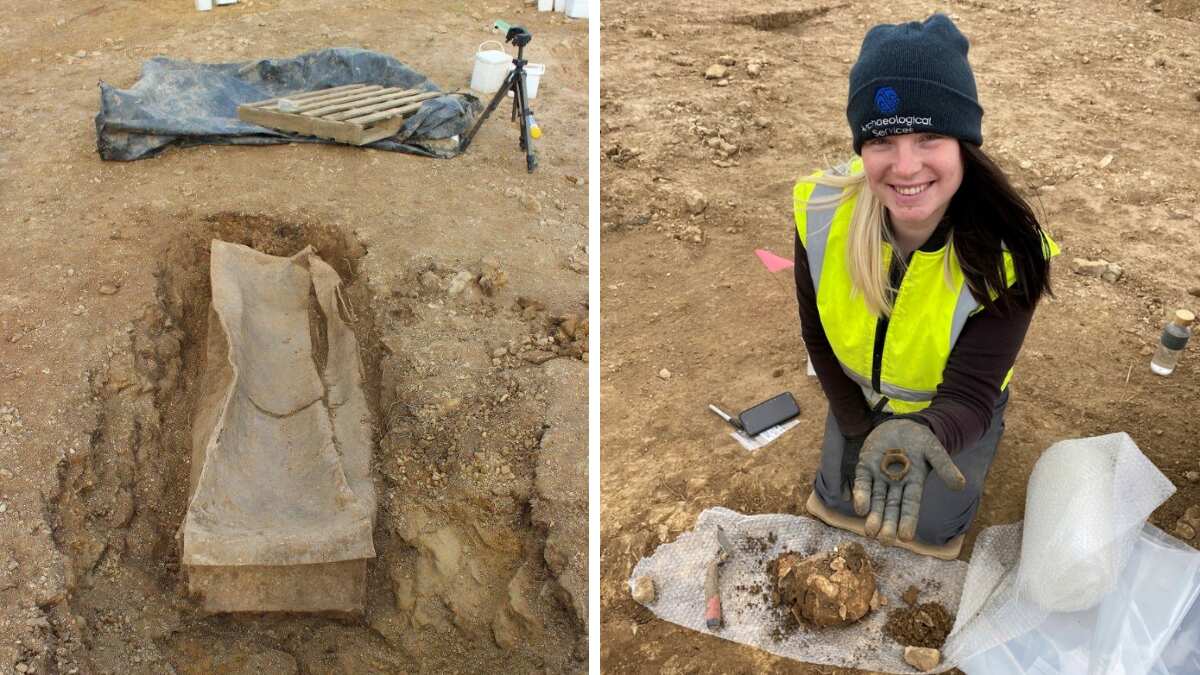
Archaeologists discovered the skeletal remains of a Roman aristocrat in what was described as a “truly extraordinary” find in a 1,600 years old hidden cemetery in northern England. The ancient lead coffin is thought to have contained the remains of a late-Roman aristocratic woman. Additionally, the team during their dig near the town of Garforth in Leeds also unearthed remains of more than 60 men, women and children who lived there more thanthousands of years ago.
According to a statement published by the Leeds City Council, on Monday (March 13) the remains of 62 people, including 23 children were found last year. The cemetery might include people from both the late Roman and early Saxon eras as evidence of their burial customs was found in the graves. It could also indicate early Christian beliefs as well as Saxon burials. The team of archaeologists also found personal possessions such as knives and pottery.
The skeletal remains of the aristocrat are believed to be of a high-status woman from the later years of the Roman Empire. David Hunter, principalarchaeologist with West Yorkshire Joint Services, in the statement said that the “lead coffin itself is extremely rare, so this has been a truly extraordinary dig.”

In an interview with CNN, Hunter also spoke about how the dig began after a commercial developer submitted an application for planning permission to the council. Subsequently, an archaeological survey of the site was conducted where they found the “very rare” lead coffin. “The lead sheeting is the lining of a larger wooden coffin so it’s a very high status Roman body,” he added. However, the precise location of the cemetery has not been revealed.
The archaeologists also hope that the site will help them gain an insight into the largely undocumented and significant transition between the fall of the Roman Empire which took place around 400 AD and the establishment of Anglo-Saxon kingdoms which came after. “This has the potential to be a find of massive significance for what we understand about the development of ancient Britain and Yorkshire,” said Hunter, in a press release.
He added, “The presence of two communities using the same burial site is highly unusual and whether their use of this graveyard overlapped or not will determine just how significant the find is. When seen together, the burials indicate the complexity and precariousness of life during what was a dynamic period in Yorkshire’s history.” The discovery which was made last spring has been revealed only now since the dig is complete and the team needed to “keep the site safe” for initial tests, the city council explained in the statement.
(With inputs from agencies)
&imwidth=180&imheight=135&format=webp&quality=medium)
The Royals season 2: Ishaan Khatter's series gets new director after two back-to-back exits- Report
&imwidth=180&imheight=135&format=webp&quality=medium)
Viral video shows cross falling on Colombia priest, no official confirmation | WATCH
&imwidth=180&imheight=135&format=webp&quality=medium)
Trump’s approval ratings hit a new low, Democrats want US president to campaign more
&imwidth=180&imheight=135&format=webp&quality=medium)
France reports first human case of livestock virus Shamonda, patient dies; what we know so far
&imwidth=180&imheight=135&format=webp&quality=medium)
Trump called Musk to lift Starlink restrictions affecting Ukraine's military operation: Report
&imwidth=180&imheight=135&format=webp&quality=medium)
Two BrahMos missiles on Tejas, triple the range and 100% indigenisation, says former BrahMos CEO
&imwidth=180&imheight=135&format=webp&quality=medium)
Ilhan Omar breaks silence over alleged marriage to her brother; Trump thinks it's 'really good answer'
&imwidth=180&imheight=135&format=webp&quality=medium)
Pakistan signs another defence pact even as Makkah Alliance shows no teeth. This time, it's with Qatar, Indonesia, Turkey
&imwidth=180&imheight=135&format=webp&quality=medium)
Netanyahu dials PM Modi, invites him and Capt Smit Machchhar to light torch on Israel’s Independence Day
&imwidth=180&imheight=135&format=webp&quality=medium)
‘Russian humanitarians’ fired missiles at Kyiv: Zelensky takes swipe at Witkoff over Putin praise
&imwidth=180&imheight=135&format=webp&quality=medium)
Putin fires nuclear capable hypersonic missiles, Zelensky ready to surrender 25% territory
&imwidth=180&imheight=135&format=webp&quality=medium)
From Agni-V to Project Kusha: How are India’s indigenous missile systems and defence shield reshaping modern warfare
&imwidth=180&imheight=135&format=webp&quality=medium)
'It's a crime not to see this scene': Tehran puts Trump 'behind bars'
&imwidth=180&imheight=135&format=webp&quality=medium)
What is the ‘heat ray’ weapon? Pete Hegseth reportedly authorises DHS to test it at US-Mexico border
&imwidth=180&imheight=135&format=webp&quality=medium)
Will Rohit and Kohli play ODI World Cup 2027? BCCI president Manhas says board 'not in a position to comment'
&imwidth=180&imheight=135&format=webp&quality=medium)
China's dancing robot turns violent bodyguard, lifts cars and fights intruders - Watch
&imwidth=180&imheight=135&format=webp&quality=medium)
Watch: India rejects ‘imprecise and unsupported’ references in UN migrant rights report
&imwidth=180&imheight=135&format=webp&quality=medium)
US to get 850 F-35 stealth fighter jets under 10-year Pentagon-Lockheed deal
&imwidth=180&imheight=135&format=webp&quality=medium)
GRAVITAS | Putin fires nuclear-capable hypersonic missiles, Zelensky ready to surrender 25% territory
&imwidth=180&imheight=135&format=webp&quality=medium)
IIFA 2026: Salman Khan warns paps, kisses little fan and hugs Kareena Kapoor at press conference
&im=FitAndFill=(700,400)&imwidth=180&imheight=135&format=webp&quality=medium)
New OTT releases this week (October 19-25, 2026): Gajab Raat to Chaar Yaar-8 titles to watch during Dussehra week on Netflix, Prime Video and more
&imwidth=180&imheight=135&format=webp&quality=medium)
US business activity grows in June, but tariffs and inflation cloud outlook
&imwidth=180&imheight=135&format=webp&quality=medium)
'That was great, who threw that punch?': Trump asks as protester punched at rally
&imwidth=180&imheight=135&format=webp&quality=medium)
‘I caution the president...’: Trump’s ex-press secretary warns after Zacharia’s exit
&imwidth=180&imheight=135&format=webp&quality=medium)
Trump’s bid to put his name on everything: This time, it was Atlantic Ocean; a look at past efforts
&imwidth=180&imheight=135&format=webp&quality=medium)
Diljit Dosanjh's Oct 30 Delhi show hits roadblock, Delhi Police denies permission
&imwidth=180&imheight=135&format=webp&quality=medium)
'This is despicable': Amy Acton hits back at Vivek Ramaswamy over Ohio campaign ad featuring her estranged mother
&imwidth=180&imheight=135&format=webp&quality=medium)
'Misunderstanding should be resolved through dialogue': Uttarakhand CM Dhami intervenes in Daler Mehndi controversy, speaks to brother Mika Singh
&imwidth=180&imheight=135&format=webp&quality=medium)
Finance influencer dies by suicide in Chennai; father accuses tech CEO, who denies charge
&imwidth=180&imheight=135&format=webp&quality=medium)
One man, 8 months of work, and a river dirty again: Why Bittu Tabahi may quit
&imwidth=180&imheight=135&format=webp&quality=medium)
'Vivek should keep it up': Trump defends Ramaswamy's controversial campaign ad targeting Amy Acton
&imwidth=180&imheight=135&format=webp&quality=medium)
ENG vs SL: Harry Brook’s 202 goes in vain as Sri Lanka pull off second-highest ODI chase
&imwidth=180&imheight=135&format=webp&quality=medium)
ENG vs SL: Harry Brook breaks Shubman Gill’s record for fastest ODI double century
&imwidth=180&imheight=135&format=webp&quality=medium)
Saudi Arabia targeted yacht carrying 14 Indians in Red Sea, rescue underway, Houthis claim
WATCH WION LIVE HERE
You can now write for wionews.com and be a part of the community. Share your stories and opinions with us here.