There were once only 1,280 early humans left to breed, claim Chinese scientists

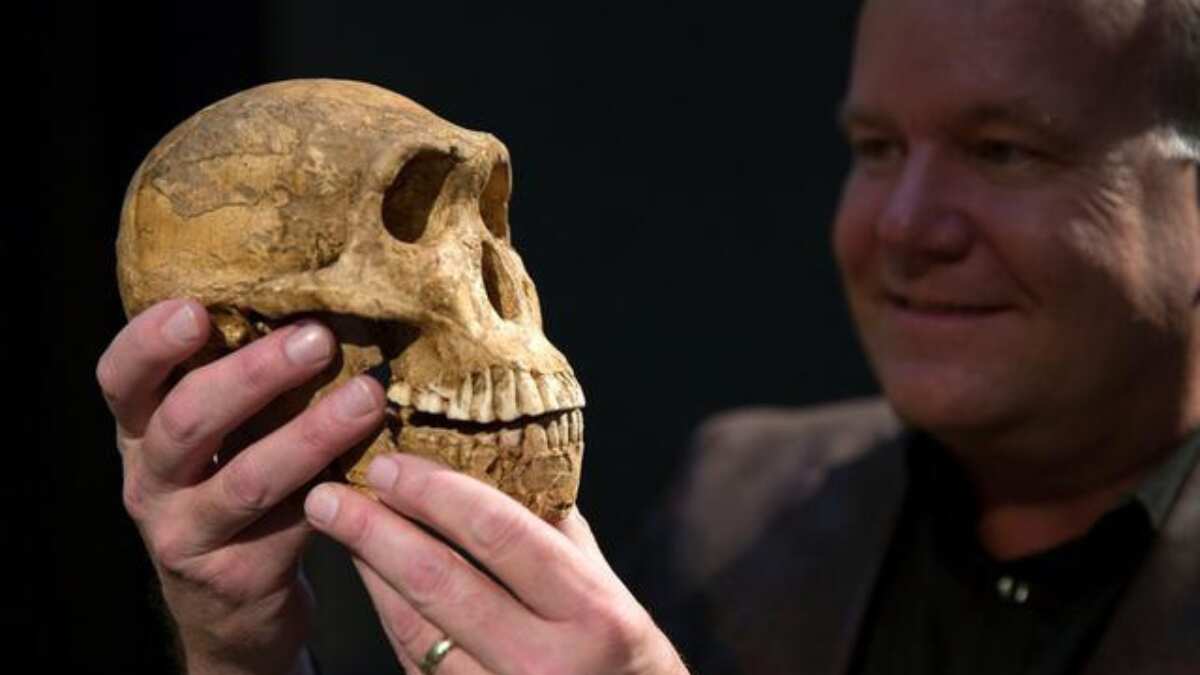
A cast of the new Homo naledi skull
Plastics, deforestation, polluted water bodies and a world full of concrete. The evidence of the continuous existence of humanity is spread across the world.
The human population has currently exceeded 8 billion.
But scientists now propose that humanity was once on the brink of never existing.

Chinese researchers have uncovered evidence suggesting that 930,000 years ago, our modern human ancestors endured a catastrophic population collapse, likely triggered by dramatic climate changes.
During this period, known as a "bottleneck," our ancestors dwindled to fewer than 1,280 breeding individuals, with approximately 98.7 per cent of human ancestors lost, endangering their survival.
Theirstudywas published on Thursday in the journal Science.
)
US vs China over South China Sea: Washington backs Philippines, Beijing hits back
)
Outrage erupts after 3-year-old is married to 60-year-old man in Pakistan, link to her sister's murder being probed
)
UK police arrest several under explosives act near air base used by US forces
)
‘Anti-social elements spreading false rumours’: LPU issues statement amid massive unrest over alleged rape
)
LPU students go on rampage, vandalise campus amid widespread protest: What's happening
)
OpenAI AI Agents hacked 4 websites before Hugging Face, researchers reveal
)
US Treasury Secretary Scott Bessent hails global crackdown on Iranian banks and airlines
&im=FitAndFill=(700,400))
New Friday OTT releases (September 25, 2026): Don’t Be Shy, Hunkkaar: The Roar, Mango Pachcha- 6 movies and TV shows on Netflix, Prime Video and more
)
Asian Games 2026: India face Afghanistan in quarterfinal on Sep 28; Pakistan clash with Hong Kong
)
‘Attack on Mecca a red line for Pakistan’: Shehbaz Sharif warns Houthis at UN
)
'Countries far from conflict are penalised': Jaishankar calls for Gulf peace, seafarer safety at UN
)
Bigg Boss 20: Salman Khan schools Rhiti Tiwari over Qazi Touqeer clash, compares her to Dolly Bindra
&im=FitAndFill=(700,400))
Humanoid robots to virtual worlds! Korean sci-fi dramas to watch: Are You Human Too?, Memories of the Alhambra and more
)
IND vs WI 1st ODI: Naman Dhir debuts as India bowl first in Trivandrum; check playing XIs
)
Nations League: Spain sink England at Wembley; Modric shines for Croatia
)
Two men die of suspected chemical exposure inside public toilet in Mumbai
)
Trump-Xi summit wrap: Big pageantry, Iran talks, few major developments and more meetings planned
)
‘Could kill billions...’: Bill Gates backs calls to slow AI development amid fears of catastrophe
)
Bollywood x K-pop crossover! LE SSERAFIM’s Kazuha charms fans with Shah Rukh Khan’s ‘Chammak Challo’ steps
)
US-Iran war: Trump rejects Iran's Hormuz proposal, reports suggest talks expected next week
)
'What kind of confession is this?': Pakistan PM Shehbaz Sharif’s 'terrorists would be roaming New York' remark goes viral, raises alarm online. Watch
)
Jaishankar at UNGA: Goodwill and friendship can't coexist with terrorism
)
Sri Lankan Tamil migrant worker gets death sentence in Saudi Arabia, help sought from India
)
'FIRST LOOK from inside Noah’s Ark': Researchers share video from inside mysterious mound in Turkey
)
UNSC reform momentum grows: Russia, Portugal, Mauritius push for India's permanent seat bid
)
WATCH | As Shehbaz Sharif claims Pakistan’s ‘victory’ during 2025 conflict, Indian diplomat R Srinivas laughs at UN
)
Ceuta migrant crisis: Protesters take to streets as Spain grapples with migrant challenge
)
Ramayana: Yash’s Ravana gets first official poster from Nitesh Tiwari’s epic
)
'A terrorist country is asking me that question?': Jaishankar hits back at Pakistani journalist at UN; flags attacks on commercial shipping
)
Russia will achieve Ukraine war aims; Europe doing everything to block peace talks: Lavrov at UN
What does it mean?
This research raises the intriguing possibility that a climate-induced bottleneck may have contributed to the divergence of early humans into two evolutionary paths; one leading to Neanderthals and the other to modern humans.
For decades, scientists have reconstructed human history through genetic analysis, through the use ofinherent biological facts of genetic mutations and their transmission across generations.
Technological advancements in DNA sequencing now enablethe comparison of complete genomes from diverse human populations.
How the study was done?
Haipeng Li and his colleagues, based in Chinese Academy of Sciences atShanghai, developed the FitCoal method, allowing the modelling of a million years of evolution, dissected into monthly segments.
This tool helps uncover the histories of various living organisms, including humans.
Initially focused on animals like fruit flies, the researchers later turned their attention to humans, comparing the genomes of 3,154 individuals from 50 populations worldwide.
Their investigation led to the conclusion that a near-extinction event occurred among our ancestors 930,000 years ago.
Before the bottleneck, the ancestral human population numbered approximately 98,000 breeding individuals.
This number plummeted to fewer than 1,280 individuals, persisting for 117,000 years before recovery.
The scientists argue that this bottleneck aligns with the fossil record of our human ancestors.
Our branch of the evolutionary tree diverged from other apes around seven million years ago in Africa. By a million years ago, our ancestors in Africa had evolved to be tall and large-brained.
Also watch |Ancient human civilisation needed three attempts & 12,000 years to colonise Europe: Study
Subsequently, some of these early humans migrated to Europe and Asia, evolving into Neanderthals and Denisovans, while our lineage continued to evolve into modern humans in Africa.
Despite decades of fossil hunting, the scarcity of remains from ancient human relatives in Africa between 950,000 and 650,000 years ago remains puzzling, and critics have demanded more conclusive evidence for the claim made by Chinese scientists.
WATCH WION LIVE HERE
You can now write for wionews.com and be a part of the community. Share your stories and opinions with us here.