Study shows several bird species nesting and laying eggs almost a month early

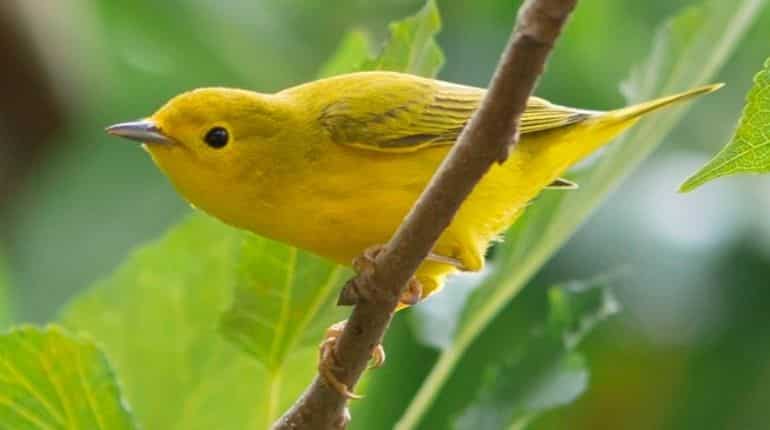
Yellow warbler
A new study has shown that several bird species are nesting and laying eggs almost a month early.
The research, published in the Journal of Animal Ecology, discusses in detail how a warming climate is causing spring to arrive earlier across most of the United States.
This is throwing off the timing of important natural events like migration and reproduction, as well as prolonging pest and allergy seasons.

“It was shocking to find this,” said John Bates, curator of birds at the Field Museum and the study’s lead author.
“What we can see is clearly pointing in the direction that climate change is having a significant effect on the behavior of birds. It’s another piece of the puzzle we are trying to figure out in terms of impacts.”
)
US vs China over South China Sea: Washington backs Philippines, Beijing hits back
)
Election Commission on 'damage control' : What do nine new decisions mean?
)
UK police arrest several under explosives act near air base used by US forces
)
LPU students go on rampage, vandalise campus amid widespread protest: What's happening
)
OpenAI AI Agents hacked 4 websites before Hugging Face, researchers reveal
)
US Treasury Secretary Scott Bessent hails global crackdown on Iranian banks and airlines
&im=FitAndFill=(700,400))
New Friday OTT releases (September 25, 2026): Don’t Be Shy, Hunkkaar: The Roar, Mango Pachcha- 6 movies and TV shows on Netflix, Prime Video and more
)
Asian Games 2026: India face Afghanistan in quarterfinal on Sep 28; Pakistan clash with Hong Kong
)
‘Attack on Mecca a red line for Pakistan’: Shehbaz Sharif warns Houthis at UN
)
WATCH | Delhi minister Parvesh Verma slaps man during road inspection – Here’s what happened
)
'Countries far from conflict are penalised': Jaishankar calls for Gulf peace, seafarer safety at UN
)
Bigg Boss 20: Salman Khan schools Rhiti Tiwari over Qazi Touqeer clash, compares her to Dolly Bindra
)
Gunmen kill 27 in two separate mass shootings in South Africa
&im=FitAndFill=(700,400))
Humanoid robots to virtual worlds! Korean sci-fi dramas to watch: Are You Human Too?, Memories of the Alhambra and more
)
IND vs WI 1st ODI: Naman Dhir debuts as India bowl first in Trivandrum; check playing XIs
)
Nations League: Spain sink England at Wembley; Modric shines for Croatia
)
Two men die of suspected chemical exposure inside public toilet in Mumbai
)
Trump-Xi summit wrap: Big pageantry, Iran talks, few major developments and more meetings planned
)
‘Could kill billions...’: Bill Gates backs calls to slow AI development amid fears of catastrophe
)
Bollywood x K-pop crossover! LE SSERAFIM’s Kazuha charms fans with Shah Rukh Khan’s ‘Chammak Challo’ steps
)
US-Iran war: Trump rejects Iran's Hormuz proposal, reports suggest talks expected next week
)
Jaishankar at UNGA: Goodwill and friendship can't coexist with terrorism
)
Sri Lankan Tamil migrant worker gets death sentence in Saudi Arabia, help sought from India
)
'FIRST LOOK from inside Noah’s Ark': Researchers share video from inside mysterious mound in Turkey
)
UNSC reform momentum grows: Russia, Portugal, Mauritius push for India's permanent seat bid
)
Man arrested after his 22-year-old girlfriend dies at homestay in Guwahati; police suspect murder over suicide claim
)
SIR row: RTI response raises questions over EC’s claim of unanimous approval
)
WATCH | As Shehbaz Sharif claims Pakistan’s ‘victory’ during 2025 conflict, Indian diplomat R Srinivas laughs at UN
)
Ceuta migrant crisis: Protesters take to streets as Spain grapples with migrant challenge
)
Ramayana: Yash’s Ravana gets first official poster from Nitesh Tiwari’s epic
)
'A terrorist country is asking me that question?': Jaishankar hits back at Pakistani journalist at UN; flags attacks on commercial shipping
)
Russia will achieve Ukraine war aims; Europe doing everything to block peace talks: Lavrov at UN
The analysis finds that spring ‘leaf out’ is happening earlier in 76 per cent (181) of the 239 cities analysed, compared to 1981.
Species including bluejays, yellow warblers and field sparrows are now laying their first eggs 25 days earlier than they were 100 years ago.
Earlier springs created a mismatching in availability of food (and other resources) with important natural events such as migration, hibernation and reproduction.
“If you’re a bird and you nest earlier, you put yourself at risk of these cold snaps that can still arrive in spring, which then affects the plants and insects,” said Bates.
“That then impacts the reproductive success of the birds. Springs are becoming more volatile and that is taking its toll.”
It might seem appealing to shake off the winter cold sooner, but earlier springs can have negative consequences such as longer allergy seasons, more persistent pests (like mosquitoes), and risks to fruit production.
(With inputs from agencies)