Scientists understood ancient shrimp like creature as 'predator', says new research

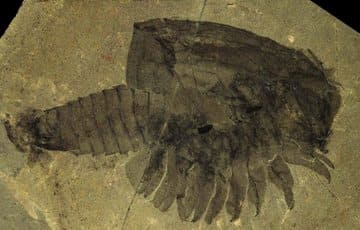
Well-preserved fossil of Anomalocaris canadensis which was discovered in Canada.
An ancient shrimplike creature, which has an armoured mouth and appendages growing out of its head, was believed to be the quintessential apex predator of its time by scientists.
The sea creature gained a fearsome reputation after palaeontologists believed that it was responsible for crushing and scarring the fossilized skeletons of trilobites, which were early hard-shelled invertebrates that had skittered on the seafloor before they disappeared in a mass extinction, giving way to the dinosaurs.
The 2-foot-long (0.6-meter-long) Anomalocaris canadensis was among the largest marine animals, which survived 508 million years ago. During the Cambrian period, the underwater hunter was believed to have prowled the seas.

This period was considered as a critical juncture in the history of the planet when there was an explosion in the diversity of living creatures and when many major animal groups alive emerged.
ALSO READ |Discovery of fossils shows humongous sea creature decapitated by dinosaur predator
“That didn’t sit right with me, because trilobites have a very strong exoskeleton, which they essentially make out of rock, while this animal would have mostly been soft and squishy,” stated lead author Russell Bicknell, a postdoctoral researcher in the American Museum of Natural History’s division of palaeontology, who carried out the work while working at the University of New England in Australia.
Bicknell and his collaborators in the United Kingdom, Germany, China and Switzerland have created the creature's new three-dimensional reconstruction, using computer modelling to get a better understanding of its biomechanics.
The model was made on the basis of a well-preserved but flattened fossil discovered in the Burgess Shale formation in the Canadian Rockies.
Using long appendages to hunt
Earlier, research had stated that the mouth parts of Anomalocaris were not able to process hard food. On the basis of this research, Bicknell and his colleagues focused on whether it can use its long and spiny appendages to chew up trilobite prey.
With the use of present-day whip spiders and whip scorpions as analogues, because they also have similar appendages which allow them to grasp prey, the team carrying out the study was able to show that the segmented appendages of the predator were able to grab prey and had the capacity to stretch out and flex.
WATCH |Aliens: Are we looking in the wrong place?
However, the analysis of the team suggested that the marine animal was more of a weakling than it was assumed initially and was “incapable” of crushing hard-shelled prey with the two structures, as per the study published in the journal Proceedings of the Royal Society B on Tuesday.
“Previous conceptions were that these animals would have seen the Burgess Shale fauna as a smorgasbord, going after anything they wanted to, but we’re finding that the dynamics of the Cambrian food webs were likely much more complex than we once thought,” said Bicknell, in a statement.
You cannow write for wionews.comand be a part of the community. Share your stories and opinions with ushere.
WATCH WION LIVE HERE