Researchers spot sea pig in Chile’s deepest known cold seeps located 2,836 metres below the sea

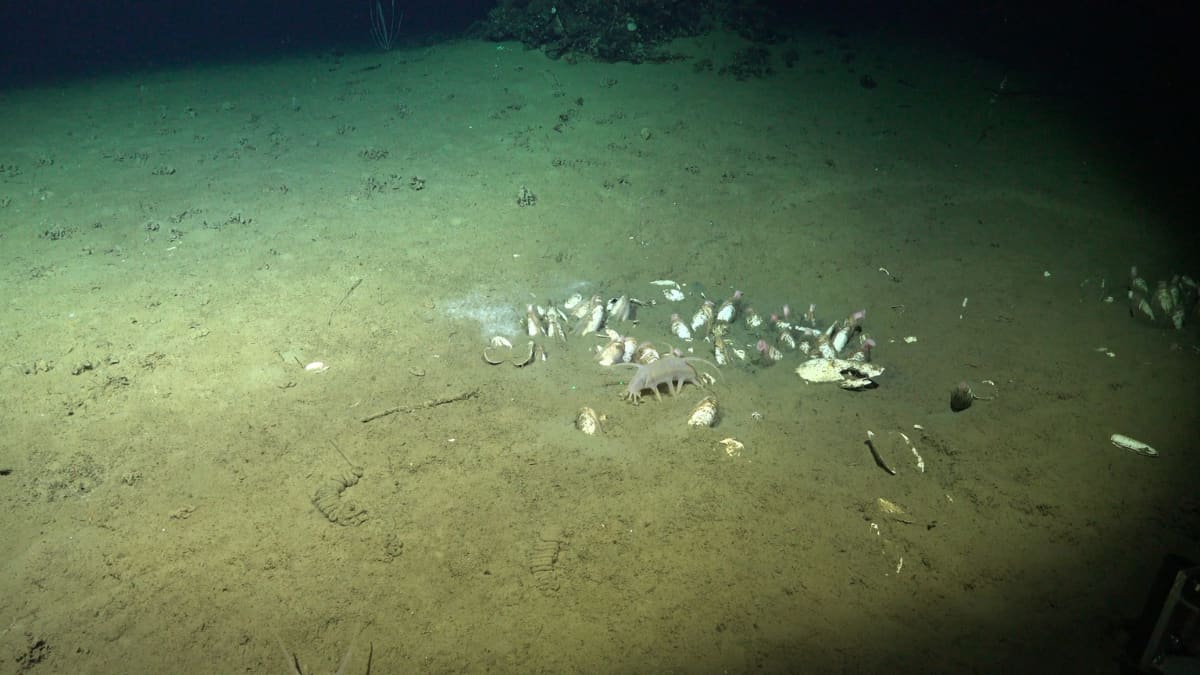
Sea Pig
The scientists on board Schmidt Ocean Institute’s R/V Falkor (too) who are in the midst of a research expedition in the Atacama Trench found Chile’s deepest and most northern cold seeps at the depth of 2,836 metres. During their research, they also spotted a type of odd-looking sea cucumber.
What did the researchers find?
During their expedition in the Atacama Trench, an 8,000-metre-deep formation that stretches along the length of Peru and Chile, the scientists discovered the record-breaking cold seeps.

Cold seeps, according to the National Oceanic and Atmospheric Administration (NOAA), are locations where hydrocarbon-rich fluid like methane or hydrogen sulphide seeps up from below the seafloor.
Also Read |Freshwater and key conditions for life first appeared on Earth 4 billion years ago, study suggests
These areas which get more difficult to find as you go deeper were discovered by the team on board the R/V Falkor (too) after more than 12 hours using seafloor mapping data.
&im=FitAndFill=(700,400))
Suriya and Jyothika say ‘I do’ again after 20 years! See their dreamy wedding pics
)
Saudi vs Houthis: Riyadh claims to have shot Houthi drone targeting Mecca
)
Trump gets new power to hit India, China with up to 100% tariffs as US Senate clears Russia sanctions bill
)
Ex-CIA officer caught with gold bars worth $40 million seeks plea deal | Gravitas
)
Trump calls Canada-EU associate membership plan ‘laughable’ and threatens 'very serious tariffs'
)
Lionel Messi for 2026 Ballon d’Or over Mbappe and Yamal, says Diego Simeone
)
Shahzad Bhatti Network declared terrorist organisation under UAPA: Govt order
)
US Treasury rallies global financial institutions for Op Economic Outcast to isolate Iran
)
Trump's Iran war faces fresh House rebuke; 7 Republicans join Democrats in push to end conflict ahead of midterms
)
Veteran actor Anant Nag honoured with Indian cinema’s highest award
)
Fed raises rates for first time in 3 years, Kevin Warsh defies Trump as inflation mounts
)
Alex Saab, ally of Venezuela's Maduro, pleads guilty in US corruption case
)
Pakistan naval vessel returns to harbour with 'severe damage' after collision with Indian warship in Arabian Sea
)
The Early Spring season 2 is happening, but fans have one request - 'don't change the actors'
)
BRICS success stuns White House, Trump targets India with 100% tariff | Gravitas
)
Finnish president Stubb calls Trump 'good for NATO' as allies increase defense expenditure
)
Trump backs PM Modi’s anti-opium push even as India remains on US illicit drug-producing list
&im=FitAndFill=(700,400))
New OTT releases this week (September 14-20, 2026): Lust Stories 3, Waiting Hai, Irumudi- 5 new titles coming on Netflix, Prime Video and more
)
What is Article 10 of the 1991 treaty at the centre of Pakistan Navy's 'unprofessional conduct'
)
Meghan Markle's phone number leaked from children's WhatsApp group, couple switches Archie and Lilibet's school
)
Trump praises India’s Opium crackdown, hails anti-drug efforts
)
800 million years old - Scientists discover 'fingerprints' of supercontinent Gondwana in ancient rocks
)
No Pandya as Auqib Nabi earns maiden ODI call-up; Mayank returns for WI T20Is| check full squads
)
Katrina Kaif’s postpartum weight is not the problem; your gaze is
)
US, China dominate global economy: Where does India rank among the world's biggest economies?
)
Hockey: Pakistan urges AHF to move Asian Champions Trophy out of India over security concerns
)
US trade tariff: 100% tariff targets Russian buyers amid trade tensions
)
Sydney Sweeney defends provocative ad choice, the internet is still not impressed
)
Bigg Boss 20: Mahhi Vij reveals she lost Yuva role to Kareena Kapoor; 'didn’t work out in my favour'
)
Riyadh warns of ‘red line’ after Mecca targeted; Houthis claim downing Saudi fighter jet – What’s happening?
)
Daayra movie review: Kareena Kapoor, Prithviraj Sukumaran shine in Meghna Gulzar’s cop-versus-cop crime thriller
)
Pakistan: Imran Khan's sons Kasim & Sulaiman claim their father is 'tortured' in jail
)
FBI Director Kash Patel grilled over change of hiring rules on bestiality
)
Abhishek Sharma rises to No. 2 in T20Is; ENG’s Robinson 3rd after record Pakistan Tests
)
Extreme warming in Indian Ocean added 695 billion tons of ice to Antarctica ice sheet
)
All Indian goods to get duty-free access to New Zealand
At 2,836 metres deep, the seeps provide chemical energy for deep-sea animals living without sunlight and offer insights as to how these conditions led to the development of life on Earth, said the team in a press release, on Tuesday (Jun 18).
“The microbes that live on these seeps have amazing strategies for producing food without sunlight,” said expedition lead Dr Lauren Seyler of Stockton University, in the statement.
She added, “Here on Earth, life in the dark is alien in its own right and provides critical information for understanding how organisms persist under the most extreme conditions.”
Seyler noted that we are still to figure out how life started on Earth and environments like these “might offer clues about the spark that ignited all the biodiversity on our beautiful planet.”
Creatures found
In a statement, the researchers said that visual evidence “strongly suggests” that the seeps found are methane seeps, chemosynthetic ecosystems where naturally occurring bubbles of the gas emerge from fissures in the seafloor.
They noted that the methane on the seafloor not only provides energy for the bacteria but also acts as a food source for animals like clams, squat lobsters, and tube worms.
Also Read |‘Atoco Point’: NASA’s rover spots strikingly mysterious rock never seen before on Mars
The team reportedly collected 70 specimens during their expedition and even spotted a sea pig, one of the planet’s strangest deep sea cucumbers, snuffling along the seafloor.
The sea pig may have gotten its name due to its pink-coloured body and love of the muddy seafloor as it is known for sifting out organic morsels to feed on.
(With inputs from agencies)