Researchers discover 'remarkable' 24,000-year-old palaeolithic cave art in Spain

Spain cave art
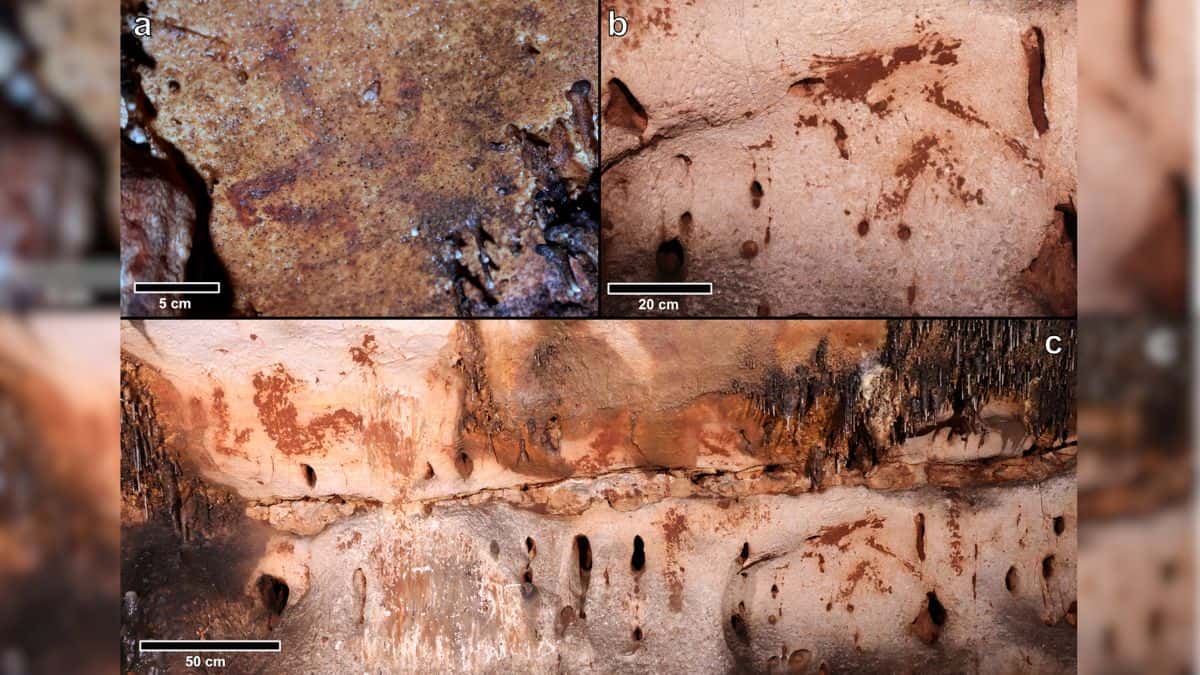
Archaeologists have made a significant discovery of Palaeolithic cave art in "Cova Dones" or "Cueva Dones", a cave site in Spain.
With over 100 ancient paintings and engravings believed to be at least 24,000 years old, this discovery can arguably be considered one of the most important finds on the Eastern Iberian Coast in Europe.
A remarkable find

The 500-metre-long cave located near Valencia, as per Phys.org, is an often visited site for locals, hikers, and explorers.Despite this, the existence of Palaeolithic paintings remained unnoticed until researchers made this remarkable discovery in June 2021.The findings have been published in the journal 'Antiquity'.
Also read |Australia collaborates with tech giants to block AI-generated child porn in search engines
"When we saw the first painted auroch [extinct wild bull], we immediately acknowledged it was important. Although Spain is the country with the largest number of Palaeolithic cave art sites, most of them are concentrated in northern Spain. Eastern Iberia is an area where few of these sites have been documented so far," said Dr Aitor Ruiz-Redondo, Senior Lecturer of Prehistory at the University of Zaragoza and a research affiliate at the University of Southampton.
)
Trump 2.0: Dark days ahead for America’s ‘imperial presidency’
66 years of the Indus Waters Treaty: How India and Pakistan settled a bitter river dispute
)
Trump defends AI amid growing alarm, announces new 'AI force' and promises an 'AI czar'
)
9 women found dead near Johannesburg: South Africans rally, demand 'enough' to femicide
&im=FitAndFill=(700,400))
How many F-35s does Britain, Japan and Israel have?
)
‘Will go to any extent’: Pakistan vows to defend Saudi Arabia amid Houthi attacks
)
Nigeria: Protesters take to the streets, police fire shots
)
Raphinha hat-trick powers Barcelona to 3-1 win over Sevilla in La Liga
)
US-Iran war: Tehran draws red lines — seven demands before any peace talks
)
Cochin shipyard starts building Indian Navy's next-gen missile vessels
&im=FitAndFill=(700,400))
Meet top 5 Indian batters with fastest T20I centuries
)
Harry Brook targets long reign at top of T20I rankings after Sri Lanka sweep
)
Brigitte Bardot’s private collection set for Paris auction; key items and prices revealed
)
Pak: A series of counter terrorism operations in Khyber Pakhtunkhwa
)
Iran sets 7 conditions to end war with US: What are Tehran’s demands?
)
Pentagon revives mandatory testosterone testing for male troops aged 30 and above
)
Russia extends ban on Western food imports for two more years in extended sanctions countermeasure
)
Flying cars in UAE: Ras Al Khaimah signs deal with Chinese company to test new transport
&im=FitAndFill=(700,400))
Ananya Panday to Sharvari: 5 actresses serving major princess vibes
)
Africa is splitting, and a lot sooner than estimated, giving way to a new ocean
)
Iran rebuilding nuclear facilities? New satellite images show Tehran may be rapidly restoring bombed Parchin base
)
FACT CHECK: Why did PM Modi ask Xi ‘is it okay’ at BRICS Summit? New video reveals...
)
Trump announces ‘AI Force’ as debate grows over AI risks and regulation
)
Tirupati Laddu ghee adulterated with chemicals, says ED, supplier arrested
)
The Verdict | When precision fails: US commits war crime in Minab school strike, UN finds
)
Trump bans CNN, MS NOW and Politico from White House over ‘FAKE NEWS’
)
Mark Carney mimics Trump in hilarious moment over C$70 billion clean-energy investment; room erupts in laughter
)
Gaza under attack: Health chief's son killed in IDF strikes
)
Russia holds first parliamentary elections since the beginning of the Ukraine war
)
China may have gained access to US's classified F-35 jets; parts meant for repairs diverted to Hong Kong, sparking Pentagon inquiry
)
Reacher star Alan Ritchson opens up about alleged blackmail, suicide attempt during difficult period
&im=FitAndFill=(700,400))
‘Not the US or China’: These are the countries leading the world in arable land
)
How did an Australian river with 500 crocodiles pass the Olympic test? Here's how
)
Ed Sheeran addresses Macklemore's removal, Gaza conflict during Philadelphia concert: 'I cannot hide how I feel'
)
Arvind Kejriwal, family members, Delhi CM Rekha Gupta get SIR notices
)
He added that "the actual 'shock' of realising its significance came long after the first discovery."
"Once we began the proper systematic survey we realised we were facing a major cave art site, like the ones that can be found elsewhere in Cantabrian Spain, southern France or Andalusia, but that totally lack in this territory."
The discovery
The research team, led by Dr Ruiz-Redondo, Dr Virginia Barciela-González, Senior Lecturer of Prehistory at the University of Alicante, and Dr Ximo Martorell-Briz, an affiliate researcher at the University of Alicante, painstakingly documented more than a hundred motifsin Cova Dones.
As per the research abstract published on the Cambridge website, the team has "identified more than 110 graphic units, including at least 19 zoomorphic representations, located in three different zones of the cave."
The depicted animals include "seven horses, seven hinds (female red deer), two aurochs, a stag, and two indeterminate animals. The rest of the art consists of conventional signs (rectangles, meanders), several panels of ‘macaroni’ (‘flutings’ made with either fingers or tools dragged across a soft surface), isolated lines, and poorly preserved unidentified paintings."
What sets this site apart is not just the quantity of ancient artworks, but also the variety of techniques used in creating them.Remarkably, most of the paintings were created using clay.
These ancient artists would drag their fingers and palms covered with clay on the cave walls, and the humid cave environment allowed the paintings to dry slowly, preserving them over thousands of years.Although clay painting is a known art form in Palaeolithic art, examples of its usage or preservation are rare.
The research is still in its early stages, and there is much more to explore and document within the cave. Scientists predict that further investigationof the caves should uncover more art in the coming years.
(With inputs from agencies)
WATCH WION LIVE HERE
You can now write for wionews.com and be a part of the community. Share your stories and opinions with us here.

