Asteroid Dinkinesh has its own moon, pictures sent by Lucy mission show

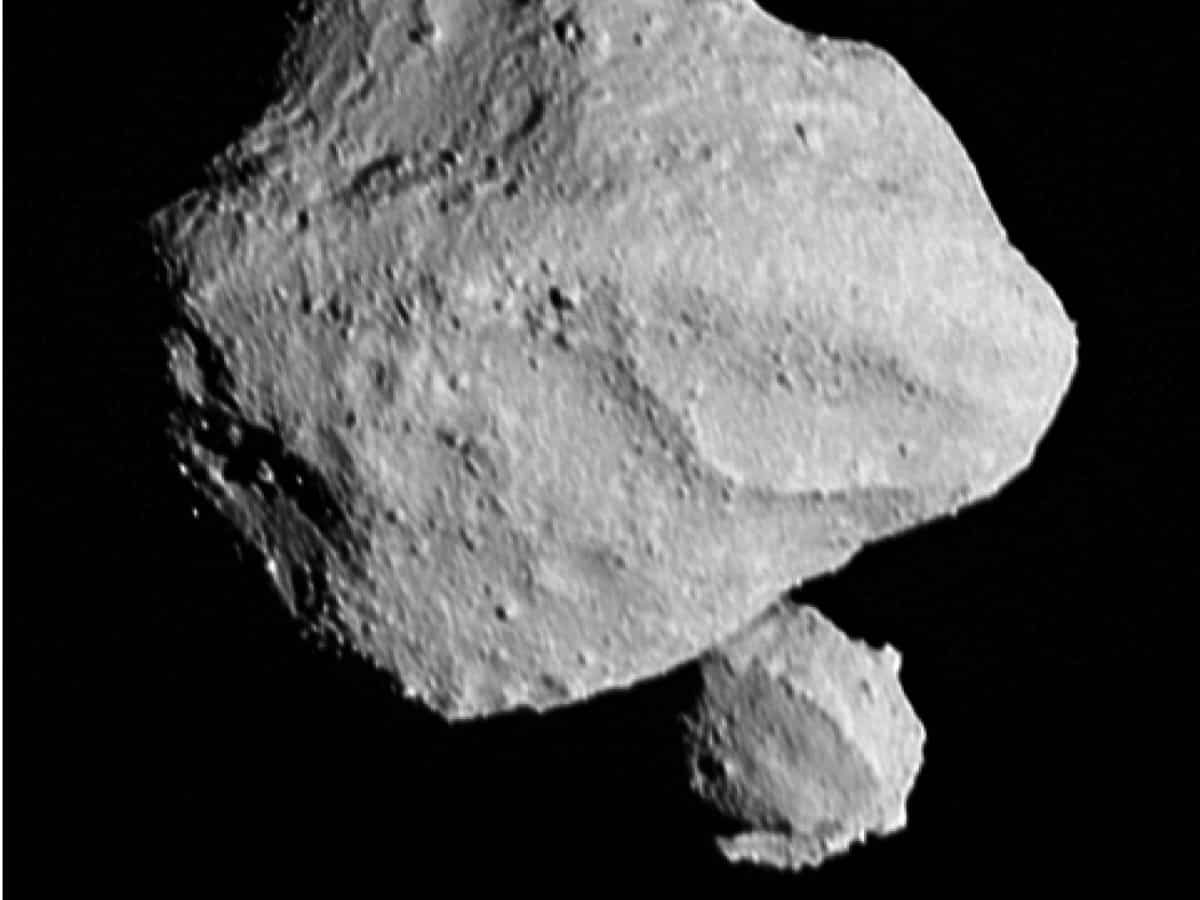
Asteroid Dinkinesh with another smaller space rock
NASA’s Lucy spacecraft flew past asteroid Dinkinesh on Nov 1, marking its first flyby since its launch. But to everyone’s surprise, asteroid Dinkinesh is not one but actually made up of two tiny space rocks. This means, Lucy has flown past two small asteroids in a single shot, making this a one-of-a-kind event in space exploration.
Lucy zoomed by the small asteroid Dinkinesh, also known as Dinky, on Wednesday and sent back its images to Earth. These images revealed that Dinkinesh has an even smaller space rock orbiting it, which is essentially its "satellite".Scientists at NASA were amazed at this discovery and called it “marvellous.”

Han Levinson, who is the principal investigator for Lucy from Southwest Research Institute, said, “Dinkinesh really did live up to its name; this is marvellous.” He was referring to the meaning of Dinkinesh in the Amharic language, “marvellous.”
Asteroid Dinkinesh is actually a binary unit
This discovery doesn’t come as a surprise to NASA scientists though, as the Lucy team has been wondering for quite a long time if Dinkinesh might be a binary unit, i.e., is it made up of two extremely tiny space rocks? The observation was based on Lucy's instrument’s readings as it measured a change in the brightness with time. But as the images came, all doubts were cleared.
)
No Pandya as Auqib Nabi earns maiden ODI call-up; Mayank returns for WI T20Is| check full squads
)
FBI Director Kash Patel grilled over change of hiring rules on bestiality
)
Sydney Sweeney defends provocative ad choice, the internet is still not impressed
)
War will be ‘completely different and very short’ if Europe attacks Russia, warns Lavrov
)
Shahzad Bhatti Network declared terrorist organisation under UAPA: Govt order
)
US, China dominate global economy: Where does India rank among the world's biggest economies?
)
Finnish president Stubb calls Trump 'good for NATO' as allies increase defense expenditure
)
Bigg Boss 20: Mahhi Vij reveals she lost Yuva role to Kareena Kapoor; 'didn’t work out in my favour'
)
Alex Saab, ally of Venezuela's Maduro, pleads guilty in US corruption case
)
Lionel Messi for 2026 Ballon d’Or over Mbappe and Yamal, says Diego Simeone
)
Indonesia wildfires: Over 12.5 million people exposed to poison haze
)
Who was Eliana Moreno? NBC LA aerial reporter killed in Chatsworth crash
)
Trump backs PM Modi’s anti-opium push even as India remains on US illicit drug-producing list
)
At least 20 killed after war-damaged apartment building collapses in Gaza; rescuers search for survivors
)
Pakistan naval vessel returns to harbour with 'severe damage' after collision with Indian warship in Arabian Sea
)
Fed raises rates for first time in 3 years, Kevin Warsh defies Trump as inflation mounts
)
What is Article 10 of the 1991 treaty at the centre of Pakistan Navy's 'unprofessional conduct'
)
Ex-CIA officer caught with gold bars worth $40 million seeks plea deal | Gravitas
)
Daayra movie review: Kareena Kapoor, Prithviraj Sukumaran shine in Meghna Gulzar’s cop-versus-cop crime thriller
)
Gurugram biker hit-and-run case: Accused Kalyan Bainsla, cousin sent to 2-day police custody
)
Pakistan: Imran Khan's sons Kasim & Sulaiman claim their father is 'tortured' in jail
)
Trump's Iran war faces fresh House rebuke; 7 Republicans join Democrats in push to end conflict ahead of midterms
)
PNS Hunain: All you need to know about Pakistani vessel that hit Indian Navy warship
&im=FitAndFill=(700,400))
New OTT releases this week (September 14-20, 2026): Lust Stories 3, Waiting Hai, Irumudi- 5 new titles coming on Netflix, Prime Video and more
)
‘There’s no Pak-China boundary’: India rejects ‘so-called’ boundary joint commission, tells Islamabad to stop ‘theatrics’
)
Riyadh warns of ‘red line’ after Mecca targeted; Houthis claim downing Saudi fighter jet – What’s happening?
&im=FitAndFill=(700,400))
Suriya and Jyothika say ‘I do’ again after 20 years! See their dreamy wedding pics
)
Abhishek Sharma rises to No. 2 in T20Is; ENG’s Robinson 3rd after record Pakistan Tests
)
Extreme warming in Indian Ocean added 695 billion tons of ice to Antarctica ice sheet
)
BRICS success stuns White House, Trump targets India with 100% tariff | Gravitas
)
Meghan Markle's phone number leaked from children's WhatsApp group, couple switches Archie and Lilibet's school
)
The Early Spring season 2 is happening, but fans have one request - 'don't change the actors'
Dinkinesh is a close binary. From a preliminary analysis of the first available images, the team estimates that the larger body is approximately 0.5 miles (790 m) at its widest, while the smaller is about 0.15 miles (220 m) in size, NASA said in a press release.
The team believe that this encounter has served as an in-flight test of the spacecraft, specifically focusing on testing the system that allows Lucy to autonomously track an asteroid while flying past at 10,000 mph. This system is referred to as the terminal tracking system.
Also Read |New study paints a scary scenario for when Earth passes the 1.5 degree threshold
“This is an awesome series of images. They indicate that the terminal tracking system worked as intended, even when the universe presented us with a more difficult target than we expected,” said Tom Kennedy, guidance and navigation engineer at Lockheed Martin in Littleton, Colorado.
The Lucy team will now take another week to completely unravel, or in this case, downlink all the data coming from the spacecraft. The team will use this data to evaluate the spacecraft’s behaviour during the encounter and to prepare for the next close-up look at the main belt asteroid, Donaldjohanson, in 2025.
(With inputs from agencies)