

&imwidth=800&imheight=600&format=webp&quality=medium "Like China and Japan, Europe working on vertical landing rockets")
In a global space launch ecosystem that is defined and dominated by Elon Musk's SpaceX and their vertical landing Falcon-series and Starship rockets, which perform over 100 launches annually, many entities are trying to join the club. China, Japan, Europe are the major contenders in this effort, with their respective private entities or government-backed entities making efforts towards developing re-usable rockets, which would eventually help them save on precious hardware, reduce launch-to-launch turnaround time, increase launch frequency, and reduce launch costs significantly.
China is rapidly developing its capacity to build and launch re-usable vertical landing rockets via its Government entities and private ones. Several Chinese vertical landing rockets have been tested over the last three years. There are high hopes on entities such as Space Pioneer with its Tianlong-3 rocket, LandSpace with its Zhuque-3 rocket, and the Chinese government's Long March 12-A. All three rockets share a similar design, and capability-wise are quite similar to SpaceX's workhorse Falcon 9 rocket.
Another Chinese firm SpaceEpoch has been testing their Hiker-1 vertical landing rocket and conducted a successful initial trial at sea. With multiple competing players in the fray, China has the overall edge among the nations that are trying to master this new-age technological capability.
In June 2025, Japan's Honda R&D, a research and development subsidiary of Honda Motor Co, conducted a launch and landing test of an experimental reusable rocket. The test vehicle stood 6.3 meters tall, measured 85 cm in diameter, and had a 1,312 kg mass including fuel. Developed independently by Honda, the test was completed successfully, and marked the first time Honda landed a rocket after reaching an altitude of nearly 300 meters.
According to the firm, Honda started rocket research based on the belief that it has the potential to contribute more to people’s daily lives by launching satellites with its own rockets, that could lead to various services that are also compatible with other Honda businesses. Honda has chosen to take on the technological challenge of developing reusable rockets by utilizing Honda technologies amassed in the development of various products and automated driving systems, based on a belief that reusable rockets will contribute to achieving sustainable transportation.
Although Honda's rocket research is still in the fundamental research phase, and no decisions have been made regarding commercialization of these rocket technologies, Honda will continue making progress in the fundamental research with a technology development goal of having technological capability to enable a suborbital launch by 2029, the firm says.
Trending Stories
&imwidth=180&imheight=135&format=webp&quality=medium)
Other Mommy leads North American box Office as Verity, Resident Evil round out top four
&im=FitAndFill=(700,400)&imwidth=180&imheight=135&format=webp&quality=medium)
Navratri 2026: 9 days, 9 forms of Goddess Durga and 9 colours- Check the complete list
&imwidth=180&imheight=135&format=webp&quality=medium)
Anti-SIR protest in Mumbai: Protestors wear black masks & ribbons in Mumbai
&imwidth=180&imheight=135&format=webp&quality=medium)
BCCI rejects venue shift reports, India vs Sri Lanka 1st ODI to remain in Delhi
&imwidth=180&imheight=135&format=webp&quality=medium)
Diljit Dosanjh’s Delhi concert gets a new date: When and where to catch the singer
&im=FitAndFill=(700,400)&imwidth=180&imheight=135&format=webp&quality=medium)
Is sending robots to Mars easier than sending humans?
&imwidth=180&imheight=135&format=webp&quality=medium)
A watchdog rated 'ChatGPT for Teens' an unacceptable risk and says keep under-18s off it
&imwidth=180&imheight=135&format=webp&quality=medium)
1,500 drones illuminate Mumbai sky as Cordelia Cruises unveils second ship, Cordelia Sky
&imwidth=180&imheight=135&format=webp&quality=medium)
'Just coincidence': Police mistakes protester as AISA chief Neha Bora, arrests her from site
&imwidth=180&imheight=135&format=webp&quality=medium)
Anthropic's AI invented a murder witness and sent the fake tip to Philadelphia police
&imwidth=180&imheight=135&format=webp&quality=medium)
Congress demands action against chief election commissioner
&imwidth=180&imheight=135&format=webp&quality=medium)
CJI Surya Kant declines INDIA bloc leaders’ request for meeting ahead of march to SC, asks them to file petition
&imwidth=180&imheight=135&format=webp&quality=medium)
Saif Ali Khan is finally on Instagram! Here's what he shared in his first post
&imwidth=180&imheight=135&format=webp&quality=medium)
'Turn approver, resign, we'll forgive you': Rahul Gandhi claims receiving messages from CEC Gyanesh Kumar
&imwidth=180&imheight=135&format=webp&quality=medium)
One Indian killed in Riyadh airport attack; 11 others injured : MEA
&imwidth=180&imheight=135&format=webp&quality=medium)
Top AI models flunked a test of inventing new AI research, so much for self-improving AI
&imwidth=180&imheight=135&format=webp&quality=medium)
Wasim Jaffer blames Ajit Agarkar-led selection panel for Virat Kohli’s Test retirement
&imwidth=180&imheight=135&format=webp&quality=medium)
'Ouch!!! That must hurt': Kangana Ranaut hails Kamal Haasan's sharp reply to Elon Musk over Starlink row
&imwidth=180&imheight=135&format=webp&quality=medium)
Sidhu Moose Wala’s younger brother wins hearts by recreating late singer’s signature move at Toronto Hologram Show
&imwidth=180&imheight=135&format=webp&quality=medium)
UK school ditches technology, shifts from screen to pen and paper for learning
&imwidth=180&imheight=135&format=webp&quality=medium)
Telangana ATM heist: Thieves in nighties arrive in ambulance, break into SBI ATM in Kamareddy - VIDEO
&imwidth=180&imheight=135&format=webp&quality=medium)
Houthis claim Riyadh airport attacks, Aramco strikes; issue fresh warning to airlines, travellers and workers
&imwidth=180&imheight=135&format=webp&quality=medium)
Portugal Federation confirms Cristiano Ronaldo’s return to national team despite suspension
&imwidth=180&imheight=135&format=webp&quality=medium)
Delhi protests: 'Court should not be dragged into political activity', says CJI Surya Kant
&im=FitAndFill=(700,400)&imwidth=180&imheight=135&format=webp&quality=medium)
New OTT releases this week (October 12-18, 2026): Sacrifice, Koffee with Karan S9, Roadies Rebirth- 6 titles coming on Netflix, JioHotstar and more
&imwidth=180&imheight=135&format=webp&quality=medium)
Microsoft's Nadella says treat every AI model as already hacked, and build an 'emergency brake'
&imwidth=180&imheight=135&format=webp&quality=medium)
Delhi protest: CJI Surya Kant declines to meet India Bloc leaders
&imwidth=180&imheight=135&format=webp&quality=medium)
Telangana man allegedly recruited into Russian military dies near Ukraine border
&imwidth=180&imheight=135&format=webp&quality=medium)
China imposes first-ever sanctions on ministers from Taiwan allies: What this means
&imwidth=180&imheight=135&format=webp&quality=medium)
McSweeney reveals how studying Virat Kohli’s YouTube clips helped Australia A conquer India
&imwidth=180&imheight=135&format=webp&quality=medium)
Maharashtra appoints FDA commissioner Tukaram Mundhe as secretary of committee for MPSC overhaul amid stir
&imwidth=180&imheight=135&format=webp&quality=medium)
Iran: US accepted some conditions, Clarity needed on others
&imwidth=180&imheight=135&format=webp&quality=medium)
Nana Patekar's cause of death confirmed; here's what his postmortem report says
&imwidth=180&imheight=135&format=webp&quality=medium)
iPhone Duo price index: Tracking Apple’s latest pricing trends
&imwidth=180&imheight=135&format=webp&quality=medium)
'Say no to Muse': Meta has no control over its own moderation AI while it forces a security nightmare on everyone
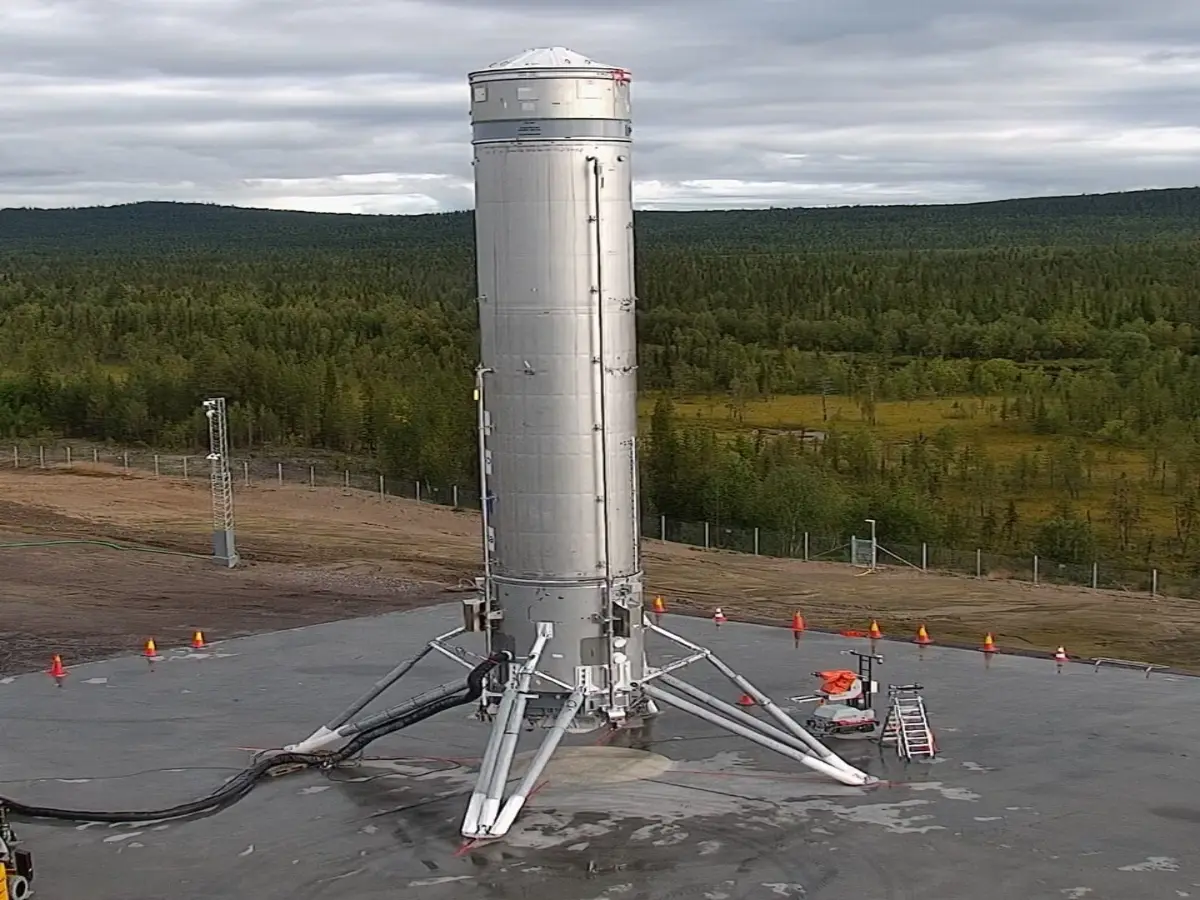
The latest entrant is Europe's ArianeGroup, which announced on Friday, 19th September, that the first Themis reusable rocket demonstrator has been fully integrated and is standing on its own four legs on a launch pad in Sweden. The demonstrator will now be put through a combined test campaign before an initial low-altitude hop test is performed. Hop tests are the baby steps in the long and technologically sophisticated journey to building a vertical landing rocket.
European Space Agency(ESA )Member States adopted the Themis programme in November 2019 with the aim of developing and maturing key technologies for future reusable rockets. The reusable rocket first stage demonstrator stands 30 metres tall and is powered by a Prometheus rocket engine, which is being developed by ArianeGroup as part of a separate ESA-funded project and is capable of producing approximately 100 tonnes of thrust.
In addition to funding from the European Space Agency, the project is also being funded through a European Union initiative called SALTO. According to ArianeGroup, the €39 million project aims to facilitate the first flight tests of the Themis reusable stage demonstrator at the Esrange Space Center in Sweden.
