ISRO: Indigenously designed and developed supersonic decelerator test successful

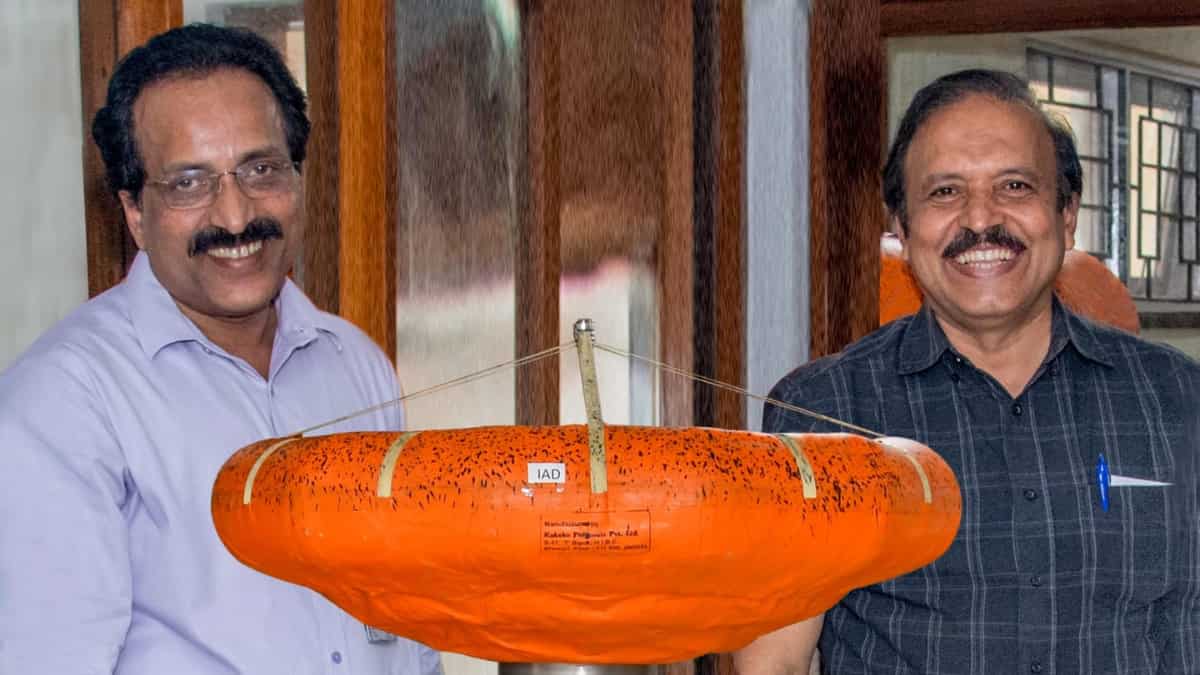
ISRO Chairman Dr S Somanath (L) & Director VSSC Dr S Unnikrishnan Nair seen with the IAD
The Indian Space Research Organization (ISRO) recently announced the successful test of a supersonic 'Inflatable Aerodynamic Decelerator' (IAD). The IAD was indigenously designed by ISRO's lead facility, the Vikram Sarabhai Space Centre(VSSC), and was realised by the Indian industry. WION spoke to Dr S. Unnikrishnan Nair, Director, VSSC, regarding the significance of this test; what went into the making, and the potential this technology holds.
Traditionally, rocket scientists think of ways and means to have their rockets travel faster and do so more efficiently. However, when it comes to performing interplanetary missions and recovering spent rocket stages(re-usability), it is crucial to slow down a rocket/spacecraft. The rocket stages that are re-entering earth's atmosphere travel at supersonic speeds and spacecraft entering other planets travel at hypersonic speeds.
The commonly used technology to slow down a descending spacecraft/rocket is the firing of a retro-rocket. Simply put, when a rocket is on the ground its engines are fired to lift it off and it functions like a typical rocket. In the case of re-entry, the rocket is travelling at high speeds owing to the energy added by its propulsion system and gravitational pull on its mass.

So, the same engines used for lift-off are fired again to slow it down to a suitable speed for landing. The IAD aims to do something similar without firing rocket engines. It just uses friction or aerodynamic drag.
"IAD is an inflatable structure made of kevlar fabric, coated with Polychloroprene. As the IAD is made of fabric, it can be packed into a small volume of 15litres and can be packed into the nosecone of RH300 rocket (which was used for the test). Once the test rocket reaches an altitude of about 84kilometre, the IAD is deployed and begins to slow down the rocket body(the component known as the payload part) as it undergoes atmospheric re-entry and finally splashes down in the sea" explained Dr Nair.
Read more:ISRO PSLV to be entirely made by industry
&imwidth=180&imheight=135&format=webp&quality=medium)
Premier League: Haaland wants Manchester City to 'try to enjoy the situation and win the game'
&imwidth=180&imheight=135&format=webp&quality=medium)
'Nidal Hasan's firing-squad execution to be livestreamed', says Pentagon; first US military execution since 1961
&imwidth=180&imheight=135&format=webp&quality=medium)
Trump's naked 23-karat gold statue unveiled near European Parliament
&imwidth=180&imheight=135&format=webp&quality=medium)
Musk doubles down on Starlink India licence allegations; Rahul Gandhi says ‘wait till...’
&imwidth=180&imheight=135&format=webp&quality=medium)
Thai Actors Fourth Nattawat, Gemini Norawit face racism accusations from Indian fans over viral Bollywood act
&imwidth=180&imheight=135&format=webp&quality=medium)
Nigeria govt rolls out 30-day NNPC petrol discount, insists it is not a subsidy
&im=FitAndFill=(700,400)&imwidth=180&imheight=135&format=webp&quality=medium)
Fastest-growing Asian economies in 2026: Who tops the chart? Where does India rank?
&imwidth=180&imheight=135&format=webp&quality=medium)
24-year-old Sri Lankan man sentenced to death for blasphemy in Saudi Arabia
&imwidth=180&imheight=135&format=webp&quality=medium)
A Love Other Than Yours: The temptation to cheat and what pushes people over the edge
&imwidth=180&imheight=135&format=webp&quality=medium)
Russia president Putin promises to 'do everything' to help settle Middle East conflict as US-Iran negotiations stall
&imwidth=180&imheight=135&format=webp&quality=medium)
‘Wait till you discover the other guy’: Rahul Gandhi takes a swipe as Musk's 'Ambani real boss of India' remark triggers X subscription cancellations
&imwidth=180&imheight=135&format=webp&quality=medium)
BTS agency HYBE announces first-ever Weverse Con Festival in India
&imwidth=180&imheight=135&format=webp&quality=medium)
Trump has a new 'enemy': Anyone who calls it 'artificial intelligence'. Here's what we wants instead
&imwidth=180&imheight=135&format=webp&quality=medium)
India at UN: Pak allows terror groups to operate from its soil
&imwidth=180&imheight=135&format=webp&quality=medium)
Air India, Air India Express increase fuel surcharge on domestic, international flights amid rising ATF costs
&imwidth=180&imheight=135&format=webp&quality=medium)
'Something truly catastrophic will happen': Former OpenAI researchers sound the alarm, claim they were fired for prioritising AI safety
&im=FitAndFill=(700,400)&imwidth=180&imheight=135&format=webp&quality=medium)
From Kramatorsk buses to Yandex fire: Russia-Ukraine war in the last 48 hours
&imwidth=180&imheight=135&format=webp&quality=medium)
Pakistan denies reports of PAF jets being used in attacks against Iran-backed Houthis in Yemen
&imwidth=180&imheight=135&format=webp&quality=medium)
New York ICE shooting sparks protests as Mamdani to call on Trump to halt ICE operations
&imwidth=180&imheight=135&format=webp&quality=medium)
Atlantic hurricane Isaias could make landfall as a strong Category 2 storm, tornado warnings issued
&imwidth=180&imheight=135&format=webp&quality=medium)
Nana Patekar's #MeToo controversy: From Tanushree Dutta’s allegations to court ruling
&imwidth=180&imheight=135&format=webp&quality=medium)
Who is Nana Patekar's wife Neelakanti? The bank officer who earned Rs 2,500 when he earned Rs 50
&imwidth=180&imheight=135&format=webp&quality=medium)
KATSEYE’s Sophia Laforteza to return in 2027 after hiatus, agency issues statement
&imwidth=180&imheight=135&format=webp&quality=medium)
French students light European bonfire, protests erupt in Belgium, Italy & Greece | Gravitas
&imwidth=180&imheight=135&format=webp&quality=medium)
France student protests: Over 500 arrested, govt promises 3,000 substitute teachers
&imwidth=180&imheight=135&format=webp&quality=medium)
Arizona congressional candidate claims she was sexually assaulted while repairing signs
&imwidth=180&imheight=135&format=webp&quality=medium)
New Cold War: Why is China buying more gold? Explained
&imwidth=180&imheight=135&format=webp&quality=medium)
OpenAI shuts down Russian, Iranian influence operations using ChatGPT to spread propaganda
&imwidth=180&imheight=135&format=webp&quality=medium)
'Understood consequences of a few mistakes': Ishan Kishan reflects on journey back to India team
&im=FitAndFill=(700,400)&imwidth=180&imheight=135&format=webp&quality=medium)
435 House seats, 35 Senate races: The numbers behind US midterms 2026
&imwidth=180&imheight=135&format=webp&quality=medium)
Zendaya gives The Odyssey white lace jacket a stylish twist at Paris Fashion Week 2026
&imwidth=180&imheight=135&format=webp&quality=medium)
SC asks Centre to frame mechanism against unethical pharma marketing practices
&imwidth=180&imheight=135&format=webp&quality=medium)
US suspends Microsoft, Infosys, Tata, Wipro from green card programme over alleged H-1B abuse
&imwidth=180&imheight=135&format=webp&quality=medium)
Trump honours Microsoft CEO Satya Nadella with top technology honour amid immigration scrutiny
&imwidth=180&imheight=135&format=webp&quality=medium)
Flydubai flight attack: Indian pilot Smit Machchhar to receive Israel's highest civilian bravery award for saving 174 lives
He added that the inflation of the IAD was carried out by compressed nitrogen gas stored in a gas bottle. Once the IAD falls into the sea, it is deflated by firing a pyro valve to prevent it from floating and thereby causing any harm to sea vehicles.
Notably, this is the first time that an IAD is designed specifically for spent stage recovery. The IAD has huge potential in a variety of space applications like recovery of spent stages of the rocket, landing payloads on Mars or Venus, and making space habitats for human space flight missions.
"This demonstration opens a gateway for cost effective spent stage recovery using the IAD technology. This technology can also be used in ISRO's future missions to Venus and Mars" said Dr S Somanath, Chairman ISRO, and Secretary DOS, who witnessed the successful launch.
Read more:Emirates Mars Mission discovers new 'patchy' Proton Aurora on the red planet
Queried about the scalability of the IAD and the possibility of guided landings, Dr Nair said that it can be scaled up to recover even a spent rocket stage.
"It can be used to systematically decelerate a re-entering vehicle by gradually inflating the decelerator. As such, the IAD is not guided. For sea landing precise guidance is not a must. By suitably sizing the IAD, the need for a retro rocket can be avoided for spent stages of vehicle first stage, where energy of spent stage is comparatively less." said Dr Nair before adding that we are yet to do a scaled-up design.
WATCH WION LIVE HERE:
