'Hello from the other side': NASA's Voyager 1 faces glitch in interstellar space, can't call back home

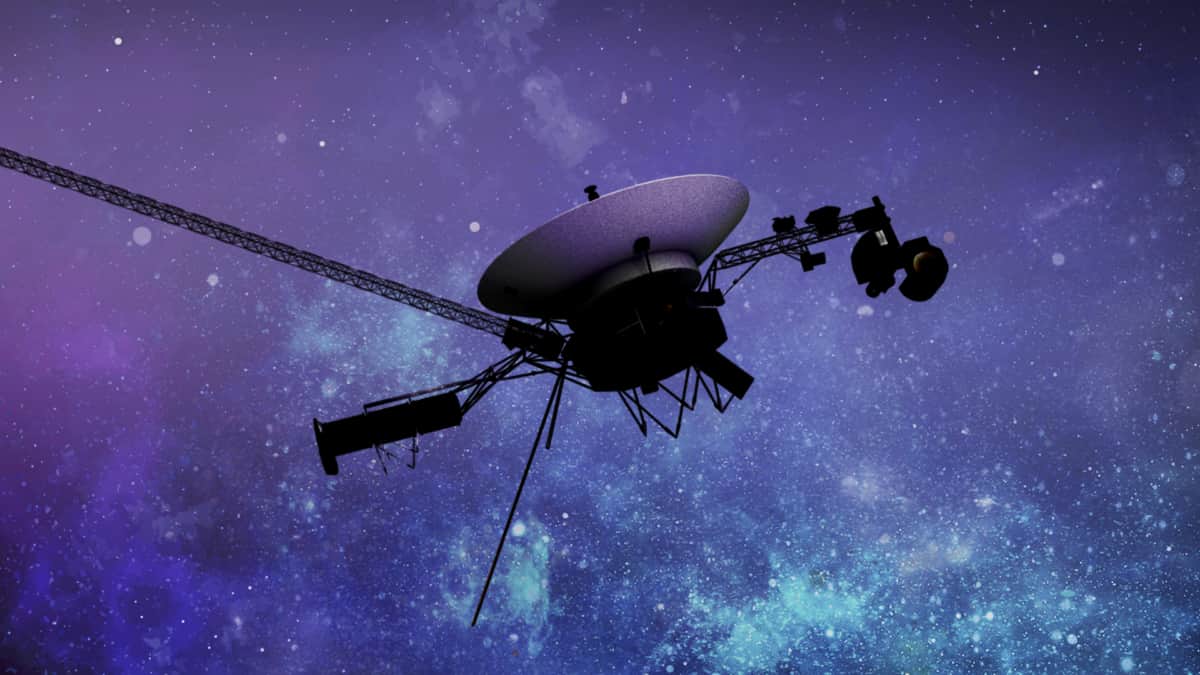
NASA's Voyager 1
The National Aeronautics and Space Administration (NASA) launched the space probe Voyager 1 in 1977 to study the outer Solar System, the interstellar space beyond the Sun's heliosphere.
No spacecraft has travelled as far as Voyager 1, which is still collecting data. But sadly, it is unable to dial back home because of a glitch.
The spacecraft and its twin, Voyager 2, are the two longest-operating spacecraft in history. It's like a cosmic version of a song by Adele when she sang 'Hello from the other side. I must've called a thousand times...'

Also read:NASA's Perseverance rover decodes Martian lake's ancient history after spending 1000 Martian days
In a blog post, NASA wrote that engineers and other experts are working to resolve an issue with one of Voyager 1's three onboard computers, called the flight data system (FDS).
When it works properly, the FDS works on compiling information into a data package. It collects data from the science instruments as well as engineering data about the health and status of the spacecraft.
)
Justice eludes Air India 1985 bombing victims as Canada probe goes 'inactive' | Gravitas
)
Trump revives India-Middle East-Europe economic corridor as India emerges central to West Asia’s future: What is it?
)
Erdogan again raises Kashmir issue at UNGA, calls for dialogue under UN Charter
)
'Our team opened the gate of gold medals': Harmanpreet Kaur on India’s Asian Games final win
)
Four decades after leaving Kolkata, the Birlas may be coming back for more
)
The Verdict | Moral policing isn’t culture or discipline, it’s crime
)
Trump signs Greenland security deal with Denmark, paving way for two new US military bases
)
Trump-Xi summit: From trade to Taiwan, what will the US and Chinese presidents discuss in Washington?
)
Cyclone Arnab: Landfall expected before midnight tomorrow as IMD issues orange alerts across six states
)
Glitch in the matrix caught on camera: Woman vanishes after talking to reporter
)
Rani Mukerji's mother Krishna Mukerji passes away; Karan Johar, Jaideep Ahlawat visit actress
)
Asian Games 2026: India women's cricket team beats Sri Lanka by 147 runs for first gold
)
ICC plans T20I expansion and fewer ODIs in 2027–2031 FTP cycle: Report
)
Key accused in Bihar's Jamui molestation case, arrested after police shoot him in leg
)
'Mumma’s boy from Gwalior who dared to dream': Kartik Aaryan pens long note after first National Award win
)
Gravitas | Boosting NHS productivity could save 20,600 lives in UK annually: Report
)
US and China vie for AI dominance as calls grow for regulation | Gravitas
)
Yemen clashes kill 154 people in two days as cornered Saudi battles Houthi offensive | Gravitas
72nd National Film Awards: Kartik Aaryan receives Best Actor honour for Chandu Champion in Gujarat
)
Bomb scare in New York amid UNGA: Suspicious suitcase found near UN headquarters
)
IND vs JPN, one-off T20I: Japan captain Kendel on pushing India to the brink - ‘It was special’
)
Raaka creates history! Allu Arjun’s film secures Guinness World Record ahead of release
)
Saudi Arabia exits China-led mBridge digital currency platform amid Saudi-Houthi conflict
)
WION Iconic Tourism Summit and Awards 2026: Key voices to discuss India’s tourism future
)
World leaders repeatedly call Gaza crisis ‘genocide’ as Israel’s war dominates opening sessions of UNGA
)
WION Iconic Tourism Summit and Iconic Awards 2026: India's travel economy leaders gather in Delhi
)
American manufacturing is reshoring faster than its factory floors can absorb
&im=FitAndFill=(700,400))
New OTT releases this week (September 21-27, 2026): Shaque: Trust No One, Hunkkaar, Don’t Be Shy- 5 new titles coming to Netflix, Prime Video and more
)
Trump calls on nations to quit ‘rogue’ and ‘out-of-control’ International Criminal Court, rips UN
)
Who is Clavicular? The 20-year-old controversial 'Looksmaxxing' influencer charged with rape allegations
)
'This is normally what toddlers do': Why a psychiatrist is raising fresh questions about Trump’s recent behaviour
&im=FitAndFill=(700,400))
National Film Awards 2026: Kartik Aaryan, Mammootty, Yami Gautam, Randeep Hooda and other key winners
)
‘Strike a deal or drive Iran into hell’: Trump issues fresh warning to Tehran at UNGA
)
Over 4,200 books withdrawn from circulation in J&K colleges, 94% from Kashmir
)
Explainer: Why rare-earth export licences and Board of Trade are US priorities ahead of Trump-Xi summit
)
Oil slips to $98 as Saudi Arabia restarts East-West oil pipeline
)
‘Shame on you’: Netanyahu vows to ‘tell the truth’ about Mamdani at UN ahead of New York visit
Once compiled, the data is then transmitted back to Earth using the telecommunications unit (TMU).
The blog post said that the spacecraft is receiving and executing commands sent from Earth; however, the FDS is not communicating properly with one of the probe's subsystems, called the TMU. As a result, no science or engineering data is being sent back to Earth.
It said that the 46-year-old spacecraft is capable of receiving commands, but a fault appears to have occurred with the probe's processors.
NASA said that the data is in the form of ones and zeros (or binary code). "Varying combinations of the two numbers are the basis of all computer language," it said.
When the issue will be resolved?
As per the NASA blog post, it could take several weeks for engineers to develop a new plan to remedy the issue.
Finding solutions to problems encountered by the probes requires reading original, decades-old materials written by engineers. It is assumed that the experts may not even anticipate the issue faced by the probe today.
"As a result, it takes time for the team to understand how a new command will affect the spacecraft’s operations in order to avoid unintended consequences," NASA said.