Giant kangaroos didn't hop on two legs, they walked on all fours in Australia

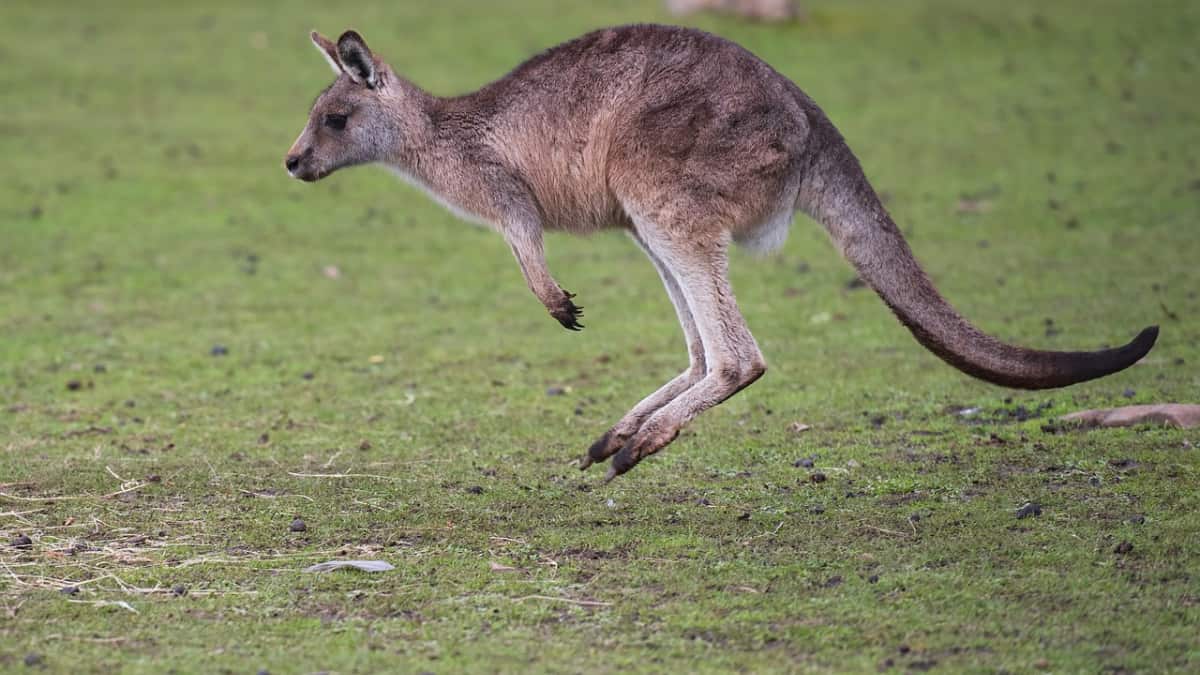
Image of hopping kangaroo in Australia.
In an intriguing study, it has been found that the kangaroos in ancient times did not hop on two legs but walked on all fours when they roamed the prehistoric landscapes of Australia.
These mammoth“giant wallaby” kangaroos were ancestors of today's kangaroos and were not agile and bounding like them.
In the research, it was found that such contemporary kangaroos' extinct relatives travelled in quite a different way.

Also Read:Largest animal on Earth spotted in Massachusetts in rare sighting
The ancestors of modern-day kangaroos were called Protemnodon which exhibited different kinds of locomotion techniques which emphasised the diverse evolutionary history of marsupials.
All about giant wallaby kangaroos
)
Asian Games 2026: India face Afghanistan in quarterfinal on Sep 28; Pakistan clash with Hong Kong
)
Myanmar training camp case: US national, 6 Ukrainians allowed to meet their families abroad
)
Bigg Boss 20: Salman Khan schools Rhiti Tiwari over Qazi Touqeer clash, compares her to Dolly Bindra
)
Mushtaq Khan dies at 56: When Welcome actor opened up about his salary for iconic role Ballu
)
LPU students go on rampage, vandalise campus amid widespread protest: What's happening
)
'FIRST LOOK from inside Noah’s Ark': Researchers share video from inside mysterious mound in Turkey
)
‘Attack on Mecca a red line for Pakistan’: Shehbaz Sharif warns Houthis at UN
)
Pakistan deploys over 20,000 security personnel as PTI vows march for Imran Khan's release
)
OpenAI AI Agents hacked 4 websites before Hugging Face, researchers reveal
)
'A terrorist country is asking me that question?': Jaishankar hits back at Pakistani journalist at UN; flags attacks on commercial shipping
)
Trump-Xi summit wrap: Big pageantry, Iran talks, few major developments and more meetings planned
)
Did Hitler kill his niece Geli Raubal? Newly found records reopen a 95-year-old mystery
)
Hawaii braces for Hurricane Nolo: NOAA warns of flash flooding and mudslides
)
'What kind of confession is this?': Pakistan PM Shehbaz Sharif’s 'terrorists would be roaming New York' remark goes viral, raises alarm online. Watch
)
US-Iran war: Trump rejects Iran's Hormuz proposal, reports suggest talks expected next week
)
Bollywood x K-pop crossover! LE SSERAFIM’s Kazuha charms fans with Shah Rukh Khan’s ‘Chammak Challo’ steps
)
Gaza's war turned environmental damage into second crisis
)
‘Serial practitioner of terrorism’: Jaishankar calls out Pakistan’s ‘state-sponsored’ terror at UNGA
)
‘It is all possible’: Putin weighs next steps on Ukraine talks, rules out Europe conflict
)
Prince Harry offers rare glimpse into Archie and Lilibet’s life after UK move
)
Nigeria Navy moves to boost oil security, tackle crude theft and infrastructure threats
)
Donald Trump shares image of Xi's arrival in Washington, carries signs of AI
)
Pentagon quietly adds 37 wounded troops to Iran war tally without explaining when or how
)
US court backs Pentagon's decision to exclude Anthropic over Claude AI restrictions
)
US Supreme Court backs Trump administration's use of SAVE database to check voter citizenship
)
‘Could kill billions...’: Bill Gates backs calls to slow AI development amid fears of catastrophe
)
'Countries far from conflict are penalised': Jaishankar calls for Gulf peace, seafarer safety at UN
)
WATCH | As Shehbaz Sharif claims Pakistan’s ‘victory’ during 2025 conflict, Indian diplomat R Srinivas laughs at UN
)
Outrage erupts after 3-year-old is married to 60-year-old man in Pakistan, link to her sister's murder being probed
&im=FitAndFill=(700,400))
New Friday OTT releases (September 25, 2026): Don’t Be Shy, Hunkkaar: The Roar, Mango Pachcha- 6 movies and TV shows on Netflix, Prime Video and more
)
Global community 'absent' in Gulf crisis: Saudi at UN calls for freedom of navigation, pre war status for Hormuz
)
Farhan, who went viral for AK47 celebration vs India in Asia Cup, hopes to lead Pakistan beyond Asian Games
)
‘I rejected it’: Trump confirms turning down Iran’s proposal to reopen Hormuz, claims Tehran is losing ‘badly’
)
Russia will achieve Ukraine war aims; Europe doing everything to block peace talks: Lavrov at UN
The extinct kangaroo species, called Protemnodon, was a giant wallaby which existed in the Pleistocene era. This era lasted between two and a half million to ten thousand years ago.
In comparison to modern kangaroos, these predecessors were far larger, however, they were not really hopping around, as per the latest study.
Ancient kangaroos walked on four legs: Study
It was earlier believed that even though they had large sizes, the ancient kangaroos hopped in a similar way to their descendants.
In anew study, conducted by a team of researchers, ithas been found that these mega-marsupials were actually quadrupedal, which means they preferred to walk on all four legs.
University of Bristol's former master's student Billie Jones had earlier said that the giant wallaby has chances of being a quadrupedal.
The suggested theory was confirmed by the research team after they took a quantitative look at the animal's limb proportions.
Watch:Finger found in Ice Cream, followed by disturbing animal find in deliveries
The scientists found that the limb proportions of Protemnodon were not like any other living kangaroos. It's short feet were one of the main reasons why it was believed Protemnodon was a quadrupedal creature.
“There had been some speculation in a graduate thesis from the University of Uppsala that it might have been more quadrupedal in its habits compared to living kangaroos,” said Jones, the study's lead author.
“This new paper draws on a couple of previous quantitative studies that looked at the anatomy of the humerus (upper arm bone) in a diversity of mammals, and concluded thatProtemnodonhabitually put more weight on its forelimbs than kangaroos today," he added.
(With inputs from agencies)