Did space flight instructions exist in the 16th century? Historians discover...

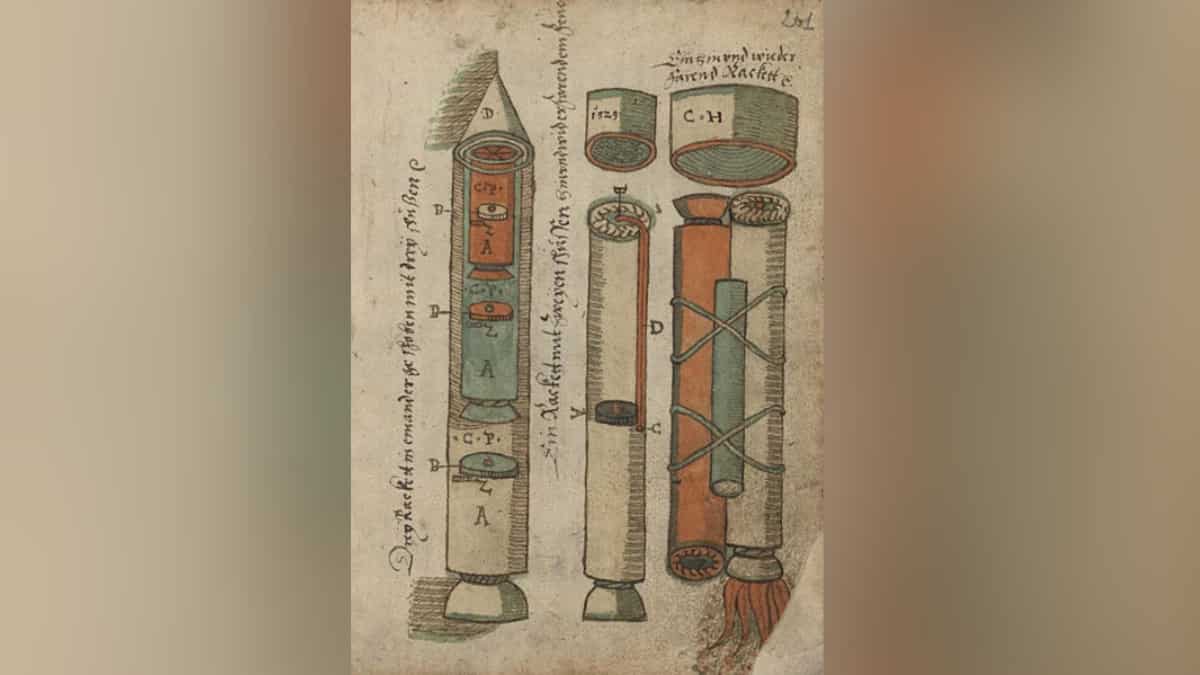
The illustration of a rocket by Conrad Haas. (Courtesy: Wikipedia)
In an unbelievable find, historians stumbled upon a document of space flight instructions which was said to belong to the 16th century.
According to historians, Austrian military engineer Conrad Haas had written the Sibiu Manuscript in the 16th century.
Haas lived from 1509 to 1576 and was always ahead of his time. He has been credited as the first person to documentthe theories related to multi-stage rockets.

The 450-page document was originally written in German and has detailed mentions of artillery and ballistics.
Also Read:Mayan city with buildings and plazas hiding in plain sight has only now been found
Historians have verified the document; however, very few people are aware of its existence. In the document, Haas talked about rocket science, including weapons and fireworks.
)
Pentagon revives mandatory testosterone testing for male troops aged 30 and above
)
FACT CHECK: Why did PM Modi ask Xi ‘is it okay’ at BRICS Summit? New video reveals...
)
India seeks to build a full semiconductor supply chain
&im=FitAndFill=(700,400))
From Abhishek Sharma to Sahil Chauhan, 5 batters with fastest T20I hundreds
)
Pyongyang dismisses US, western pressure over nuclear programme
)
US And Denmark reach Greenland deal, Trump announces expanded military presence
)
Google’s Gemini AI hacks real systems by guessing passwords during security test
)
US hiding troop deaths in Iran war? Toll higher than Pentagon count, claims report
)
China may have gained access to US's classified F-35 jets; parts meant for repairs diverted to Hong Kong, sparking Pentagon inquiry
)
NASA research plane reaches 61,000 feet over Panama
)
Godfather of AI Geoffrey Hinton gives US lawmakers a one-year warning on AI
)
Trump signs Russia sanctions law: India faces fresh 100% tariff threat over Russian oil
)
Brigitte Bardot’s private collection set for Paris auction; key items and prices revealed
)
Why Ranveer Singh’s Dhurandhar missed India’s Oscar entry; FFI jury member reveals what happened
)
Zendaya and Tom Holland step out for a low-key date in Los Angeles
)
‘Will go to any extent’: Pakistan vows to defend Saudi Arabia amid Houthi attacks
)
The Verdict | When precision fails: US commits war crime in Minab school strike, UN finds
)
Trump signs Russia sanctions bill into law, targets Moscow’s energy sector
66 years of the Indus Waters Treaty: How India and Pakistan settled a bitter river dispute
&im=FitAndFill=(700,400))
New Friday OTT releases (September 18, 2026): Lust Stories 3, You+Me, Best of the Best- 8 new titles coming on Netflix, Prime Video and more
)
Pak: A series of counter terrorism operations in Khyber Pakhtunkhwa
)
Fast bowler Brydon Carse faces no charges over Derby nightclub incident
)
Flying cars in UAE: Ras Al Khaimah signs deal with Chinese company to test new transport
)
Africa is splitting, and a lot sooner than estimated, giving way to a new ocean
)
Trump bans CNN, MS NOW and Politico from White House over ‘FAKE NEWS’
)
Trump 2.0: Dark days ahead for America’s ‘imperial presidency’
)
Trump's Greenland dream comes true? POTUS announces 'Infinite Life' deal with Denmark, claims permanent US control
)
Tirupati Laddu ghee adulterated with chemicals, says ED, supplier arrested
)
Who is Khalilur Rahman? All you need to know about 81st UN General Assembly President
)
IIT Bombay student dies by suicide, was caught seeking AI help during exams
&im=FitAndFill=(700,400))
Meet top 5 bowlers in latest ICC T20I rankings
)
Indian Cinema bets big on mythology, brings ancient stories to modern audiences
)
Ukraine plans record $109 bn defence spending, nearly two thirds of budget amid Russia war
)
Russia holds first parliamentary elections since the beginning of the Ukraine war
&im=FitAndFill=(700,400))
Meet top 5 Indian batters with fastest T20I centuries
)
How was the manuscript discovered?
In 1961, Professor Doru Todericiu of Science and Technology at the University of Bucharest discovered the manuscript of Haas in the State Archives of Sibiu and this is how the document got its name.
In the Sibiu Manuscript, the illustrations were very accurate and the plans regarding the multi-stage rockets created by Haas were very advanced for the 16th century.
In the manuscript, a cylinder-shaped thrust chamber is illustrated, which is filled with powder fuel and has a conical hole for increasing the combustion area gradually.
Before the historians found the Sibiu Manuscript, it was believed that Kazimierz Siemienowicz wrote the first detailed description of the three-stage rocket.
Kazimierz Siemienowicz was born in the Raseiniai region of the Grand Duchy of Lithuania and served in the armies of the Polish-Lithuanian Commonwealth.
Also Read:Female 'vampire' padlocked inside grave with sickle at neck 350 years ago: Archaeologists
In 1650, he wrote a treatise, Artis Magnae Artilleriae, which discussed rocketry and pyrotechnics.
Haas also wrote a warning regarding the military use of rockets in the manuscript.
The warning's English translation read, “But my advice is for more peace and no war, leaving the rifles calmly in storage, so the bullet is not fired, the gunpowder is not burned or wet, so the prince keeps his money, the arsenal master his life; that is the advice Conrad Haas gives.”
The document is an accurate example of how humans advanced in the realm of science and technology.
(With inputs from agencies)