Captured in style! SpaceX's dying Falcon 9 rocket appeared as 'dashed' line of a luminous streak

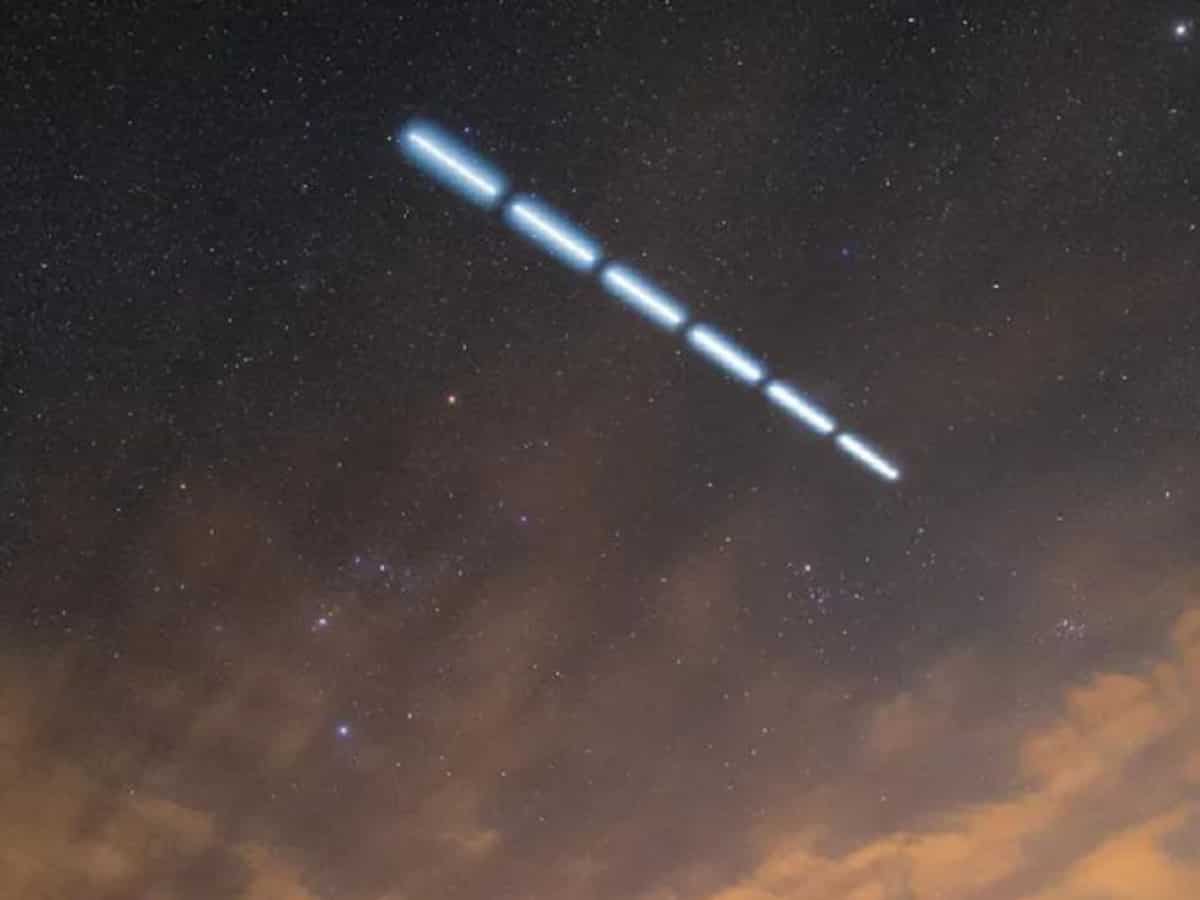
Dying Falcon 9 rocket captured by Jeremy Perez
Elon Musk’s SpaceX is on a rocket launching spree with dozens of rockets being launched in the past week over the skies of the United States. In one such occurrence, a fascinatingphoto of a rocket’s trail while falling back to Earth was captured in the night sky over Arizona.
With some clever photo tricks, the rocket’s trail in the sky looked like a perfect dashed line of luminous streak, a treat to the eyes.
On Saturday (Mar 30), SpaceX launched two of their Falcon 9 rockets in less than four hours, as reported by Space.com. Both the rockets were carrying Starlink satellites. The first rocket was launched at 5:52 EDT from NASA’s Kennedy Space Center in Florida and another took off at 9:30 pm EDT from Cape Canaveral Space Force Center.

Also Read |Universe to pose for humans? World's biggest 3.2bn pixels camera will capture cosmic marvels
After the launch, rockets deploy their payloads and start for their second phase, in which the main part of the rocket separates from its reusable boosters. During this stage, the rockets went in a controlled deorbit burn, which caused them to fall back toward Earth and burn up in the planet’s upper atmosphere.
It was at this moment that photographer Jeremy Perez was ready with his camera to capture the deorbit burns. Though he missed the fall of the first rocket as it was heavily clouded in Arizona at that time, he managed to capture the second rocket. As the second rocket started its manoeuvre, Perez captured this stunning image of the deorbiting debris (as sent to Spaceweather.com).
)
What’s in a name? Trump’s 'Lake America' move gets a tit-for-tat response from Canada
)
‘Not just a local tragedy’: Nepal PM Shah warns UN of growing climate threat, says Nepal floods were 'a warning to the world'
)
CNN, Politico and MS NOW back in White House after judge blocks Trump’s media ban
)
US judge questions Trump’s decision to ban CNN, MS NOW and Politico from White House
)
Italy hit by floods in the north, drought in the south
)
'We would all be dead': Netanyahu defends decision to strike Iran's nuclear facilities in his UN speech
)
Mumbai Indians appoint Luke Williams as head coach for Women’s Premier League
)
'There will be elections': Venezuela's interim leader Delcy Rodriguez makes big announcement at UN
)
IIT Bombay CCTV footage emerges: Sahil Wakode seen looking at phone in examination hall
)
Cyclone Arnab: Landfall expected before midnight tomorrow as IMD issues orange alerts across six states
)
Welcome actor Mushtaq Khan dies at 56 after battling cancer
)
Trump's welcome to Xi demonstrates 'attraction' to dictators: Chuck Schumer
)
WION Iconic Tourism Summit 2026: Union Minister Shekhawat on 'experiential travel', peace diplomacy
)
Property registration becomes faster, convenient as model sub-registrar offices open in Maharashtra
)
'AI got into my speech': Prince Harry jokes after teleprompter failure at event in New York
)
Scientists detect first radio signals directly from faraway planet
)
What’s on the menu? Inside Trump’s lavish White House state dinner for Xi
)
China to test supersonic jet that moves at Mach 2, double the speed of sound
)
Xi Jinping's 'special plane' vs Trump's Air Force One: What's the difference?
)
Forget the smartphone: This tiny gadget could be Meta’s answer to the post-smartphone era
)
'Partners rather than rivals': Xi Jinping's first message after landing in US for Trump summit
)
Yemen called Trump for US military support in fight against Houthis: Official
)
WION Iconic Tourism Summit: Is India's travel boom outrunning its airports, airlines and hotels?
)
2,000-foot tube, laser tests and more: China builds towns to expand nuclear arsenal, satellite images show
)
Meet Adrian Abraham: 9-year-old Indian-origin guitar prodigy aiming for a Guinness World Record
)
US faces fresh cost crunch as mortgage rates hit 7%, oil tops $107 and gas prices surge
)
Winter coat, gloves in September? Trump’s Xi welcome sparks social media buzz
)
Trump-Xi state dinner 2026: Who is invited? Full guest list of tech CEOs, business leaders and officials
)
'Making history': Xi Jinping praises Trump as US-China leaders dine at White House
)
Australian PM Anthony Albanese calls OpenAI AI incident 'unacceptable' after restricted data access
)
'What kind of confession is this?': Pakistan PM Shehbaz Sharif’s 'terrorists would be roaming New York' remark goes viral, raises alarm online. Watch
&im=FitAndFill=(700,400))
Netanyahu at UN: Mass walkout, attack on Mamdani and Iran threats | In Pics
)
Russia likely to target Spain, France and Italy in drone attacks, warns CIA: Report
)
WION Iconic Tourism Summit: How local tourism MSMEs must upskill for AI integration
)
Trump’s Board of Peace unveils $2.45bn Gaza plan,66 projects: But where’s the money?
)
EC appointment law: Why is the 2023 act controversial, and what happens next? WION explains
)
Who is Lt-Gen Nauman Mahmood, Pakistan's first secretary general of Makkah Defence Alliance?
)
Israeli envoy to US Yechiel Leiter’s son critically injured in West Bank ramming attack
)
'Fund people, not bombs': Hundreds take to New York streets as Netanyahu delivers speech at UN; dozens arrested
)
WATCH | China President Xi Jinping lands in US as Trump greets him ahead of high-stakes summit
)
US spy satellite from Cold War shatters 775 km above Earth
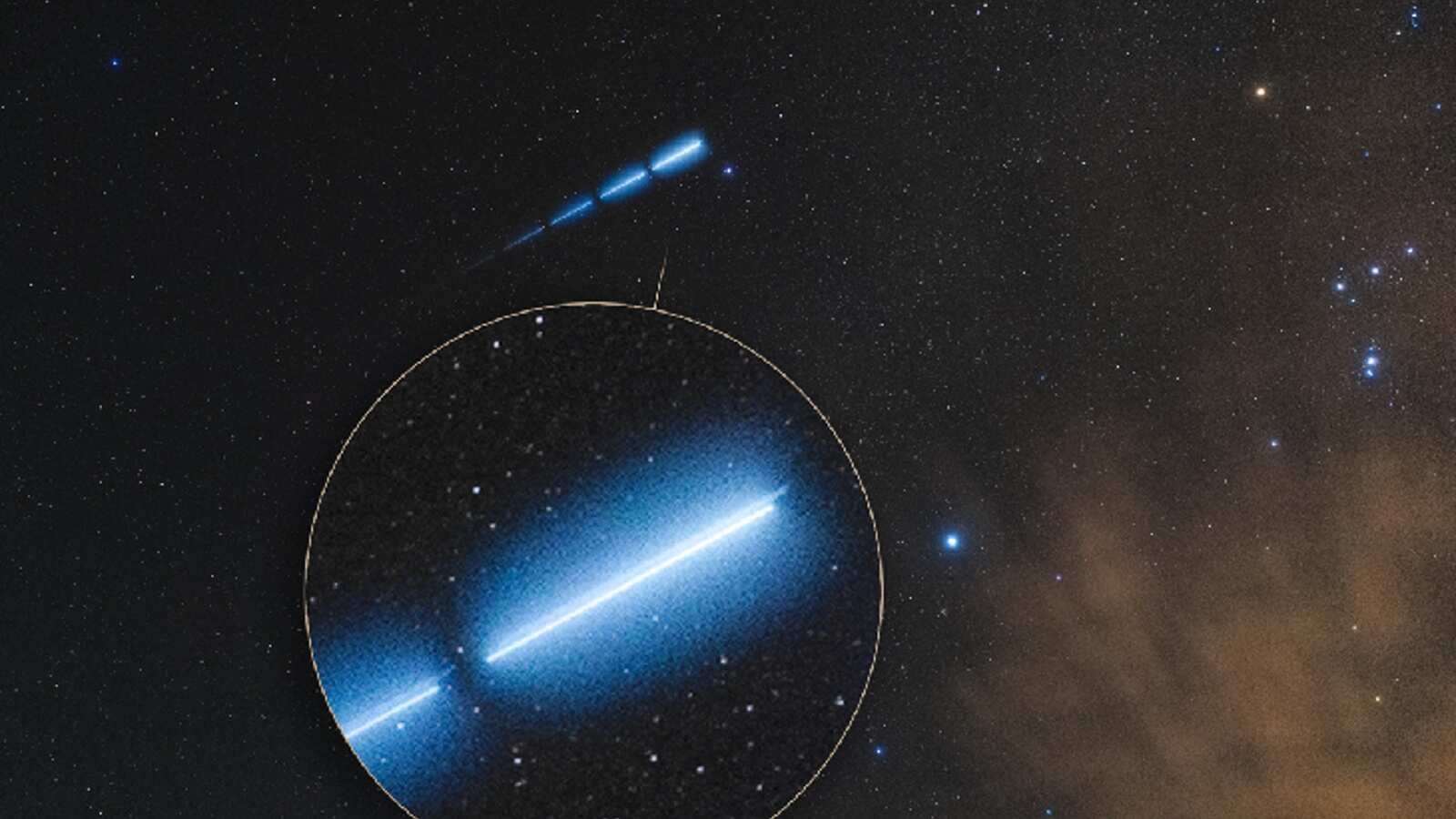
Dashed lines of a luminous streak captured in the sky
In the image, as you can see, a dashed continuous line of luminous streak can be seen. This was not how the rocket looked in reality, but Perez’s multiple long-exposure shots of the ignited second stage made them look like this. The breaks seen in the luminous streak are the points where the camera’s shutter was closed.
In real-time, the appearance was somewhat different. "It looked like a delicate, cometary dandelion poof drifting overhead," Perez told Spaceweather.com. The light also appeared white in real-time instead of the bright blues seen in the photos, he added.
Also Read |James Webb captures creation of 'third world' and birth of moons 400 light-years away
If you zoom in close enough, you can also see a second simmer line alongside the falling space junk. This streak is made up of light from the satellites developed by the rocket, which were drifting alongside it before it started its final manoeuvre.
With SpaceX’s back-to-back launches in the recent past, these visuals are becoming a common sight for people in the States. Some people have also spotted SpaceX spirals, which are swirls of light created by the frozen rocket fuel ejected from one of the deorbiting Falcon 9 boosters.
(With inputs from agencies)