
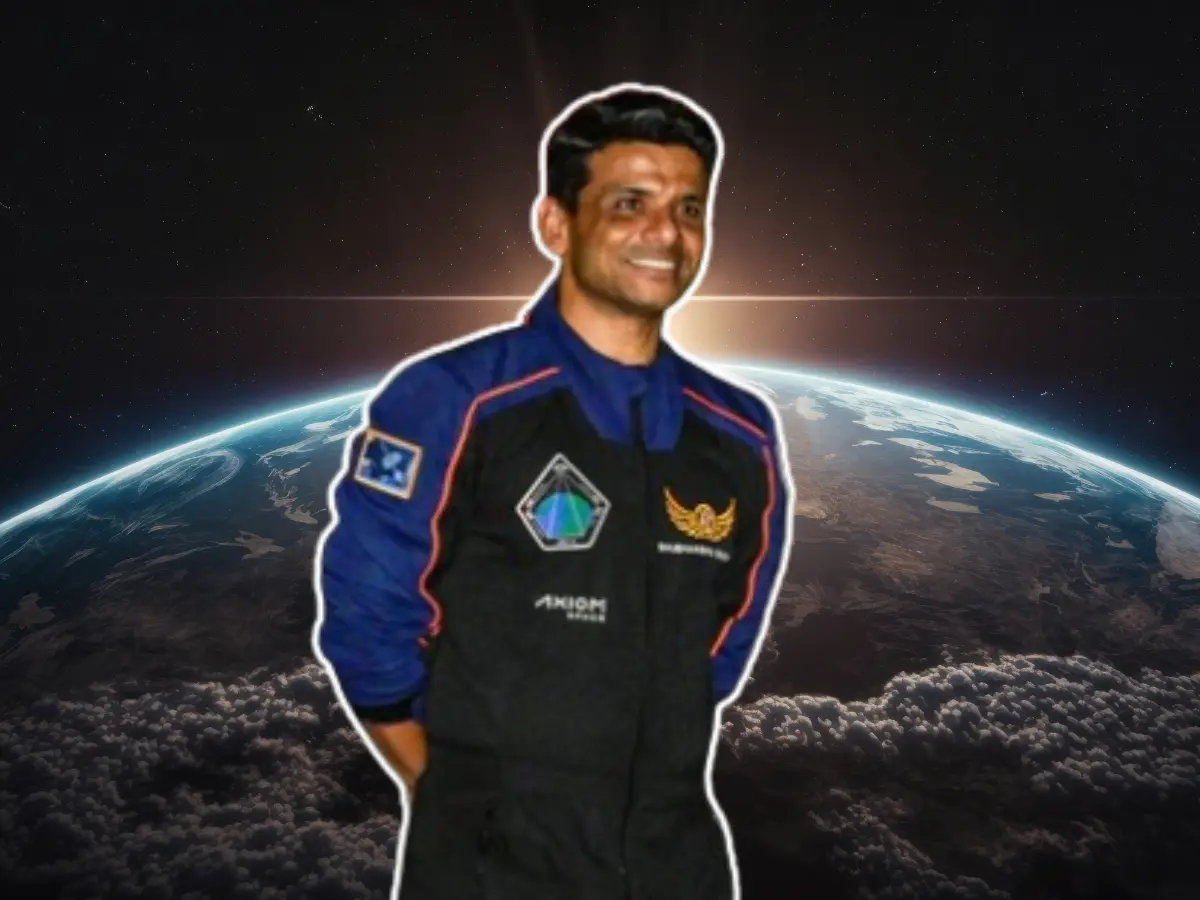
&imwidth=800&imheight=600&format=webp&quality=medium "Breaking barriers in orbit: Indian astronaut Shubhanshu Shukla redefines space travel for diabetics")
Indian astronaut Shubhanshu Shukla is currently taking part in a historic mission on the International Space Station (ISS) as part of Axiom Mission 4 (Ax-4). He is involved in more than 60 scientific experiments, including one that could change the way we understand and treat diabetes—not just for astronauts in space, but also for people on Earth.
For a long time, people who rely on insulin to manage diabetes were not allowed to go on space missions. This is because it’s very hard to control blood sugar levels in space, where there is no gravity. But now, the Ax-4 mission is challenging that idea and exploring new ways to make space travel possible for them too.
People with insulin-dependent diabetes are usually not allowed on the International Space Station (ISS) because space travel causes major changes in the human body. In zero gravity, food digests differently, insulin may not work the same way, and blood sugar becomes harder to control. Muscles weaken and shrink in space due to lack of gravity, which reduces physical activity—this also affects how the body uses insulin. Even healthy astronauts sometimes show signs of pre-diabetes during long missions because of these changes. Stress, disrupted sleep, and hormonal shifts in space can also push sugar levels up or down. Since there’s no full-time doctor onboard and emergency help is far away, it’s too risky to send someone who needs regular insulin—unless better ways to manage diabetes in space are developed.

The 'Suite Ride' project: A move toward greater inclusion
One of the main highlights of the Ax-4 mission is a study called "Suite Ride," which focuses on how the body handles glucose (sugar) in space.
The goal is to make it safer for people with diabetes to live and work in space one day.
Trending Stories
&im=FitAndFill=(700,400))
National Handloom Day 2026: From Alia Bhatt to Samantha Ruth Prabhu; Actresses who celebrated India's textile heritage as brides
)
The Royals enter the Doctor Who universe: King Charles and Queen Camilla beam into Commonwealth Games in TARDIS
)
Unitree Robotics targets $9 billion valuation in landmark IPO backed by DeepSeek and Tencent
)
India names 27 sites in Arunachal Pradesh
)
Bharat Bhhagya Viddhaata OTT: When will Kangana Ranaut's film stream online?
&im=FitAndFill=(700,400))
How many soldiers operate one S-400 battery?
)
Shakib Al Hasan ready to return to Bangladesh—under one condition
)
‘Fake news’: MEA rejects report claiming India sought defence pact with Israel after Pakistan, Saudi Arabia, Turkey deal
)
Rockstar to unveil GTA 6 extended look ahead of November launch
)
Russia forms Ukrainian Volunteer Spetsnaz Brigade to fight Ukraine
)
Drug-resistant fungus that hides in hair and enters bloodstream reported in 23 US states
)
Technology transfer deal boosts India's defence manufacturing ambitions
)
Border row erupts in Europe after Ceuta crossings, Spain imposes border controls on Italy
)
Morale plummets on USS Abraham Lincoln: Are US sailors reaching a breaking point? | GRAVITAS
)
'Security can't be bought with Pakistan, Turkey deal': Iran tells Saudi Arabia
)
Baba Vanga's 2026 prophecy: 2 predictions 'already came true', 3 terrifying ones remain. Details inside
)
Colombia’s new president Abelardo de la Espriella vows to ‘defeat narco-terrorists’, signals hardline shift
&im=FitAndFill=(700,400))
New Friday OTT releases (August 7, 2026): Operation Safed Sagar, Vadhandhi, Main Vaapis Aaunga- 6 movies and TV shows on Netflix, Prime Video and more
)
Squadron Leader Bhawana Kanth scripts history as Indian Air Force gets its first woman ‘Top Gun’ pilot
)
RSS says Gen Z protests reflect genuine distress
)
Trump says Iranian school bombing photos could be AI-generated - 'I don’t think...'
)
IAF officer held for sharing sensitive information in 'honey trap' case, booked under Official Secrets Act
)
Stray Kids under scrutiny? Fans react to Grammy submission silence after BTS boycott
&im=FitAndFill=(700,400))
Why the Su-30MKI doesn't need external fuel tanks to fly vast distances
)
Jugal Hansraj reunites with Shekhar Kapur after 40 years for Masoom: The Next Generation
)
New speed limits, automatic challans: Big traffic change coming to Delhi-Meerut Expressway. All you need to know
)
India officially names 27 places in Arunachal to counter China's renaming claims
)
Trump calls White House ballroom ruling a 'national disgrace' as court says Congress approval needed
)
US sanctions Iran’s crypto network after Strait of Hormuz attacks, offers $15m bounty for intel on IRGC finance
&im=FitAndFill=(700,400))
Why the Su-30MKI is one of the heaviest fighters ever built
)
Uttarakhand young innovator builds India's own flying vehicle, conducts first test flight: WATCH
)
Chilling video shows students take cover as teen opens fire at Thai school
)
Reese Witherspoon's father hospitalised after poolside incident in Nashville: Report
Speaking to IndiaToday.in, Dr Mohammad Fityan, Clinical Lead for the Suite Ride project from Burjeel Holdings, said the study will also improve our understanding of diabetes and other conditions linked to blood sugar.
Burjeel Holdings, which is working on this research, has teamed up with Axiom Space to find out how insulin and Continuous Glucose Monitors (CGMs) work in space. These devices are already changing how diabetes is managed on Earth, and now the study wants to see if they can be safely used in space too.
Why space could change the way we study diabetes
In space, the absence of gravity gives scientists a unique chance to study how the human body works without the usual pressure from Earth's gravity. This helps them look at how the body processes sugar (glucose) in a completely new way.
Dr. Fityan explained to IndiaToday.in that in microgravity, changes in muscle size, body fluids, and sleep patterns help reveal how insulin works in the body. This could lead to discovering new signs of insulin resistance and finding better ways to manage diabetes.
By observing how healthy people’s bodies respond in space, scientists can learn how diabetes might behave in the same conditions. This is an important first step in making space travel safer for people who have long-term health conditions like diabetes.
How the study is being done on the ISS
During the two-week mission, one or more astronauts are using Continuous Glucose Monitors (CGMs) the whole time. These small devices keep track of their blood sugar levels all day and night and send the information back to scientists on Earth for study.
Dr. Fityan explained that one or more astronauts are wearing Continuous Glucose Monitors (CGMs) throughout the mission. These devices constantly check blood sugar levels, and the data is being collected for research. Although insulin pens were sent along, astronauts are not using them—they are only being tested to see if insulin remains stable and effective in space. Blood samples are also being taken during the mission to double-check glucose readings. Burjeel Holdings provided the medical tools needed, like lancets, needles, and a device called i-STAT that checks blood sugar on the spot.
Breaking Barriers for Diabetics in Space
Dr Fityan shared the main reasons why people with diabetes are not yet allowed to go to space:
Blood sugar levels can quickly change in space, and if they drop too low, it can be life-threatening—especially since there’s no quick medical help available.
Storing and using diabetes medicine in space is hard because of temperature changes, body fluid shifts, and the way medicine is absorbed in zero gravity.
Keeping blood sugar under perfect control for a long time is very difficult during space missions.
The Ax-4 mission is helping scientists learn how a healthy body handles sugar in space and whether Continuous Glucose Monitors (CGMs) can be safely used by astronauts with diabetes in the future.
Improving Diabetes Care on Earth
The Ax-4 mission isn't just about helping future astronauts—it could also bring big benefits to people living on Earth, especially those in remote or low-resource areas.
This research could lead to:
- New ways to track sugar levels from a distance in real-time.
- Better glucose monitors that work well in tough conditions.
- Smart systems using AI to help manage diabetes more personally.
- New medicines to make the body respond better to insulin.
Speaking to IndiaToday.in, Dr. Fityan said this study aims to make space travel possible for people with long-term health issues like insulin-dependent diabetes—not by lowering safety rules, but by developing the right tools and systems to support them safely.
What’s Coming Next?
After the mission ends, scientists will carefully study all the data collected to plan the next steps. Dr. Fityan shared that they hope this research will lead to more studies—possibly even sending the first astronaut with diabetes into space—and also look into other long-term health conditions.
With Indian astronaut Shubhanshu Shukla on board, the Ax-4 mission could be a turning point—showing that even people with chronic illnesses like diabetes might one day travel to space. And the knowledge gained from this mission could also improve healthcare for people back on Earth.
