Another lo in space? A cloud of gas hints at first exomoon bursting with volcanoes

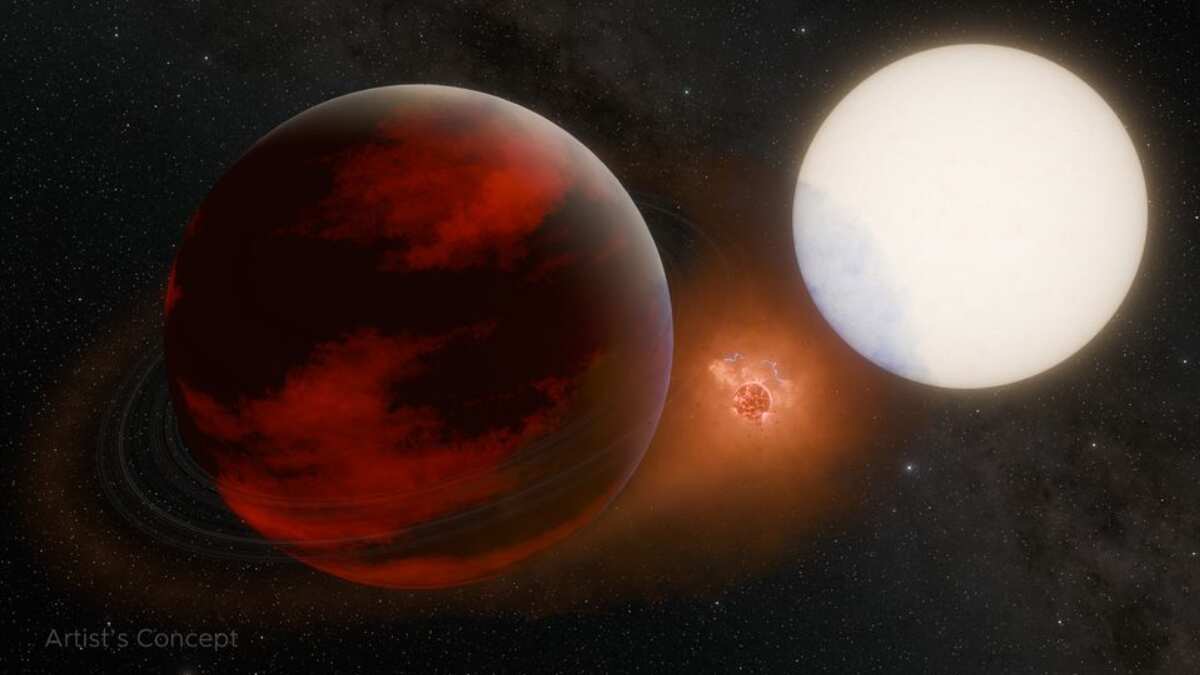
Exomoon full of volcanoes
A volcanic moon has just been discovered in space. Till now, the most volcanic system has only been known to exist in our solar system. Jupiter's moon lo is the most volcanic object in the known universe. A lava lake was also discovered a few months back.
Now another volcanic moon has been discovered, located beyond our solar system. Researchers from NASA's Jet Propulsion Laboratory (JPL) in Southern California have found a similar object orbiting an exoplanet named WASP-49 b, which is about the size of Saturn. It is located 635 light-years from Earth.
The team noticed a sodium cloud in the vicinity of WASP-49 b. This was enough to suggest that a natural satellite, also known as an exomoon, was orbiting it.

Multiple exomoon candidates had been identified in the past, including one near WASP-49 b. However, one has never been confirmed. Experts say that signs of volcanic activity may be the key to unveiling such objects since they are too small and dim to spot using modern telescopes, according to a statement from NASA.
"For example, Io, the most volcanic body in our solar system, constantly spews sulfur dioxide, sodium, potassium and other gasses that can form vast clouds around Jupiter up to 1,000 times the giant planet's radius," NASA officials said in the statement.
Also Read:Scientists crack the code, reveal what transported seeds of life to Earth
)
Asian Games 2026: India face Afghanistan in quarterfinal on Sep 28; Pakistan clash with Hong Kong
)
Myanmar training camp case: US national, 6 Ukrainians allowed to meet their families abroad
)
Bigg Boss 20: Salman Khan schools Rhiti Tiwari over Qazi Touqeer clash, compares her to Dolly Bindra
)
Mushtaq Khan dies at 56: When Welcome actor opened up about his salary for iconic role Ballu
)
LPU students go on rampage, vandalise campus amid widespread protest: What's happening
)
'FIRST LOOK from inside Noah’s Ark': Researchers share video from inside mysterious mound in Turkey
)
‘Attack on Mecca a red line for Pakistan’: Shehbaz Sharif warns Houthis at UN
)
Pakistan deploys over 20,000 security personnel as PTI vows march for Imran Khan's release
)
OpenAI AI Agents hacked 4 websites before Hugging Face, researchers reveal
)
'A terrorist country is asking me that question?': Jaishankar hits back at Pakistani journalist at UN; flags attacks on commercial shipping
)
Trump-Xi summit wrap: Big pageantry, Iran talks, few major developments and more meetings planned
)
Did Hitler kill his niece Geli Raubal? Newly found records reopen a 95-year-old mystery
)
Hawaii braces for Hurricane Nolo: NOAA warns of flash flooding and mudslides
)
'What kind of confession is this?': Pakistan PM Shehbaz Sharif’s 'terrorists would be roaming New York' remark goes viral, raises alarm online. Watch
)
US-Iran war: Trump rejects Iran's Hormuz proposal, reports suggest talks expected next week
)
Bollywood x K-pop crossover! LE SSERAFIM’s Kazuha charms fans with Shah Rukh Khan’s ‘Chammak Challo’ steps
)
Gaza's war turned environmental damage into second crisis
)
‘Serial practitioner of terrorism’: Jaishankar calls out Pakistan’s ‘state-sponsored’ terror at UNGA
)
‘It is all possible’: Putin weighs next steps on Ukraine talks, rules out Europe conflict
)
Prince Harry offers rare glimpse into Archie and Lilibet’s life after UK move
)
Nigeria Navy moves to boost oil security, tackle crude theft and infrastructure threats
)
Donald Trump shares image of Xi's arrival in Washington, carries signs of AI
)
Pentagon quietly adds 37 wounded troops to Iran war tally without explaining when or how
)
US court backs Pentagon's decision to exclude Anthropic over Claude AI restrictions
)
US Supreme Court backs Trump administration's use of SAVE database to check voter citizenship
)
‘Could kill billions...’: Bill Gates backs calls to slow AI development amid fears of catastrophe
)
'Countries far from conflict are penalised': Jaishankar calls for Gulf peace, seafarer safety at UN
)
WATCH | As Shehbaz Sharif claims Pakistan’s ‘victory’ during 2025 conflict, Indian diplomat R Srinivas laughs at UN
)
Outrage erupts after 3-year-old is married to 60-year-old man in Pakistan, link to her sister's murder being probed
&im=FitAndFill=(700,400))
New Friday OTT releases (September 25, 2026): Don’t Be Shy, Hunkkaar: The Roar, Mango Pachcha- 6 movies and TV shows on Netflix, Prime Video and more
)
Global community 'absent' in Gulf crisis: Saudi at UN calls for freedom of navigation, pre war status for Hormuz
)
Farhan, who went viral for AK47 celebration vs India in Asia Cup, hopes to lead Pakistan beyond Asian Games
)
‘I rejected it’: Trump confirms turning down Iran’s proposal to reopen Hormuz, claims Tehran is losing ‘badly’
)
Russia will achieve Ukraine war aims; Europe doing everything to block peace talks: Lavrov at UN
"It's possible that astronomers looking at another star system could detect a gas cloud like Io's even if the moon itself were too small to see."
Cloud of gas above exoplanet
European Southern Observatory's Very Large Telescope in Chile saw that the cloud around WASP-49 b sits high above the planet's atmosphere. This was similar to the cloud of gas that Io produces around Jupiter.
The cloud was also found to be filled with sodium, was showing sudden changes in size and moving a lot faster than the planet. This hinted that it is a separate body orbiting the planet.
Meanwhile, both WASP-49 b and its star mostly contain only hydrogen and helium. But the cloud seems to be coming from a source that is releasing roughly 100,000 kilogrammes of sodium per second, NASA said in the statement.
"We think this is a really critical piece of evidence," Apurva Oza, lead author of the study and a staff scientist at the California Institute of Technology, which manages JPL, said in the statement. "The cloud is moving in the opposite direction that physics tells us it should be going if it were part of the planet's atmosphere."
The cloud also does not align with the planet's 2.8-Earth-day orbital cycle. However, more observations are needed to confirm the existence of the exomoon.

