NASA's James Webb makes new revelation about 'city-killer' asteroid visiting in 2032

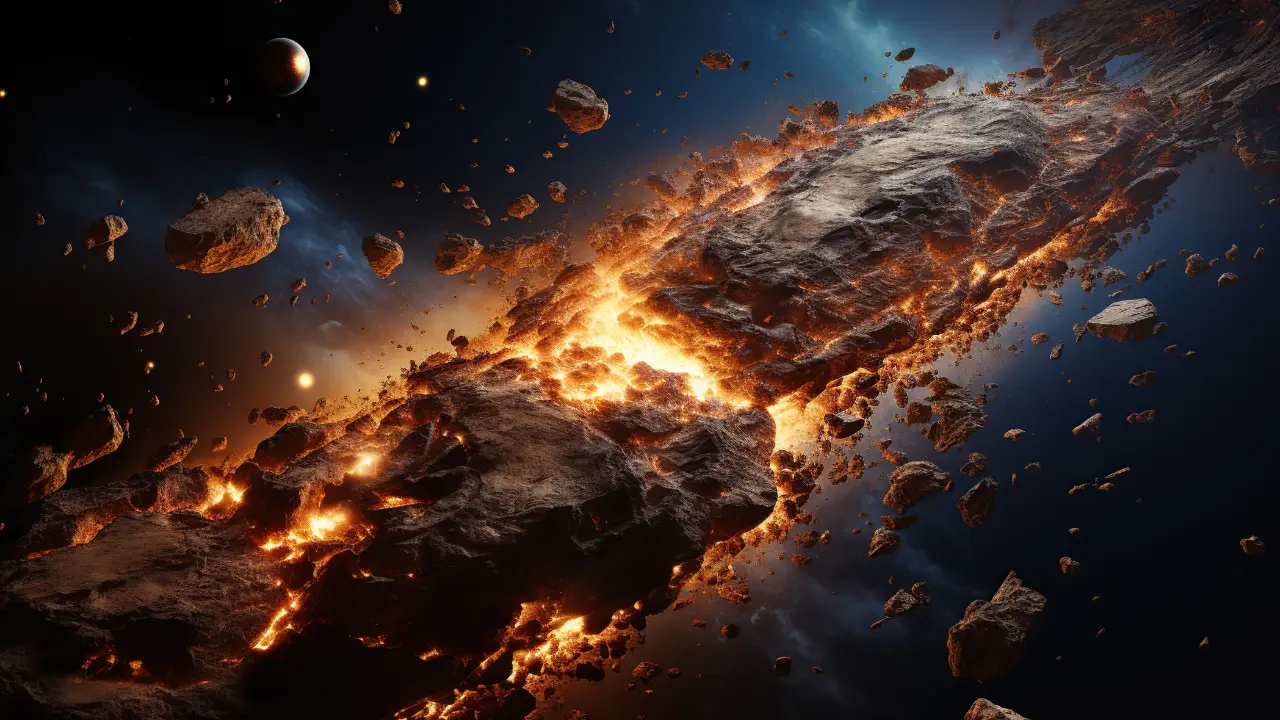
NASA's James Webb Space Telescope (JWST) looked at the asteroid that was predicted to hit Earth in 2032. What did the space observatory find? Science & Tech trending
Scientists have finally seen what the "city-killer" asteroid 2024 YR4 looks like. The James Webb Space Telescope (JWST) took a peek at the asteroid scheduled to fly by Earth and Moon at an extremely close distance in 2032. It made the observations on March 26, watching the asteroid rotate once every 20 minutes over five hours. The asteroid was once predicted to smash into Earth, however, later, experts said that this might not be the case. Did JWST uncover any other secrets about the asteroid?
The space observatory looked at the building-size asteroid for the first time and a second round of viewing is scheduled for May this year. Ground telescopes had earlier zoomed in on the asteroid, but their observations were not fully correct. JWST found that it is rockier and larger than earlier estimates suggested. It also re-checked the possibility of asteroid 2024 YR4 hitting Earth in 2032.
Also Read: 'Once in 1,000 years...': NASA says asteroid 2024 YR4 can hit the Moon. Is Earth safe?

Luckily, it confirmed what scientists say, that it is not a hazard to Earth and will safely pass by the planet. However, the Moon might not be able to escape the asteroid's wrath and is in the firing line. Scientists say there is a high likelihood of a direct collision between the two in 2032.
Researchers said in the preliminary report, "While an Earth impact by 2024 YR4 on December 22, 2032, has now been ruled out, it continues to have a non-zero probability of impacting the Moon at this time."
Also Read: Asteroid to hit Earth in 2032? Scientists warn of space rock that can cause 'severe damage'
)
US vs China over South China Sea: Washington backs Philippines, Beijing hits back
)
Election Commission on 'damage control' : What do nine new decisions mean?
)
UK police arrest several under explosives act near air base used by US forces
)
LPU students go on rampage, vandalise campus amid widespread protest: What's happening
)
OpenAI AI Agents hacked 4 websites before Hugging Face, researchers reveal
)
US Treasury Secretary Scott Bessent hails global crackdown on Iranian banks and airlines
&im=FitAndFill=(700,400))
New Friday OTT releases (September 25, 2026): Don’t Be Shy, Hunkkaar: The Roar, Mango Pachcha- 6 movies and TV shows on Netflix, Prime Video and more
)
Asian Games 2026: India face Afghanistan in quarterfinal on Sep 28; Pakistan clash with Hong Kong
)
‘Attack on Mecca a red line for Pakistan’: Shehbaz Sharif warns Houthis at UN
)
WATCH | Delhi minister Parvesh Verma slaps man during road inspection – Here’s what happened
)
'Countries far from conflict are penalised': Jaishankar calls for Gulf peace, seafarer safety at UN
)
Beyond metros: How Tier-2 and Tier-3 cities could drive India’s next AI wave
)
Bigg Boss 20: Salman Khan schools Rhiti Tiwari over Qazi Touqeer clash, compares her to Dolly Bindra
)
Gunmen kill 27 in two separate mass shootings in South Africa
&im=FitAndFill=(700,400))
Humanoid robots to virtual worlds! Korean sci-fi dramas to watch: Are You Human Too?, Memories of the Alhambra and more
)
IND vs WI 1st ODI: Naman Dhir debuts as India bowl first in Trivandrum; check playing XIs
)
‘Olympic inclusion is our major target’: WPA President Ishaun Singh on pool’s global ambitions
)
Nations League: Spain sink England at Wembley; Modric shines for Croatia
)
Two men die of suspected chemical exposure inside public toilet in Mumbai
)
Trump-Xi summit wrap: Big pageantry, Iran talks, few major developments and more meetings planned
)
‘Could kill billions...’: Bill Gates backs calls to slow AI development amid fears of catastrophe
)
Bollywood x K-pop crossover! LE SSERAFIM’s Kazuha charms fans with Shah Rukh Khan’s ‘Chammak Challo’ steps
)
US-Iran war: Trump rejects Iran's Hormuz proposal, reports suggest talks expected next week
)
Sri Lankan Tamil migrant worker gets death sentence in Saudi Arabia, help sought from India
)
'FIRST LOOK from inside Noah’s Ark': Researchers share video from inside mysterious mound in Turkey
)
UNSC reform momentum grows: Russia, Portugal, Mauritius push for India's permanent seat bid
)
Man arrested after his 22-year-old girlfriend dies at homestay in Guwahati; police suspect murder over suicide claim
)
SIR row: RTI response raises questions over EC’s claim of unanimous approval
)
WATCH | As Shehbaz Sharif claims Pakistan’s ‘victory’ during 2025 conflict, Indian diplomat R Srinivas laughs at UN
)
Afghanistan says 28 fighters killed in clash near Pakistan border, Islamabad denies
)
Ramayana: Yash’s Ravana gets first official poster from Nitesh Tiwari’s epic
)
'A terrorist country is asking me that question?': Jaishankar hits back at Pakistani journalist at UN; flags attacks on commercial shipping
)
Russia will achieve Ukraine war aims; Europe doing everything to block peace talks: Lavrov at UN
JWST will look at the asteroid again in May 2025 to gain more information. This would be the last time astronomers would get a look at it before it vanishes from view for three years. It is moving away from Earth and will return only in 2028, leaving scientists with another four years before it makes a grand visit. While things might change during this time, experts aren't worried about any threat to Earth.
"City-killer" asteroid 2024 YR4
The asteroid was first noticed in December 2024. It sent a wave of fear among scientists who calculated its trajectory to collide with Earth's in 2032. Such a collision would hold a force equivalent to 500 Hiroshima bombs. At one point, it had a 3.1 per cent chance of crashing into Earth in 2032, the highest probability ever recorded for an object of this size.
Also Read: Earth's temporary ‘mini moon’ may have been a piece of actual moon
Later, the danger was downgraded, and the threat to Earth was nil. The European Space Agency (ESA) announced that JWST's emergency discretionary time was needed to learn in detail about the asteroid, leaving a tiny doubt in people's minds. JWST's infrared sensors can directly detect heat emitted by the asteroid as opposed to ground telescopes that can only observe sunlight reflected off of the asteroid's surface.
Also Read: ESA's Gaia telescope discovers over 100 black holes hidden in ancient star cluster
"In general, the brighter the asteroid, the larger it is, but this relationship strongly depends on how reflective the asteroid's surface is," ESA officials wrote in a blog post.
Will asteroid hit Moon in 2032?
Scientists are watching the asteroid not only for the sake of Earth but also the Moon which appears on track for a collision with the asteroid. Report co-author Andrew Rivkin, an astronomer at Johns Hopkins University, told New Scientist that there is roughly a 2% chance that the asteroid will slam into the moon in 2032.

