Supermassive black hole 12,500,000,000 light-years away is shooting jets towards Earth. What does it mean?

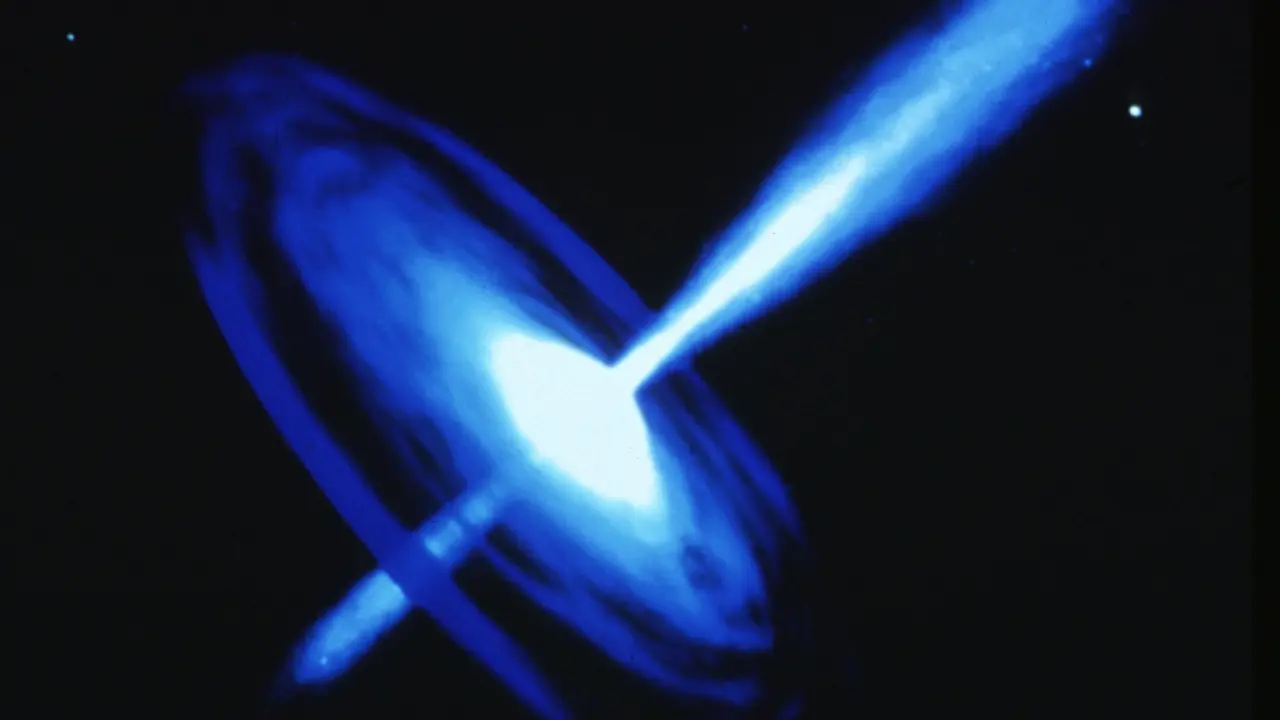
Science & Tech Trending: A galaxy 12.9 billion light-years away has a supermassive black hole at its centre that is shooting a jetstream right at Earth.
Scientists have discovered the farthest and oldest blazar in the universe that is shooting out jets of charged particles directly at us. It sits at the heart of a galaxy 12.9 billion light-years away and is named J0410–0139. The blazar offers a view into the universe when it was less than 800 million years old. Astronomers are eager to peer into it and learn more about supermassive black holes, something they say were likely more common in the early universe than believed.
Blazars are a rare discovery. They are active galactic nucleus (AGN) that are powered by supermassive black holes, some of which can be billions of times the mass of our Sun. These black holes ingest matter and shoot out charged particles at nearly the speed of light. These are in the form of jets and are classified as blazars when they are aiming right for Earth.
Also Read: '200 million light years': Radio burst reaches Earth from other side of the universe

The discovery of the blazar was published in Nature Astronomy and The Astrophysical Journal Letters. The US National Science Foundation's Very Large Array, the Very Long Baseline Array, the Chandra X-ray Observatory, and ALMA (Atacama Large Millimetre/submillimetre Array) were some of the equipment that helped them pinpoint the blazar.
Also Read: 'Second home for humanity?' Super-Earth 20 light-years away excites scientists
Oldest blazar in universe discovered
The blazar has stumped scientists who are now questioning the existing notions about supermassive black holes and their existence in the early universe. Since J0410–0139 is officially the oldest blazar, scientists are now trying to figure out how big these black holes could get and how quickly.
Also Read: Here’s why NASA engineers are switching off instruments on Voyager space probes
The latest blazar is like a window into a universe that is in its infancy stage, and experts are hoping to learn how many such supermassive black holes were there when the universe was still young.
Supermassive black holes in the universe
Researchers believe that supermassive black holes in the early universe either grew much faster than we previously believed or were simply born bigger than we thought possible. Since the jet stream is pointed directly at Earth, it sets up a unique platform for scientists to explore black holes, ancient galaxies, and the jet stream.
Also Read: Ancient Magdalena people practiced cannibalism, made jewellery from body parts
Joe Pesce, programme director at the NSF National Radio Astronomy Observatory (NSF NRAO), said, "This observation adds to a body of findings indicating that supermassive black holes in the early universe aren't acting like we thought they should."
“These observations are surprising because we don't seem to understand supermassive black hole formation as well as we thought. But they are also exciting because it's a new mystery that we have to solve," he added.
Not just one, but a 'hundred more'
Researchers believe that finding one such jet stream means that there were likely a hundred more at the time. The first author of the study, Eduardo Bañados states, "Finding one AGN with a jet pointing directly towards us implies that at that time, there must have been many AGN in that period of cosmic history."

