
The World Economic Forum at Davos has long been a comfort zone for the old colonial powers of Europe, where terms like ‘multilateralism‘, ‘rule-based order’, and ‘shared values’ frequently appear alongside political statements and business opportunities for the powerful and wealthy. Donald Trump’s 2026 Davos intervention was not simply another provocative speech; it sharply embodied a new type of big-power colonialism: transactional, coercive, unapologetic, and free of historical remorse.
In doing so, Trump forced Europe to confront an uncomfortable irony: the former colonisers found themselves at the receiving end of a colonial logic they once perfected. Some bold gestures, such as those by the Canadian PM, President Macron, and a few others, along with signs of determination to push back, have toned down Trump’s rhetoric, but his unilateral overdrive is far from over. It prompted Europeans to come together to mitigate the damage to fragile Western Alliance.
The Trump Doctrine at Davos: Power before pretence

Trump’s message was brutally simple. Security follows power, power follows economic strength, and alliances survive only if they serve immediate national interest. Everything else—values, norms, historical sentiment—is negotiable. At Davos, it was applied across a few prominent issues: Greenland, Venezuela, Europe’s security dependence, and Trump’s Board of Peace.
Trump did not seek approval. He sought compliance. By openly questioning NATO’s reliability, labelling it “ungrateful”, casting doubt on reciprocal defence commitments, threatening tariffs on allies, and openly floating the idea of acquiring Greenland and reframed U.S. leadership as ownership. The implicit message to Europe was unmistakable: protection is no longer free, and sovereignty is conditional. Unlike their yet-to-be-ratified trade deal, a stronger stance by some European countries/allies like Canada, and more importantly, some internal criticism in the U.S., forced him to tone down his rhetoric.
Greenland: Strategic logic or neo-colonial assertion?
Trending Stories
Trump framed Greenland in terms of geography, power projection, Arctic dominance and Golden Dome deployment, downplaying his desire to control its resources, including rare earths and minerals. Greenland straddles emerging Arctic sea lanes, missile trajectories and under‑ice submarine routes, and in his view is too strategic to be left to a weak Denmark or a divided NATO in Trump’s view.
He cast it as part of North America’s security ecosystem, claiming a U.S. right to determine its future—classic imperial logic cloaked in security necessity, overriding sovereignty and enforced through economic coercion rather than diplomacy. Europeans, long complicit in similar U.S. adventures like Iraq, understand this logic but were shaken by his removal of the polite diplomatic language that once masked such interventions. Their resistance, including threats to revoke trade deals or sell U.S. bonds, forced him to reverse a planned 10 per cent tariff on eight countries, yet confidence in U.S. reliability remains damaged.
Denmark and Greenland remain uneasy, as a verbal understanding between the NATO chief and Trump offers no real sovereignty guarantee, much like Palestinians being excluded from Trump’s expanded “Board for Peace” beyond Gaza. With no written agreement and Trump boasting of total and permanent access to Greenland under a framework deal that bypassed both Greenland and Denmark, his fixation is clearly not over.
If current trends continue, the outcome may be an updated 1951 U.S.–Denmark pact granting Washington sovereign control over expanded military bases, more NATO sentries and curbs on non‑NATO mining in Greenland—a middle path between outright U.S. takeover and simple surrender.
Venezuela: A demonstration, not a debate
Trump’s reference to Venezuela at Davos signalled the sad demise of the ‘rule-based order’. By showcasing U.S. military action and regime change as effective tools, Trump reinforced a central theme: America will act unilaterally, decisively, and unapologetically exploit other countries’ resources, without consequences.
Venezuela became the proof-of-concept for Trump’s doctrine of coercive statecraft—use force sparingly, but advertise it loudly. For old colonial powers accustomed to operating through multilateral cover and humanitarian rhetoric, Trump’s bluntness was deeply unsettling. He made no attempt to moralise intervention—instead proudly boasted on exploitative outcomes.
Europe’s Dilemma: Strategic Dependence Without Strategic Voice
Europe emerged from Davos exposed. Trump forced into the open what many already knew: Europe’s security is outsourced, its economic leverage diluted, and its political unity fragile.
By tying NATO commitments to defence spending and political obedience, he weaponised this dependency. Europe was reminded that it enjoys U.S. security guarantees without the capacity to act independently. The Greenland episode showed how urgently Europe must rebuild autonomous strategic and sovereignty capacity.
This moment marked a psychological rupture: Europe looks less like an equal partner and more like a protected territory bargaining with its protector. For former imperial capitals, this reversal is humiliating and destabilising, but it has also spurred resolve. The tougher line taken by some leaders, including talk of FTAs and defence agreements with India and even a “mother of all deals,” signals a clear intent to diversify beyond the U.S. and pursue strategic balancing.
Board for Peace or Trump’s Club!
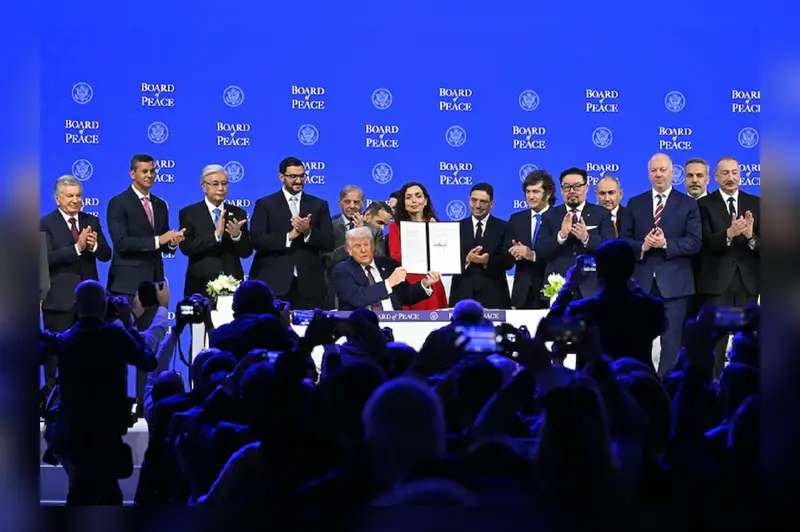
In Davos, President Trump unveiled the Board of Peace appointing himself President for Life. Except 19 countries, who are on appeasement drive to impress him, other countries stayed away, with few bluntly refusing to join. It was a poor show of bad optics and appeasement, because such a personality based organisation earns no credibility. It’s likely to survive only till Trump is in White House.
Despite many actions of President Trump to undermine UN, this board doesn’t have the traction to replace UN. No G7 country or any major power has joined so far and may not join it, as it presupposes subordination to Donald Trump, who has allotted himself over-riding powers and boasting of overstated claims for peace.
China and Russia: Reading the signals carefully
Trump’s 2026 Davos speech, when seen in the context of his National Security Strategy, framed China and Russia in the context of Arctic security and great-power rivalry.
For China, Trump’s Davos posture confirms a hardened containment mindset. Greenland is less about Denmark and more about denying China Arctic access, infrastructure footholds, and future influence over polar trade routes, to which even other NATO members are complicit. It also encourages China to exercise similar unilateralism in Indo-Pacific on the pretext of its security. China, as well as some members of the EU, view it as a justification for diverting their trade from the US to each other.
Russia, meanwhile, sees both opportunity and risk. Trump’s scepticism of alliances weakens NATO cohesion, favouring it, but his emphasis on raw power and spheres of influence clashes with Moscow’s area of influence in Arctic. The Venezuela-style demonstrations also signal that the U.S. retains escalation dominance when it chooses to use it on Russian partners like Syria and Iran.
India: Strategic autonomy vindicated
For India, Trump’s Davos stance vindicates its strategy of strategic autonomy and multilateral engagement amid Trump‑era unpredictability, transactional diplomacy, economic weaponisation, and unilateralism.
India must treat Trump 2.0 as a lasting pattern of economic pressure, tariff diplomacy, and power‑centric geopolitics, engaging the US without over‑reliance, managing China without provocation, and keeping Russia ties stable.
Trump’s idea of economic security as national security, and his readiness to override partners, warns India to pursue self‑reliance, diversify trade, and stand up to him where national interests demand. Joining Trump’s ‘Board of Peace’ is not in India’s interest; it can be left under study indefinitely to remain diplomatically correct.
Conclusion
At Davos 2026, Trump openly declared that sovereignty is elastic, alliances are transactional, and morality follows power. Europe’s former colonisers are unsettled because Trump now uses against them the language they once used abroad with American support, yet episodes like the Greenland U‑turn and the reversal of his 10 per cent tariff threat show that coordinated European pushback and united retaliation can blunt his coercive unilateralism. It vindicated India’s strategy of autonomy and multilateralism against unjustified tariffs.
Davos revealed a fractured order where the new big coloniser seeks leverage, not legitimacy, and it set a precedent for China and Russia to exercise similar unilateralism in renewed great‑power rivalry.
So long as an updated Monroe‑style “Donroe Doctrine” shapes the American strategic psyche, (could go beyond Trump’s presidency) other states must build options that let them look—and act—beyond, and without, the United States.
(Disclaimer: The views of the writer do not represent the views of WION or ZMCL. Nor does WION or ZMCL endorse the views of the writer.)