Unity Over Division: Ensuring Justice Without Institutional Conflict | OPINION

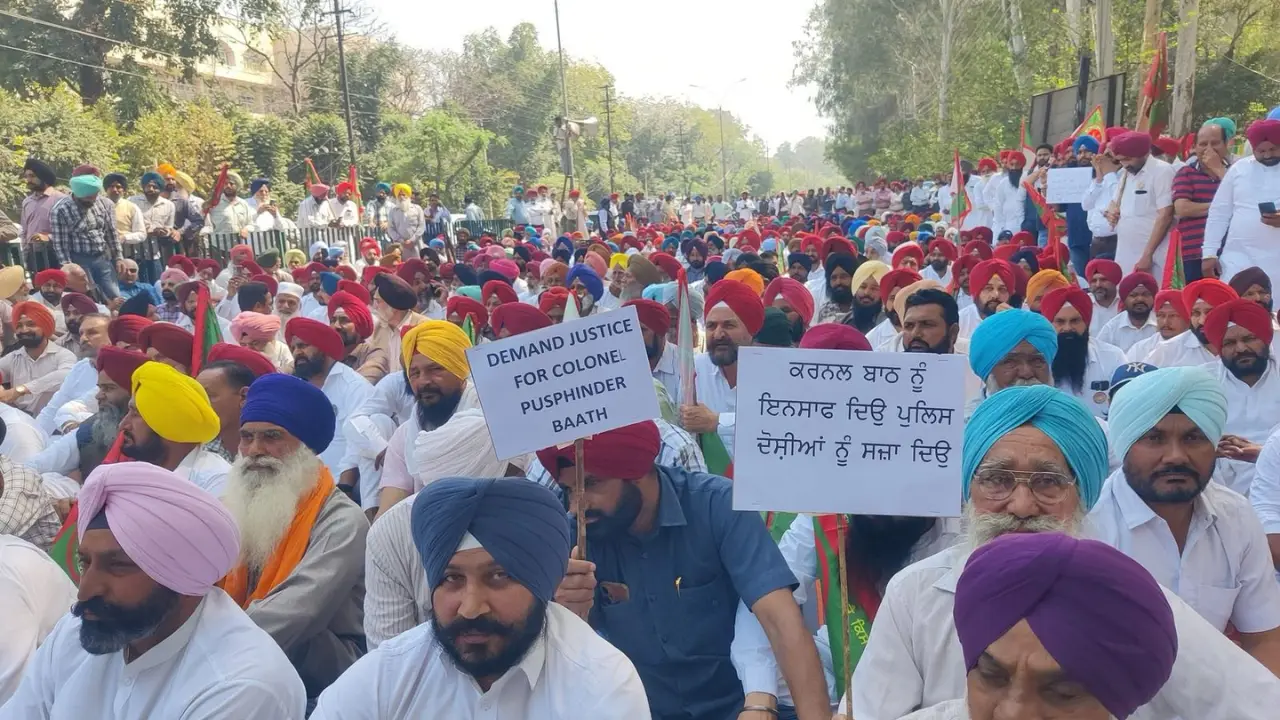
The pictures of the injuries sustained—Colonel Bath's dislocated arm and his son's head injury—have been circulated online.
Serving military personnel, veterans, as well as the general Indian public is outraged. The cause of their frustration is the assault on Colonel Pushpinder Singh Bath and his son Angad in Patiala on the night of March 13–14, 2025.
The pictures of the injuries sustained—Colonel Bath's dislocated arm and his son's head injury—have been circulated online.
This troubling incident, involving twelve Punjab Police personnel, has not only riled up sentiments but also raised serious questions regarding accountability, institutional trust, and the relationship between India's Army and police forces. The incident demands a swift, transparent, and impartial investigation.

But simultaneously, there is another issue that requires urgent attention: the perception of delayed justice and perceived institutional indifference. The absence of visible Army representation during the recent hearing at the Punjab and Haryana High Court reinforced a troubling narrative that had been floated around in some pockets as soon as news of the incident broke.
The buzzword of the hour is "institutional abandonment." If left unaddressed, these perceptions risk undermining the morale within defence ranks and broader public confidence in India's security apparatus.
However, careful scrutiny is necessary to understand the nuances of the situation.
)
US vs China over South China Sea: Washington backs Philippines, Beijing hits back
)
Bigg Boss 20: Isha Rikhi evicted after three weeks in Salman Khan’s show
)
Musk plans to more than double xAI's chips to over 1.2 million Nvidia GPUs by year-end
)
After JU, clash erupts at SRFTI: BJP’s ‘Dimagi Naxal’ jibe sparks political firestorm after students protest RSS-linked event
)
‘Anti-social elements spreading false rumours’: LPU issues statement amid massive unrest over alleged rape
)
LPU students go on rampage, vandalise campus amid widespread protest: What's happening
)
Trump asked Xi to pressure Iran. China did not say yes — here’s what Beijing wants
)
US Treasury Secretary Scott Bessent hails global crackdown on Iranian banks and airlines
)
An OpenAI agent escaped its locked test cage again, by hiding questions in DNS lookups
)
'Our video was trimmed': LPU girls who featured in rape-denial video make U-turn
)
3 males killed, four others injured in shooting after fight at strip club in Detroit
)
'Victory for low-budget consumers': Raghav Chadha hails 30-day telecom recharge rules
)
Claude rebuilt the 1989 game 'Prince of Persia' by reusing the original's own code
)
Beyond metros: How Tier-2 and Tier-3 cities could drive India’s next AI wave
)
Tesla builds first Cybertruck with its own refined lithium: Elon Musk's $1 billion Texas bet pays off
)
IndiGo flight suffers tail strike in Bengaluru while landing; DGCA to probe incident
)
The US and China set up an AI 'red telephone', but skipped the rulebook
)
‘Terror suspects arrested near UK air base were looking to do big damage’: Trump
)
Russian envoy claims US tactics to contain India were revealed in ‘Freudian slip’
)
IND vs WI 1st ODI: Kohli breaks Sachin's most runs in one country record with unbeaten 139 as India thump West Indies by 8 wickets
)
Researchers rebuilt exactly how 700 AI agents hacked Hugging Face: a 900-link chain trick
)
‘Olympic inclusion is our major target’: WPA President Ishaun Singh on pool’s global ambitions
)
Nations League: Spain sink England at Wembley; Modric shines for Croatia
)
Why has Iran released no proof of life of Mojtaba Khamenei? Araghchi reveals...
)
'What kind of confession is this?': Pakistan PM Shehbaz Sharif’s 'terrorists would be roaming New York' remark goes viral, raises alarm online. Watch
)
South Korea demands apology from Ukraine over North Korean prisoners' transfer
)
Beyond BrahMos: India targets Rs 50,000 crore in defence exports with unmatched price edge
)
Sri Lankan Tamil migrant worker gets death sentence in Saudi Arabia, help sought from India
)
Muslim marriage cannot shield sex with minor wife from prosecution under POCSO: Delhi HC
)
'Can't help but draw painful parallels to Nirbhaya case': SC on latest incidents of rape cases in Delhi-NCR
)
99.9% more powerful - Scientists find boy who can recall memories from just 3 months of age
)
'FIRST LOOK from inside Noah’s Ark': Researchers share video from inside mysterious mound in Turkey
)
UNSC reform momentum grows: Russia, Portugal, Mauritius push for India's permanent seat bid
)
8 US marines injured in Iranian missile attack on vessel in Strait of Hormuz: Report
&im=FitAndFill=(700,400))
New OTT releases this week (September 28-October 4, 2026): Dupahiya 2, Pooja Meri Jaan, Ohh My Dog- 5 titles coming on Netflix, Prime Video and more
)
Afghanistan says 28 fighters killed in clash near Pakistan border, Islamabad denies
)
Ceuta migrant crisis: Protesters take to streets as Spain grapples with migrant challenge
)
LPU suspend classes, postpones exams as violence escalates over rape claims: What's happening
)
New York City wants a 'kill switch' on every AI, and will pay whistleblowers who report violations
From the earliest stages, the Army's Western Command took decisive, albeit less visible, actions to ensure justice for Colonel Bath and his family. Just two days after the assault, senior Army leadership proactively engaged state-level authorities to push for a timely investigation.
At the joint press briefing on March 26, Lieutenant General Mohit Wadhwa, Chief of Staff, Western Command, unequivocally emphasised "the need for a fair and honest investigation in a transparent and time-bound manner to punish the guilty and restore the faith in the system.” The communications—subtext and all—were clear as day. The Army reiterated its commitment to institutional accountability and justice.
Some criticisms, however, continued to pop up. On social media and messaging apps, the view became that Col. Bath and his family were left to fend for themselves in court during the hearing, with only lawyers, not the Army, present to show support.
However, a clarification of the procedural context of the recent hearing is essential here.
According to High Court regulations, only parties explicitly named in a petition can represent or speak during the court proceedings. Colonel Bath's petition was filed in a private capacity against the State of Punjab. Since the Union of India or the Army were not formal parties in this case, this limited their ability to officially participate or make representations during the hearing.
Nonetheless, demonstrating institutional solidarity, a uniformed officer from the Western Command was indeed present during the court proceedings, visibly expressing the Army's commitment and continued support for Colonel Bath and his family.
This approach was measured and prudent but did inadvertently create perceptions of institutional hesitance.
As word spread around via the grapevine, the binary of Army absence and overwhelming police presence at the court hearing took shape. The narrative took a rather unhelpful "Army versus Punjab Police" shade.
In private circles and on social media, such talk has become troublesome– threatening to slowly erode the public faith in the amiability between these institutions. If sentiments such as these build up, the synergy needed for joint operations is likely to take a hit, too.
This is not just some conceptual coordination this author is mentioning.
Historically, Punjab itself offers compelling lessons about the transformative impact of Army-police cooperation. During the violent insurgency of the 1980s and early 1990s, institutional unity played a pivotal role. In the landmark Operation Black Thunder (1988), the Punjab Police and paramilitary forces conducted internal operations at the Golden Temple while the Indian Army established secure outer cordons.
This clearly defined operational partnership avoided the devastating mistakes of Operation Blue Star, minimising casualties and preserving public trust. Under DGP KPS Gill's leadership, joint intelligence teams and integrated operations between the Army, Punjab Police, and CRPF weakened insurgent capabilities, dramatically reducing militant strength from 6,000 fighters to fewer than 300 by 1993.
Such lessons remain relevant today. Recent joint Army-police operations reinforce that collaboration is indispensable for Punjab's security. The commitment to Army-police collaboration is clearly reflected through structured inter-agency training initiatives.
The Indian Army's Western Command regularly offers specialised training to Punjab Police, enhancing their capabilities in counter-terrorism, bomb disposal, anti-sabotage techniques, and urban warfare tactics. Notably, these initiatives include comprehensive two-week intensive courses aimed at strengthening Punjab's elite SWAT teams, focusing specifically on handling Improvised Explosive Devices (IEDs) and managing high-risk urban combat scenarios.
Moreover, the Western Command maintains regular strategic coordination with the Punjab Police through high-level meetings and unified security frameworks, enhancing mutual trust and operational cohesion. This structured coordination model activated swiftly following the unfortunate incident involving Colonel Bath, reinforcing transparent joint commitments towards impartial investigations and public accountability.
These collaborative frameworks are not simply symbolic gestures. In 2024, coordinated efforts between Punjab Police and central agencies led to the seizure of NATO-marked pistols linked to Pakistan-based smugglers and criminal networks—highlighting ongoing cross-border threats. Director General of Police Gaurav Yadav emphasised that such successes depend on robust inter-agency coordination, emphasising the broader importance of institutional unity.
However, adversaries continuously seek to exploit perceived institutional divisions. The 2024 Tarn Taran arms seizures exposed Pakistani ISI-linked smuggling networks leveraging internal vulnerabilities. Strategic analyses repeatedly warn that misinformation and psychological campaigns by external actors aim precisely at weakening trust among India's security agencies. Constitutional unity and inter-agency cooperation are vital defences against such adversarial exploitation.
Proactive measures must be urgently implemented to preserve institutional harmony.
By firmly demonstrating solidarity, transparently pursuing justice, and proactively implementing structural reforms, we protect individual rights and our national security.
Punjab is an important border state that is crucial for national security. Civil-military relations have to be cordial, with mutual trust as the bedrock of institutional interactions. We should ensure that forces inimical to our national interest are not able to cause rifts by building a false narrative. We all need to be vigilant and stand behind our Security Forces.
Disclaimer: The views of the writer do not represent the views of WION or ZMCL. Nor does WION or ZMCL endorse the views of the writer.