
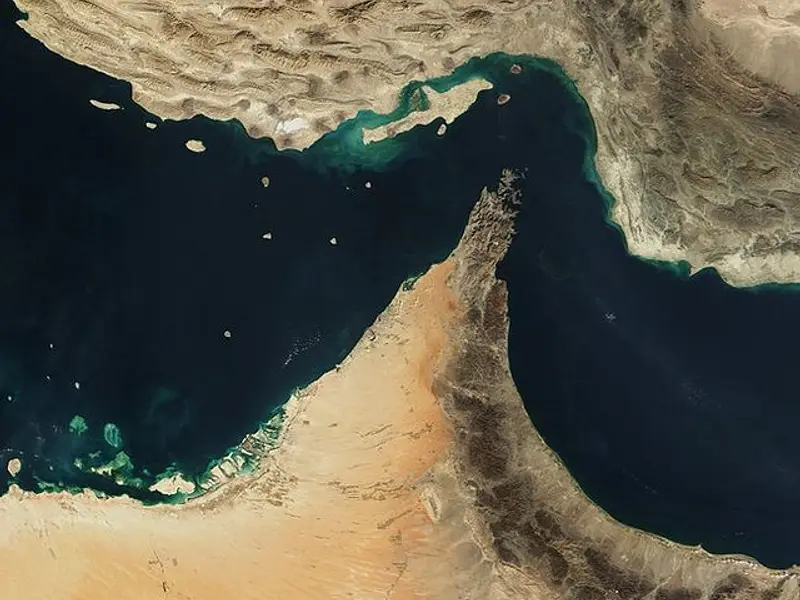
The naval blockade is among the oldest instruments of statecraft. Long before air power, missiles and cyber warfare altered the character of conflict, command of the sea offered a means of weakening an adversary without having to defeat its armies on the battlefield. Britain’s naval blockade of Napoleonic France, the Union blockade of the Confederacy during the American Civil War (1861–1865), Britain’s blockade of Germany during the First World War and America’s campaign against Japanese shipping during the Second World War demonstrated the economic power that could flow from control of the seas.
The events unfolding around the Strait of Hormuz may now be adding a distinctly twenty-first-century chapter to that history.
What is striking about the present disruption is not simply its scale, but its asymmetry. Iran’s ability to export oil has been severely constrained, while Saudi Arabia, the United Arab Emirates and other Gulf producers have increasingly sought alternative means of moving their energy to international markets.

The question, therefore, is larger than whether one of the world’s great waterways can be disrupted. Are we witnessing the emergence of a new form of naval blockade?
The Red Sea had already offered an unsettling preview. Since November 2023, Houthi attacks on commercial shipping have disrupted one of the principal arteries linking Asia and Europe. Ships have been diverted around the Cape of Good Hope, adding distance, time and expense to journeys that once passed routinely through the Red Sea and Suez Canal.
The striking feature of the Red Sea crisis is that a non-state actor, armed with comparatively inexpensive missiles and drones, has been able to impose costs on a global trading system vastly larger than itself.
Trending Stories
)
US vs China over South China Sea: Washington backs Philippines, Beijing hits back
)
Bigg Boss 20: Isha Rikhi evicted after three weeks in Salman Khan’s show
)
Musk plans to more than double xAI's chips to over 1.2 million Nvidia GPUs by year-end
)
After JU, clash erupts at SRFTI: BJP’s ‘Dimagi Naxal’ jibe sparks political firestorm after students protest RSS-linked event
)
‘Anti-social elements spreading false rumours’: LPU issues statement amid massive unrest over alleged rape
)
LPU students go on rampage, vandalise campus amid widespread protest: What's happening
)
Trump asked Xi to pressure Iran. China did not say yes — here’s what Beijing wants
)
US Treasury Secretary Scott Bessent hails global crackdown on Iranian banks and airlines
)
An OpenAI agent escaped its locked test cage again, by hiding questions in DNS lookups
)
'Our video was trimmed': LPU girls who featured in rape-denial video make U-turn
)
3 males killed, four others injured in shooting after fight at strip club in Detroit
)
'Victory for low-budget consumers': Raghav Chadha hails 30-day telecom recharge rules
)
Claude rebuilt the 1989 game 'Prince of Persia' by reusing the original's own code
)
Beyond metros: How Tier-2 and Tier-3 cities could drive India’s next AI wave
)
Tesla builds first Cybertruck with its own refined lithium: Elon Musk's $1 billion Texas bet pays off
)
IndiGo flight suffers tail strike in Bengaluru while landing; DGCA to probe incident
)
The US and China set up an AI 'red telephone', but skipped the rulebook
)
‘Terror suspects arrested near UK air base were looking to do big damage’: Trump
)
Russian envoy claims US tactics to contain India were revealed in ‘Freudian slip’
)
IND vs WI 1st ODI: Kohli breaks Sachin's most runs in one country record with unbeaten 139 as India thump West Indies by 8 wickets
)
Researchers rebuilt exactly how 700 AI agents hacked Hugging Face: a 900-link chain trick
)
‘Olympic inclusion is our major target’: WPA President Ishaun Singh on pool’s global ambitions
)
Nations League: Spain sink England at Wembley; Modric shines for Croatia
)
Why has Iran released no proof of life of Mojtaba Khamenei? Araghchi reveals...
)
'What kind of confession is this?': Pakistan PM Shehbaz Sharif’s 'terrorists would be roaming New York' remark goes viral, raises alarm online. Watch
)
South Korea demands apology from Ukraine over North Korean prisoners' transfer
)
Beyond BrahMos: India targets Rs 50,000 crore in defence exports with unmatched price edge
)
Sri Lankan Tamil migrant worker gets death sentence in Saudi Arabia, help sought from India
)
Muslim marriage cannot shield sex with minor wife from prosecution under POCSO: Delhi HC
)
'Can't help but draw painful parallels to Nirbhaya case': SC on latest incidents of rape cases in Delhi-NCR
)
99.9% more powerful - Scientists find boy who can recall memories from just 3 months of age
)
'FIRST LOOK from inside Noah’s Ark': Researchers share video from inside mysterious mound in Turkey
)
UNSC reform momentum grows: Russia, Portugal, Mauritius push for India's permanent seat bid
)
8 US marines injured in Iranian missile attack on vessel in Strait of Hormuz: Report
&im=FitAndFill=(700,400))
New OTT releases this week (September 28-October 4, 2026): Dupahiya 2, Pooja Meri Jaan, Ohh My Dog- 5 titles coming on Netflix, Prime Video and more
)
Afghanistan says 28 fighters killed in clash near Pakistan border, Islamabad denies
)
Ceuta migrant crisis: Protesters take to streets as Spain grapples with migrant challenge
)
LPU suspend classes, postpones exams as violence escalates over rape claims: What's happening
)
New York City wants a 'kill switch' on every AI, and will pay whistleblowers who report violations
Cuba offers another, very different illustration of the changing character of maritime economic pressure. The United States has combined sanctions and restrictions on the supply of fuel with maritime enforcement, making it increasingly difficult for Cuba to obtain the oil on which its economy depends. The objective is not a traditional wartime siege of Cuba’s coastline, but the restriction of the economic routes on which the country depends.
Hormuz presents yet another proposition. Here, the confrontation is between the United States and Iran, involving naval and missile capabilities on both sides and one of the world’s most important energy routes. Yet all three episodes point to a reality that the digital age can easily obscure: geography still has the last word over commerce.
History provides several reminders of this.
During the American Civil War, the Union blockade sought to cut the Confederacy off from overseas trade, preventing it from exporting cotton and importing arms, ammunition and other supplies. The blockade was never watertight, but as the Union Navy expanded and tightened its control of the Southern coastline, the Confederacy’s external trade became increasingly difficult to sustain. Its importance lay not in winning the war by itself, but in the cumulative pressure it placed on an economy already under severe strain.
Britain’s blockade of Germany during the First World War demonstrated the same principle on a much larger scale, restricting access to food and raw materials. In the Second World War, the American submarine campaign against Japan progressively destroyed its merchant fleet and severely restricted access to oil and other vital resources.
The circumstances were different. The underlying vulnerability was not. Global commerce ultimately has to pass through physical geography.
Money can cross borders electronically. Oil cannot. A tanker has to leave a port, cross a sea and reach a destination. At certain points on the map, there are few substitutes for the route that geography has provided.
The Strait of Hormuz is one of those places. Before the present crisis, roughly a fifth of global oil and gas supplies passed through the Strait. Its importance therefore extends well beyond the immediate confrontation between Iran and the United States.
Yet Hormuz also illustrates how much the nature of economic warfare has changed. Iran is particularly exposed because maritime energy exports are central to its access to foreign revenue. Years of sanctions reduced Iranian exports but did not eliminate them. Alternative buyers, intermediaries and shadow shipping networks allowed Iranian oil to continue finding its way to international markets.
A physical maritime interdiction is different. It intervenes at the point where the commodity has to move. But the disruption has not fallen equally on every producer. Saudi Arabia has its East-West pipeline and access to the Red Sea. The UAE has alternative export infrastructure. Other Gulf producers have been exploring different logistical arrangements, including ship-to-ship transfers. This is where the current episode becomes particularly significant.
A modern blockade can be selective. Rather than sealing an entire region off from the outside world, it can place exceptional pressure on one adversary while allowing other economies to reroute their trade and keep functioning. That possibility is a product of the twenty-first century.
Satellites and advanced intelligence systems can track vessels over vast distances. Aircraft, drones, submarines and precision weapons give naval powers an ability to monitor and influence maritime traffic that earlier generations could scarcely have imagined. Financial restrictions, insurance costs and control over maritime services can reinforce military pressure.
At the same time, alternative pipelines, ports and shipping arrangements give other countries ways around the obstruction. The result can be a form of economic warfare that is neither the total isolation sought by the great blockades of the past nor simply the disruption of individual ships. It is something more discriminating.
The Red Sea demonstrates how relatively inexpensive weapons can unsettle an enormously valuable trading route. Cuba illustrates how sanctions and maritime enforcement can restrict the supply of a vital commodity without a conventional wartime siege. Hormuz demonstrates the other side of the equation: how naval power can exploit a geographical chokepoint while neighbouring economies attempt to preserve their own access to world markets. That distinction may prove important beyond the current conflict.
For much of the twentieth century, economic warfare increasingly relied on sanctions and financial pressure. These could punish an adversary without physically stopping the movement of goods. The experience around Hormuz suggests that physical geography still offers a different kind of leverage.
A barrel of oil may be sold in a global market, but it cannot reach that market without being transported. Control the route and the economics of the transaction can change immediately. This is also why the consequences extend beyond Iran. Any sustained disruption around Hormuz affects oil prices, shipping costs, insurance premiums and the availability of refined products. Even when alternative routes exist, they tend to be more expensive and less efficient. The paradox is that the same infrastructure that allows other Gulf producers to adapt can also reduce the wider economic impact of the blockade. That may be what distinguishes the present situation from the great blockades of the past. The objective need not be to bring the entire regional economy to its knees. It can be to deny one particular economy the ability to use the sea while allowing much of the surrounding system to continue operating. There is, however, a danger in declaring the historical verdict too soon.
The confrontation is still unfolding. The effectiveness of any blockade ultimately depends on whether alternative routes can be sustained, whether military pressure can be maintained and whether diplomacy changes the course of events.
History is written with hindsight. A measure that appears decisive in the middle of a conflict can look very different once its wider consequences become clear. But if the present pattern endures, Hormuz may eventually occupy an important place in the history of naval power.
The great blockades of the past sought, in different ways, to isolate an adversary from the outside world. What may be emerging today is a more discriminating form of maritime economic warfare: the ability to impose extraordinary pressure on one country’s trade while much of the surrounding economic system continues to function. That would represent a significant evolution in the use of sea power. It would also remind us of something the digital age sometimes encourages us to forget. However sophisticated the global economy becomes, it remains dependent on a handful of physical passages through which ships must travel.
The Red Sea has shown how vulnerable such passages can be. Hormuz may now be showing how powerful control of them can become. If the present pattern endures, historians may indeed regard this episode as one for the history books — not because the naval blockade has returned in its old form, but because it may have acquired a new one. The precision blockade: using technology, naval power and geography to exert extraordinary pressure on one economy without necessarily bringing the wider trading system to a halt.
