Opinion: The RSS outreach - an exercise in earnest or simple political legwork?

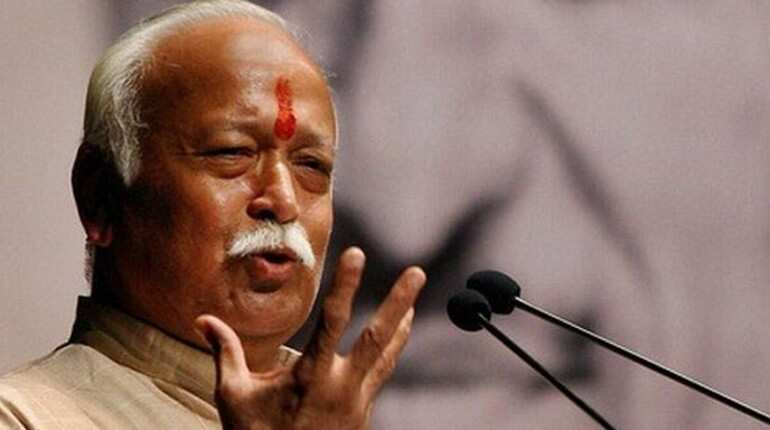
Mohan Bhagwat
A lecture series like this, 10 to 15 years ago, would have been ignored by the intellectual community. But it was this time forced to sit and listen to RSS chief Mohan Bhagwat.
There is no doubt that the three-day RSS lecture series was a unique outreach exercise carried out by an organisation that is very difficult to peer into from outside. This was not just an assembly of the believers, the naysayers also got a fair share of the invites, and questions. The fact that the RSS was able to invite those who are ideologically opposed to the organisation in public shows that the RSS today cannot be ignored as a lesser organisation. The RSS also cannot be pushed to the discussion sidelines because it (often) indulges in pseudo-scientific and academic speak.
The RSS project, for good or bad, better or worse, has been able to mainstream its politics post-2014. It is for this reason that a meeting like this 10 to 15 years ago would have been ignored by the intellectual community, but which was this time forced to sit and listen to RSS chief Mohan Bhagwat.
It was forced to listen because there is a chance the BJP might come back to power again.
The outreach exercise stated the evident barring couple of departures. The position of RSS on Article 35-A and 370 remains the same. RSS stands opposed to them. The continue to be uneasy with the idea of homosexuality. The departure was in the selective dropping of some of the writing of Golwalkar and insistence that Muslims are an integral part of nation building. The outfit also distanced itself from the BJPslogan of "Congress-mukt Bharat".

RSS chief Mohan Bhagwat said the purpose of the meeting was to have an informed debate on the RSS and its work in the country and outside.
As a preface, it is important to understand the rise of Kamandal politics over heydays of Mandal. The politics of social justice of last 40 years stands discredited.
The OBCs today are empowered both politically and financially. In fact, ‘Sanskritization’ of the intermediate caste is complete. Instead of representing the cause of castes mentioned in the Scheduled List they have become the new masters leaving Dalits and Tribals from the fold.
The Sanskritization has allowed OBC vote to split between BJP and regional parties (It earlier belonged to non-Congress socialist block) and reservation as an issue of justice has become limited to caste and lost its high moral ground. It is evident from Jat, Patidar and Maratha agitations as they fail to evoke sympathy from fellow brethren. Secondly, the middle class has expanded its say in politics which was a marginal player 20 years back.
)
US vs China over South China Sea: Washington backs Philippines, Beijing hits back
)
Bigg Boss 20: Isha Rikhi evicted after three weeks in Salman Khan’s show
)
Musk plans to more than double xAI's chips to over 1.2 million Nvidia GPUs by year-end
)
After JU, clash erupts at SRFTI: BJP’s ‘Dimagi Naxal’ jibe sparks political firestorm after students protest RSS-linked event
)
‘Anti-social elements spreading false rumours’: LPU issues statement amid massive unrest over alleged rape
)
LPU students go on rampage, vandalise campus amid widespread protest: What's happening
)
Trump asked Xi to pressure Iran. China did not say yes — here’s what Beijing wants
)
US Treasury Secretary Scott Bessent hails global crackdown on Iranian banks and airlines
)
An OpenAI agent escaped its locked test cage again, by hiding questions in DNS lookups
)
'Our video was trimmed': LPU girls who featured in rape-denial video make U-turn
)
3 males killed, four others injured in shooting after fight at strip club in Detroit
)
'Victory for low-budget consumers': Raghav Chadha hails 30-day telecom recharge rules
)
Claude rebuilt the 1989 game 'Prince of Persia' by reusing the original's own code
)
Beyond metros: How Tier-2 and Tier-3 cities could drive India’s next AI wave
)
Tesla builds first Cybertruck with its own refined lithium: Elon Musk's $1 billion Texas bet pays off
)
IndiGo flight suffers tail strike in Bengaluru while landing; DGCA to probe incident
)
The US and China set up an AI 'red telephone', but skipped the rulebook
)
‘Terror suspects arrested near UK air base were looking to do big damage’: Trump
)
Russian envoy claims US tactics to contain India were revealed in ‘Freudian slip’
)
IND vs WI 1st ODI: Kohli breaks Sachin's most runs in one country record with unbeaten 139 as India thump West Indies by 8 wickets
)
Researchers rebuilt exactly how 700 AI agents hacked Hugging Face: a 900-link chain trick
)
‘Olympic inclusion is our major target’: WPA President Ishaun Singh on pool’s global ambitions
)
Nations League: Spain sink England at Wembley; Modric shines for Croatia
)
Why has Iran released no proof of life of Mojtaba Khamenei? Araghchi reveals...
)
'What kind of confession is this?': Pakistan PM Shehbaz Sharif’s 'terrorists would be roaming New York' remark goes viral, raises alarm online. Watch
)
South Korea demands apology from Ukraine over North Korean prisoners' transfer
)
Beyond BrahMos: India targets Rs 50,000 crore in defence exports with unmatched price edge
)
Sri Lankan Tamil migrant worker gets death sentence in Saudi Arabia, help sought from India
)
Muslim marriage cannot shield sex with minor wife from prosecution under POCSO: Delhi HC
)
'Can't help but draw painful parallels to Nirbhaya case': SC on latest incidents of rape cases in Delhi-NCR
)
99.9% more powerful - Scientists find boy who can recall memories from just 3 months of age
)
'FIRST LOOK from inside Noah’s Ark': Researchers share video from inside mysterious mound in Turkey
)
UNSC reform momentum grows: Russia, Portugal, Mauritius push for India's permanent seat bid
)
8 US marines injured in Iranian missile attack on vessel in Strait of Hormuz: Report
&im=FitAndFill=(700,400))
New OTT releases this week (September 28-October 4, 2026): Dupahiya 2, Pooja Meri Jaan, Ohh My Dog- 5 titles coming on Netflix, Prime Video and more
)
Afghanistan says 28 fighters killed in clash near Pakistan border, Islamabad denies
)
Ceuta migrant crisis: Protesters take to streets as Spain grapples with migrant challenge
)
LPU suspend classes, postpones exams as violence escalates over rape claims: What's happening
)
New York City wants a 'kill switch' on every AI, and will pay whistleblowers who report violations
Lastly, there is an absence of a pan India caste axis which existed during Indira Gandhi’s tenure where Dalits, Muslims, Tribals and Brahmins voted for the Congress.
RSS seminar in the context is an acknowledgment of a resurgent reality. It also showed that RSS too requires to recalibrate its social, cultural and political position. RSS too needs to come of age. It needs to rise away from the glorification of ancient Indian history at the cost of medieval India. The conception that all ethnicities which migrated to India looted India is intrinsically wrong. The fact that Indian nationalism is a construct which flowed from the freedom struggle also needs to be accepted. RSS will need to convince people in its practiced politics that minorities are accepted as equal and do not live at the sufferance of the majority.
The consolidated Hindu vote is good when it kills the caste but it is not good when it makes minority voice or dissent useless. The consolidated Hindu vote cannot turn into minority veto as it would defeat the purpose of consolidation over caste. The theory propounded will require to be accepted at the shakha level and bias against minorities will need to be dropped. RSS will have to accept that India after independence has charted a different course and makes it different from Bangladesh and Pakistan.
Will Bhagwat’s new sermon stop BJP from polarising the election is another million dollar question? It is then the outreach will have a substantial impact. It will have to practice what it has preached.
Till then outreach will be an exercise in vain. It will only be remembered as PR exercise before Lok Sabha elections.
On the other hand, the Opposition will need to understand that RSS is a project apart from its support for a political party. It has both electoral and non-electoral character. I would insist for electoral because how much RSS may deny, its cadre do get mobilised during the elections. RSS is not an electoral machine. It is a huge apparatus working at various levels of the society openly. It has created a brotherhood of ideas. It may not be at the cutting edge of intellectual ferment but it has been able to absorb middle-level intellectual inquiry. RSS’s work with Tribals and Dalits far surpasses that of other political parties. It ideological position on nationalism also makes up for its lack of a role in the freedom struggle. The Opposition should not wish away RSS. It is here to stay.
(Disclaimer: The opinions expressed above are the personal views of the author and do not reflect the views of ZMCL)