

&imwidth=800&imheight=600&format=webp&quality=medium "Opinion: CM Vijay’s coalition govt; How can TVK synergise with allies?")
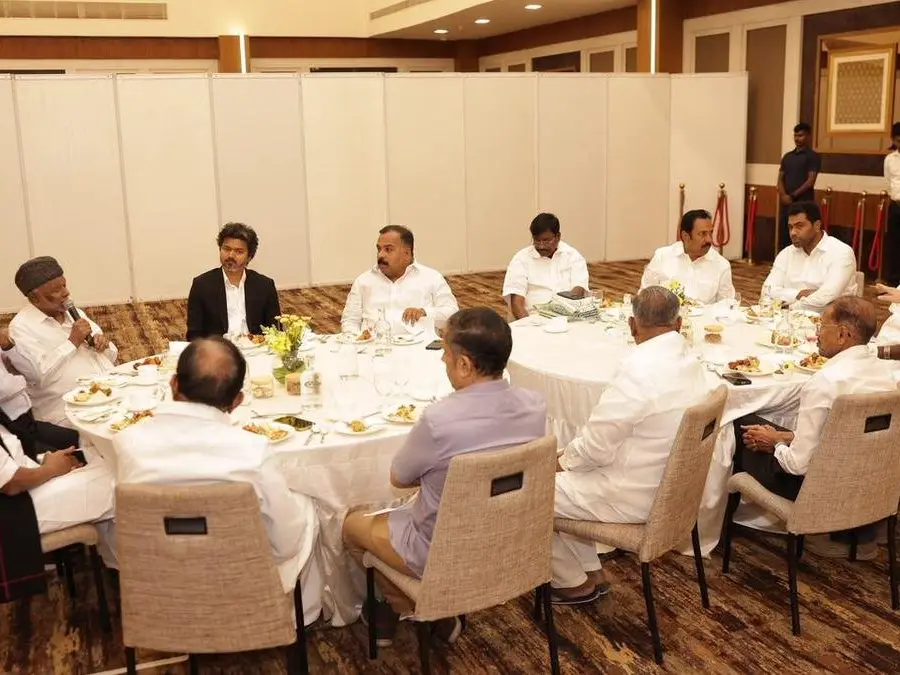
After actor-turned-politician Vijay’s TVK party won the April 2026 assembly elections in Tamil Nadu, the first-ever consultative meeting among the TVK government's coalition partners took place near Chennai last week. This gathering marks a significant step forward in fostering collaboration and unity among the partners. Manickam Tagore, MP, the new Tamil Nadu Congress President, calls this is a ‘good start.’ Though the Left parties did not attend the meeting, other coalition members participated in the discussion with a positive attitude. In Tamil Nadu politics, May 10th, 2026 (swearing-in of Chief Minister Vijay and his cabinet colleagues) is historic, and TVK’s victory will always be remembered.
Further, the formation of the coalition government is a ‘new social justice’ in Tamil Nadu politics. The bigger question is how the TVK, a newbie in Tamil Nadu politics, can synergise with its allies and negotiate the rough-and-tumble of the state's politics.
Tamil Nadu's political landscape has changed significantly, shifting from a bipolar system to a coalition government after 59 years. To improve cooperation, mutual trust and increase power-sharing among coalition partners, several constructive recommendations are proposed here.
Since coalition dharma is new to Tamil Nadu politics, it is imperative to appoint conveners at the state, district, and block levels to strengthen the coalition framework and address alliance partners' grievances. The state convenor bears the critical responsibility of conducting regular monthly meetings with the directly allied political parties, as well as those providing external support. It is essential that significant discussions, encompassing policy-level issues, divergent viewpoints, and Centre-State relations, are effectively managed at the state level. The convener should enhance the stability of a coalition government; it is crucial to ensure a fair distribution of power among the participating parties across all sectors. It is better to formulate a Common Minimum Programme.
Trending Stories
&imwidth=180&imheight=135&format=webp&quality=medium)
Gravitas | Iran threatens to hit key bridges in 7 countries if US resumes strikes
&imwidth=180&imheight=135&format=webp&quality=medium)
US midterms 2026: Dan Sullivan’s ‘gotcha’ attempt backfires against Mary Peltola in fiery Alaska Senate debate
&imwidth=180&imheight=135&format=webp&quality=medium)
India's Gen Z rebellion: Can the 'Lehra Do Tiranga' movement reshape the political order? | The Verdict
&imwidth=180&imheight=135&format=webp&quality=medium)
'We are not sitting in ivory towers, we are aware': SC issues notice to Rahul Gandhi, Akhilesh Yadav
&imwidth=180&imheight=135&format=webp&quality=medium)
CJP's Tiranga march: People hit streets of Delhi again, reiterate call for Gyanesh Kumar's resignation

Not Khan but Pal: Why did Imran Khan choose his mother's surname over his father's? Family tree explained
&imwidth=180&imheight=135&format=webp&quality=medium)
‘Pee-wee Herman’: Trump mocks Jon Ossoff’s appearance at Georgia rally, repeats false claim about El-Sayed
&im=FitAndFill=(700,400)&imwidth=180&imheight=135&format=webp&quality=medium)
New Friday OTT releases (October 16, 2026): DC, Sacrifice, Aasha- 6 new movies and TV shows coming on Netflix, Zee 5, Prime Video and more
&imwidth=180&imheight=135&format=webp&quality=medium)
Delhi police places CJP's Abhijeet Dipke under preventive arrest over breach of peace, AISA Chief Neha Bora released
&im=FitAndFill=(700,400)&imwidth=180&imheight=135&format=webp&quality=medium)
Inside Tesla's Roadster: 10 features of Elon Musk's 'flying car' that push the limits of electric vehicles | In Pics
&imwidth=180&imheight=135&format=webp&quality=medium)
Group's fibre-optic drones pose new challenge for Israel
&imwidth=180&imheight=135&format=webp&quality=medium)
Did Trump just fire Katie Zacharia as his new press secretary? Here’s what he said
&imwidth=180&imheight=135&format=webp&quality=medium)
Pakistan to head IMF, World Bank boards after 74 years amid persistent economic crisis
&imwidth=180&imheight=135&format=webp&quality=medium)
US midterms 2026: Ken Paxton may have Elon Musk to thank if he wins the Texas Senate race. Here's why
&imwidth=180&imheight=135&format=webp&quality=medium)
China tells Israel to stop West Bank settlements, calls Palestine issue ‘historic injustice’
&imwidth=180&imheight=135&format=webp&quality=medium)
BCCI names India’s ODI squad for New Zealand tour, Gill and Iyer to share captaincy
&imwidth=180&imheight=135&format=webp&quality=medium)
Iran rejects Saudi allegations of backing Houthi attacks, renews mediation offer
&imwidth=180&imheight=135&format=webp&quality=medium)
A secret code, a midnight escape and 300 deaths: The Russian officer who turned on Putin
&imwidth=180&imheight=135&format=webp&quality=medium)
Vijay Deverakonda and Rashmika Mandanna's Ranabaali X Review: Netizens call it history-rich but overstuffed
&imwidth=180&imheight=135&format=webp&quality=medium)
Ukraine drone strike disrupts 22 Russian airports, over 200 flights
&imwidth=180&imheight=135&format=webp&quality=medium)
After ODIs, T20Is and Tests, cricket set to introduce a new format: All you need to know
&im=FitAndFill=(700,400)&imwidth=180&imheight=135&format=webp&quality=medium)
Salman Khan-Karisma Kapoor reunion at Koffee with Karan season 9 sparks nostalgia: A look at their most loved films
&imwidth=180&imheight=135&format=webp&quality=medium)
Trump invokes national interest to waive new Russia sanctions, tariffs; India gets relief from 100% tariff threat
&imwidth=180&imheight=135&format=webp&quality=medium)
Russian woman and Bihar boy's love story goes viral after she reaches India to marry him
&imwidth=180&imheight=135&format=webp&quality=medium)
‘My president, I mean my husband’: Trump's new press secretary Katie Zacharia's first briefing goes off the rails in 14 minutes
&imwidth=180&imheight=135&format=webp&quality=medium)
Selma Blair’s team responds to flight incident, says actress ‘did not intend to harm anyone’
&imwidth=180&imheight=135&format=webp&quality=medium)
Here’s who is eyeing the White House press secretary role after Katie Zacharia’s exit
&im=FitAndFill=(700,400)&imwidth=180&imheight=135&format=webp&quality=medium)
Who left the White House podium the fastest? Press secretaries with the shortest stints
&imwidth=180&imheight=135&format=webp&quality=medium)
Ankita Bhandari murder case: Parents meet CBI, seek impartial investigation
&imwidth=180&imheight=135&format=webp&quality=medium)
Oregon school shooting: 16-year-old shooter identified, used shotgun bought by mother; Trump praises bystander who shot gunman as 'great hero'
&imwidth=180&imheight=135&format=webp&quality=medium)
US midterms 2026: Alexandria Ocasio-Cortez donates $1 million to Abdul El-Sayed’s as Michigan race heats up
&imwidth=180&imheight=135&format=webp&quality=medium)
Israel examines Russia's Shahed-type drones sent by Ukraine to combat Iran | Gravitas
&imwidth=180&imheight=135&format=webp&quality=medium)
India’s naval priorities: Ex-Navy Chief calls for third aircraft carrier, more warships and submarines
&imwidth=180&imheight=135&format=webp&quality=medium)
Abhishek Sharma sets all-time record for most T20I sixes in a year
&imwidth=180&imheight=135&format=webp&quality=medium)
China responds to Trump's Press Secretary Katie Zacharia after toilet remark: 'Visit China more often'
&imwidth=180&imheight=135&format=webp&quality=medium)
US budget deficit nears $2 trn as tariff refunds rise; debt crosses $40 trn
For decades, the Congress Party was in the DMK alliance. The recent poll results prompted the Congress to quit the DMK alliance and partner with the TVK. This process could have hurt TVK candidates who lost in the five constituencies where Congress candidates won. The TVK leadership should address this and help heal the wounds of the past.
To strengthen the coalition and enable jointness on the ground, it is important to inform the district presidents and MLAs of the coalition parties whenever the Ministers visit their districts. Recently, it was encouraging to witness TVK flags displayed to welcome the Tourism minister Rajesh Kumar(a Congress MLA) during his visit to several locations near Chennai.
It is important to impress upon the two Dravidian majors that offering a share in power should also apply to local elections, without conflicts among coalition partners. Therefore, the TVK's alliance partners should carefully dissect and discuss each mayoral position, panchayat, municipality, and ward with the coalition partners. Winning every local body seat should be treated as a high-priority goal; this is essential for the TVK's Government in the state and helps the party prepare for the next parliamentary poll.
Regular meetings of coalition partners' MLAs help them face assembly sessions with courage and determination against the DMK and AIADMK. Those within the alliance must be willing to openly speak about how the TVK Government is treating them with fraternal affection, as opposed to how the DMK had treated them back in the day.
In the interest of transparency and democratic functioning, it is important for all members of the coalition government to provide necessary updates to the media regarding the establishment of a secular coalition government. This communication helps inform the public about the government's intentions and structure. To effectively communicate the benefits and welfare measures of the coalition government's policies, it is crucial to organise a series of public and street meetings that bring together coalition partners.
Further, a robust social media strategy needs to be implemented to ensure that all the IT Wings are well coordinated in actively promoting and defending the coalition's policies. This would also involve crafting timely and thoughtful responses to opposition critiques, which will not only bolster the coalition's standing but also foster a sense of unity and purpose among its stakeholders.
The recent success of the TVK in Tamil Nadu has changed the state's political dynamics, with many supporters and veteran leaders from established parties switching their loyalty. However, TVK leaders should not accept disgraced opposition MLAs or former members, as this could harm their reputation.
In the context of Tamil Nadu, coalition governance and power sharing represent a novel approach. This historic moment ought to be preserved. To sustain this important achievement, it is essential to build mutual respect, dignity, and fair power-sharing among coalition partners. If the coalition leaders achieve these goals, the government will successfully complete its five-year term. Moreover, future governments in Tamil Nadu could potentially form coalitions to enhance governance and address the diverse needs of the state's population.
