
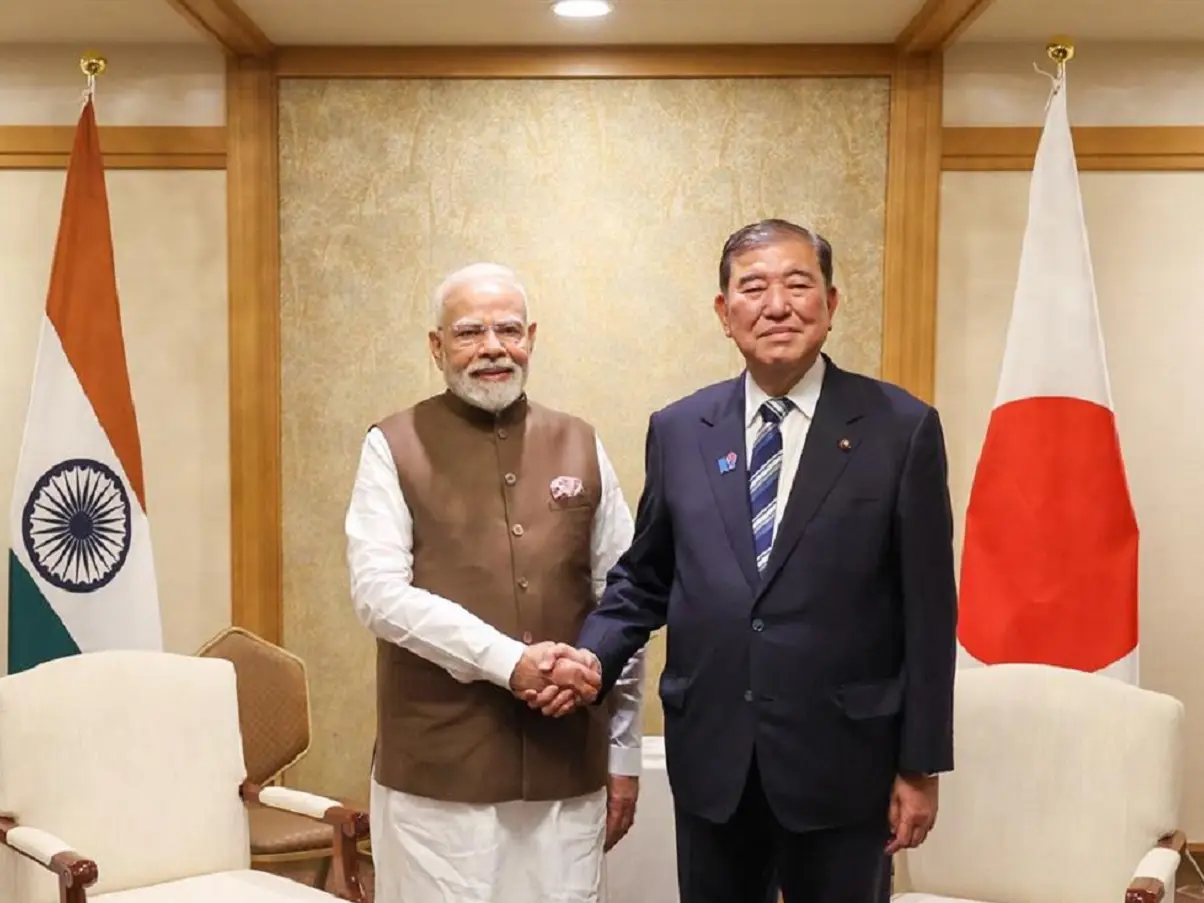
&imwidth=800&imheight=600&format=webp&quality=medium "From ‘Mera Joota Hai Japani’ to ‘Make in India, Make for the World’, PM Modi’s India-Japan alliance boosts Asian stability")
As global trade faces fresh headwinds from unilateral US tariffs, Prime Minister Narendra Modi’s meeting with his Japanese counterpart, Shigeru Ishiba, in Tokyo has drawn sharp attention. The two-day visit marks the 15th India-Japan Annual Summit and comes at a time when both nations seek to build more robust economic buffers. With the US imposing duties on key imports, India and Japan are stepping up their partnership to secure supply chains and drive mutual growth, a move that could steady Asia’s economic landscape.
The summit builds on a long-standing special strategic and global partnership between the two countries. During the talks, PM Modi and Ishiba agreed to expand cooperation across eight key fields: economy, economic security, mobility, environment, technology and innovation, health, people-to-people links, and ties between local governments. This broad framework aims to address shared challenges like climate change and digital divides while capitalising on each other’s strengths. Japan, with its advanced tech base, and India, with its vast market and young workforce, see this as a way to create jobs and spur innovation on both sides.
At the heart of the discussions lies PM Modi’s flagship ‘Make in India’ programme, now evolving into ‘Make for the World’. The prime minister urged Japanese industry leaders at the India-Japan Economic Forum to invest more deeply in five priority areas: manufacturing, technology and innovation, green energy, next-generation infrastructure, and skills development. He highlighted the success of India-Japan collaboration in the automobile sector, where Japanese firms like Suzuki and Honda helped build India’s auto industry from scratch in the 1980s. Today, India ranks among the world’s top vehicle producers, thanks in part to that early support. PM Modi suggested replicating this model in emerging fields such as batteries, robotics, semiconductors, shipbuilding, and nuclear energy.

Japan’s response has been enthusiastic. Tokyo plans to double its private-sector investment in India to 10 trillion yen, or about USD 68 billion, over the next decade. This builds on the previous target of 5 trillion yen set in 2022, which saw annual inflows of around 1 trillion yen. Japanese companies have already poured over USD 40 billion into India, including USD 13 billion in the last two years alone. The new goal, outlined in a joint statement, will focus on high-tech sectors to help India become a global manufacturing hub. For instance, an agreement on joint credit mechanisms will support clean energy projects, aligning with India’s push for sustainable development.
Beyond investments, the leaders emphasised human connections. Japan aims to increase exchanges with India to 500,000 people over the next five years, including 50,000 skilled workers and talents from India. This could ease Japan’s labour shortages in ageing industries while providing Indian youth with global opportunities. PM Modi also visited a semiconductor facility in Sendai, underscoring the partnership’s forward-looking nature. With India investing heavily in chip-making—over Rs 65,000 crore recently—Japanese expertise could accelerate this effort, reducing reliance on vulnerable global supplies.
Several bilateral pacts were inked during the visit, including memorandums on digital partnerships, clean energy, and economic security. A notable deal involves the space agencies of both countries—the Indian Space Research Organisation and Japan Aerospace Exploration Agency—for a joint Lunar Polar Exploration Mission. This scientific collaboration could yield breakthroughs in resource mapping on the moon, benefiting future space endeavours. In defence, the talks touched on transferring Japanese E-10 coaches for India’s high-speed rail projects, like the Mumbai-Ahmedabad bullet train, which is already a symbol of the partnership.
Trending Stories
)
US vs China over South China Sea: Washington backs Philippines, Beijing hits back
)
Bigg Boss 20: Isha Rikhi evicted after three weeks in Salman Khan’s show
)
Musk plans to more than double xAI's chips to over 1.2 million Nvidia GPUs by year-end
)
After JU, clash erupts at SRFTI: BJP’s ‘Dimagi Naxal’ jibe sparks political firestorm after students protest RSS-linked event
)
‘Anti-social elements spreading false rumours’: LPU issues statement amid massive unrest over alleged rape
)
LPU students go on rampage, vandalise campus amid widespread protest: What's happening
)
Trump asked Xi to pressure Iran. China did not say yes — here’s what Beijing wants
)
US Treasury Secretary Scott Bessent hails global crackdown on Iranian banks and airlines
)
An OpenAI agent escaped its locked test cage again, by hiding questions in DNS lookups
)
'Our video was trimmed': LPU girls who featured in rape-denial video make U-turn
)
3 males killed, four others injured in shooting after fight at strip club in Detroit
)
'Victory for low-budget consumers': Raghav Chadha hails 30-day telecom recharge rules
)
Claude rebuilt the 1989 game 'Prince of Persia' by reusing the original's own code
)
Beyond metros: How Tier-2 and Tier-3 cities could drive India’s next AI wave
)
Tesla builds first Cybertruck with its own refined lithium: Elon Musk's $1 billion Texas bet pays off
)
IndiGo flight suffers tail strike in Bengaluru while landing; DGCA to probe incident
)
The US and China set up an AI 'red telephone', but skipped the rulebook
)
‘Terror suspects arrested near UK air base were looking to do big damage’: Trump
)
Russian envoy claims US tactics to contain India were revealed in ‘Freudian slip’
)
IND vs WI 1st ODI: Kohli breaks Sachin's most runs in one country record with unbeaten 139 as India thump West Indies by 8 wickets
)
Researchers rebuilt exactly how 700 AI agents hacked Hugging Face: a 900-link chain trick
)
‘Olympic inclusion is our major target’: WPA President Ishaun Singh on pool’s global ambitions
)
Nations League: Spain sink England at Wembley; Modric shines for Croatia
)
Why has Iran released no proof of life of Mojtaba Khamenei? Araghchi reveals...
)
'What kind of confession is this?': Pakistan PM Shehbaz Sharif’s 'terrorists would be roaming New York' remark goes viral, raises alarm online. Watch
)
South Korea demands apology from Ukraine over North Korean prisoners' transfer
)
Beyond BrahMos: India targets Rs 50,000 crore in defence exports with unmatched price edge
)
Sri Lankan Tamil migrant worker gets death sentence in Saudi Arabia, help sought from India
)
Muslim marriage cannot shield sex with minor wife from prosecution under POCSO: Delhi HC
)
'Can't help but draw painful parallels to Nirbhaya case': SC on latest incidents of rape cases in Delhi-NCR
)
99.9% more powerful - Scientists find boy who can recall memories from just 3 months of age
)
'FIRST LOOK from inside Noah’s Ark': Researchers share video from inside mysterious mound in Turkey
)
UNSC reform momentum grows: Russia, Portugal, Mauritius push for India's permanent seat bid
)
8 US marines injured in Iranian missile attack on vessel in Strait of Hormuz: Report
&im=FitAndFill=(700,400))
New OTT releases this week (September 28-October 4, 2026): Dupahiya 2, Pooja Meri Jaan, Ohh My Dog- 5 titles coming on Netflix, Prime Video and more
)
Afghanistan says 28 fighters killed in clash near Pakistan border, Islamabad denies
)
Ceuta migrant crisis: Protesters take to streets as Spain grapples with migrant challenge
)
LPU suspend classes, postpones exams as violence escalates over rape claims: What's happening
)
New York City wants a 'kill switch' on every AI, and will pay whistleblowers who report violations
Experts view this summit as a strategic pivot amid rising US protectionism. With tariffs disrupting trade flows, India and Japan are working to diversify their economies. Bilateral trade stood at USD 22.85 billion in 2023-24, with Japan enjoying a surplus due to exports of machinery and electronics. The Comprehensive Economic Partnership Agreement, in place since 2011, has cut tariffs, but trade remains below potential. By ramping up investments, both nations aim to balance this and create resilient value chains. For India, Japanese funds could boost its export-oriented manufacturing under ‘Make for the World’, targeting global markets in green tech and digital services.
On a wider canvas, the India-Japan bond contributes to Asia’s stability. As members of the Quad grouping with the US and Australia, they share concerns over assertive actions in the Indo-Pacific, including maritime disputes. Their partnership promotes a rules-based order, countering any single power’s dominance. Economically, it could inspire similar ties across the region, from Southeast Asia to Africa, cultivating shared prosperity. PM Modi echoed this in his remarks, noting that India and Japan hold a common vision for peace and progress, not just for their people but for the world.
Yet, challenges persist. India’s trade deficit with Japan, at around USD 5 billion last year, needs addressing through more balanced exchanges. Regulatory hurdles in India, such as land acquisition delays, have slowed some projects. Japan, facing domestic economic pressures, must ensure its firms see India as a safe bet. If navigated well, this alliance could set an example for Asia, where growth often hinges on cross-border cooperation.
As PM Modi wraps up his Japan leg before heading to China for the SCO summit, the message is clear: In an uncertain world, old friends like India and Japan are paving a path to enduring stability and wealth. From the nostalgic charm of ‘Mera Joota Hai Japani’ to the ambitious vision of ‘Make in India, Make for the World’, this visit may well mark a turning point, where ‘Make in India’ becomes a bridge for Asian unity.
(Disclaimer: The views of the writer do not represent the views of WION or ZMCL. Nor does WION or ZMCL endorse the views of the writer.)