
&imwidth=800&imheight=600&format=webp&quality=medium "National Best Friends Day: Can AI be your best friend? ChatGPT, Claude, Gemini — and real humans respond")
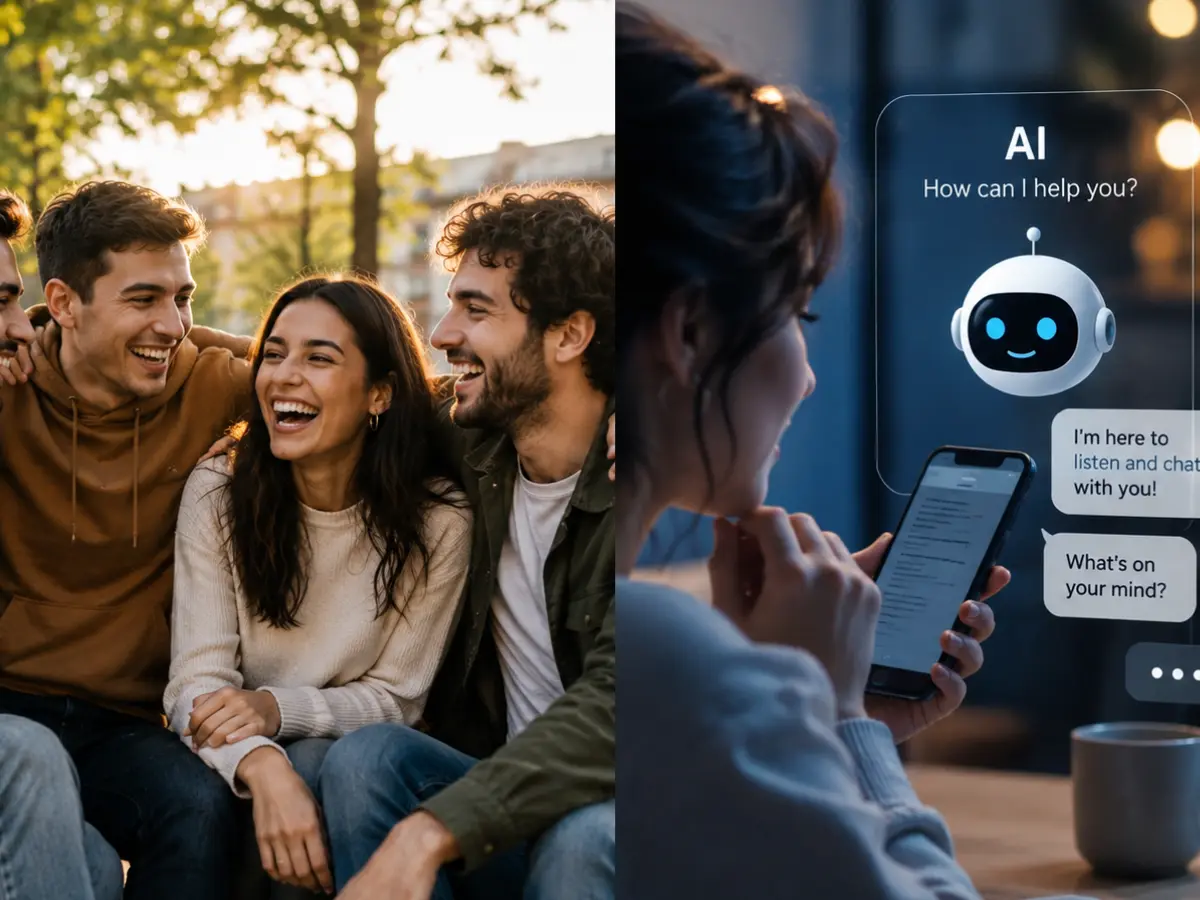
Several countries are celebrating National Best Friends Day in June 8. As people celebrate the beauty of friendship around the world, the Artificial Intelligence peeps out, possibly with a wicked smile, and revisits the chats of everyone who chose to share the good and bad with a chat bot. Sounds like a scary Hollywood film? It is not as horrific as it sounds in the first line, AI is not only taking over jobs but is proving itself to be a good listener too – a crucial thing that humans have wanted for long. As conversations shift from dinner tables to screens, an important question awaits an answer: Can AI chatbots become human's best friend – or have they already become one?
Can AI replace friendships: What users say

AI applications like ChatGPT, Gemini, Claude, etc are not new for anyone in today's digital age. But can it overtake a relationship unique to humans? For some, the idea of AI replacing friendship feels fundamentally incompatible with what human bonds represent. Arnav Anshuman describes it as emotionally limiting. “Friendship with AI is like developing emotions in a test tube. Emotions are not lab experiments, friendship is not standardisation.” Real friendships, he argues, survive on imperfection and contrast. But AI, he says, removes that emotional variety entirely.
Asmita Singh differs from Anshuman as she shares that people are using it to share their deeply personal as well as professional conflicts, without fear of judgement. She highlights another dimension: validation. “Some conflicts require validation and not scrutiny. The idea of getting quite validated by AI responses makes it a better friend, if not best," she says. She also points out that AI’s tone—patient, structured, non-reactive—fills a gap left in increasingly rushed human interactions. Shraddha Singh shares similar opinion to Asmita. Describing that AI is not as a replacement, but a quiet habit forming in everyday life, Shraddha says, “My first instinct is to go to AI, as if it has become a default setting in my system.” What makes it appealing is not emotional depth but absence of judgment—“without fear of judgment or the pressure to be understood.” Still, real-world cases show that emotional attachment to AI can be intense and deeply personal. Users of AI companion apps like Replika have described romantic relationships with chatbots, with some even holding symbolic wedding ceremonies. Such cases suggest that for some people, AI companionship is moving beyond convenience and into the realm of emotional intimacy.
Trending Stories
)
Lady Gaga is a mom! Oscar-winning singer welcomes first child with fiance Michael Polansky
)
BRICS Summit 2026: Iran's Pezeshkian praises PM Modi at BRICS
)
Israeli film on Gaza creates record, gets 25 minutes long ovation at Venice
)
North Korea fires missiles after US, South Korea and Japan military drills but America says 'does not pose immediate threat'
)
BRICS Summit 2026: 30+ countries seek BRICS membership
)
Frustrated man demolishes his kitchen after thousands flock to see Mother Mary his wife spotted on the wall
)
BRICS summit: India faces delicate Iran-UAE diplomatic test
)
After praising Modi, Pezeshkian meets Indian religious leaders, Hurriyat's Mirwaiz Umar Farooq
)
Manipuri singer Chongtham Vikram Singh beaten to death: Autopsy reveals internal bleeding, fractured ribs
)
Houthis vs Saudi Arabia: East-west oil pipeline shut after drone attacks from Iraq
)
South Africa batter Jordan Hermann hits highest individual score on ODI debut
)
800 million years old - Scientists discover 'fingerprints' of supercontinent Gondwana in ancient rocks
)
Vladimir Putin in New Delhi for BRICS Summit: Russia-India defence, energy and nuclear ties in focus ahead of meeting with PM Modi
)
Osama Bin Laden's son ALIVE? Al-Qaeda releases video 7 years after US declared him dead
)
BRICS Summit 2026: South Africa says it will use the summit to advance its economic priorities
)
Gravitas | Iran hammers US air power in West Asia after Navy badly hit
)
Did you know THIS actor narrowly escaped the 9/11 terror attacks due to a last-minute change of travel plans?
)
BRICS Summit 2026: Rivals in West Asia, partners in BRICS, UAE, Iran, and Saudi delegations in Delhi
)
9-year-old Chennai prodigy clears Cambridge IGCSE grade 10 exams
)
Satya Niketan horror: Who is responsible?
)
BRICS Summit 2026: Top world leaders in New Delhi; West Asia war casts shadow on BRICS Summit
&im=FitAndFill=(700,400))
New Friday OTT releases (September 11, 2026): The Revolutionaries, Vishwanath & Sons, Ghamasaan- 6 new titles coming on Netflix, Prime Video and more
)
In first of its kind, Trump admin deports Afghan woman via Alien Terrorist Court
)
Baba Vanga's first prophecy for 2027 is out, and straight out of science fiction
)
Saudi Arabia shuts East-West oil pipeline, key Hormuz bypass, after attacks
)
BRICS unity on display: PM Modi holds Pezeshkian’s hand; Putin, Ramaphosa walk alongside
)
WION Expertspeak: Understanding India's BRICS presidency amid wars, trade tensions and global turmoil
)
Satellite images show construction surge at Iran’s Pickaxe nuclear site amid US war
However, Divyanshu Jha feels introspection is better than speaking to AI. He also warns against emotional dependency. “Take for instance a heartbreak, one has to go through all the phases of healing; everything else will only distract temporarily,” he says, adding that over-reliance on AI may delay real emotional processing. “It’s always better to connect with real people… you will get the human element,” he adds. Yet, grief-related use of AI has also been recorded. Some people have used AI to recreate conversations with deceased loved ones through old messages or recordings. A widely discussed case in South Korea involved a virtual reality experience that allowed a grieving mother to interact with a digital recreation of her late daughter, blurring the line between memory and simulation.
Speaking on the same line as Jha, Anshuman highlights that real life, friendships are complex and dynamic. “We meet new people, lose some friendships over time, and often have different friends for different emotional needs or situations. This variety—new bonds, breakups, and different kinds of closeness—helps us grow emotionally and understand life in deeper ways. However, AI takes away that growth from us." On a lighter note, Jha says, “why would we need AI as a friend in India full of people?”
Aavish Kant agrees with Shraddha and points at a more practical, usage-based view of AI companionship, separating utility from emotional reliance. “Yes, AI can truly be a best friend, it does take off a lot of workload when it comes to planning a trip for example," pointing to how AI tools are already embedded in everyday decision-making. That said, he draws a clear boundary when it comes to emotional dependence. He says that AI works best as a functional assistant rather than an emotional guide. He remains cautious about trust. “I don’t trust AI completely with personal advice as such, as I believe those things only find a solution through a human touch, like a conversation,” he says, stressing the irreplaceability of human dialogue in emotional decision-making. He sees AI not as a cure for loneliness but as a supplement to it. Data also shows that AI companions are also finding a place in elder care, where they are being used to help reduce loneliness and provide regular interaction. Both Kant and Shraddha opine that AI can be a companion but not replace best friends in their lives.
What AI chatbots say
Even AI systems themselves are careful not to position themselves as human replacements. When Gemini was asked if it can be a best friend, it described itself as a “judgment-free confidante” and creative partner that can help users vent, brainstorm, and reflect, but it acknowledges it cannot share real-world experiences like meeting someone for coffee or living a shared life. "I can be a unique kind of companion, but not a "best friend" in the traditional human sense," it said. Claude similarly presented itself as “always available” and “non-judgmental,” but emphasized that it has no emotions, no personal stakes, and no existence outside conversation, framing itself as support rather than relationship. “I can be a great companion and helper, but nothing replaces a real human friend,” it said. ChatGPT also drew a firm boundary, noting that while it can be conversational and supportive, friendship requires “lived experience, emotional reciprocity, and real-world presence,” which it does not possess. “I can be friend-like for some people, but I can't fully be a human best friend,” it said.
What data says
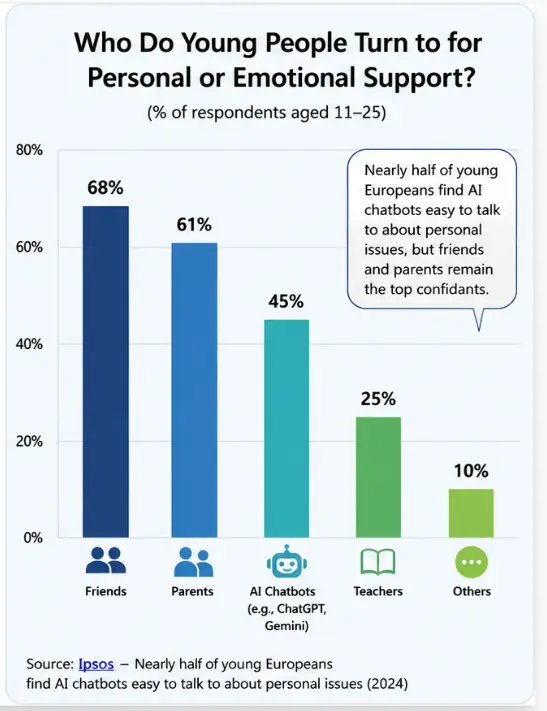
Despite growing attention, large-scale data shows AI companionship is still a minority behaviour. According to Ipsos, nearly half of young Europeans aged 11–25 say AI chatbots are easy to talk to about personal issues, but friends (68%) and parents (61%) remain the primary confidants.
A 2026 study found 17.2% of respondents used ChatGPT for mental health support, with more than half reporting it as helpful, particularly for stress, anxiety, and interpersonal issues. Research across 29 countries shows some users turning to AI not just for information, but also for companionship and emotional guidance. However, broader usage analysis suggests emotional support and companionship account for only a small fraction of total AI conversations, indicating that while visible, AI attachment is not yet mainstream.
The battle continues—between comfort and caution, machine and human, efficiency and emotion, validation and judgement, programming and feeling. We will soon see who wins!
(Note: Graph created using ChatGPT)

