ISRO releases majestic images of Earth and Moon captured by Chandrayaan-3

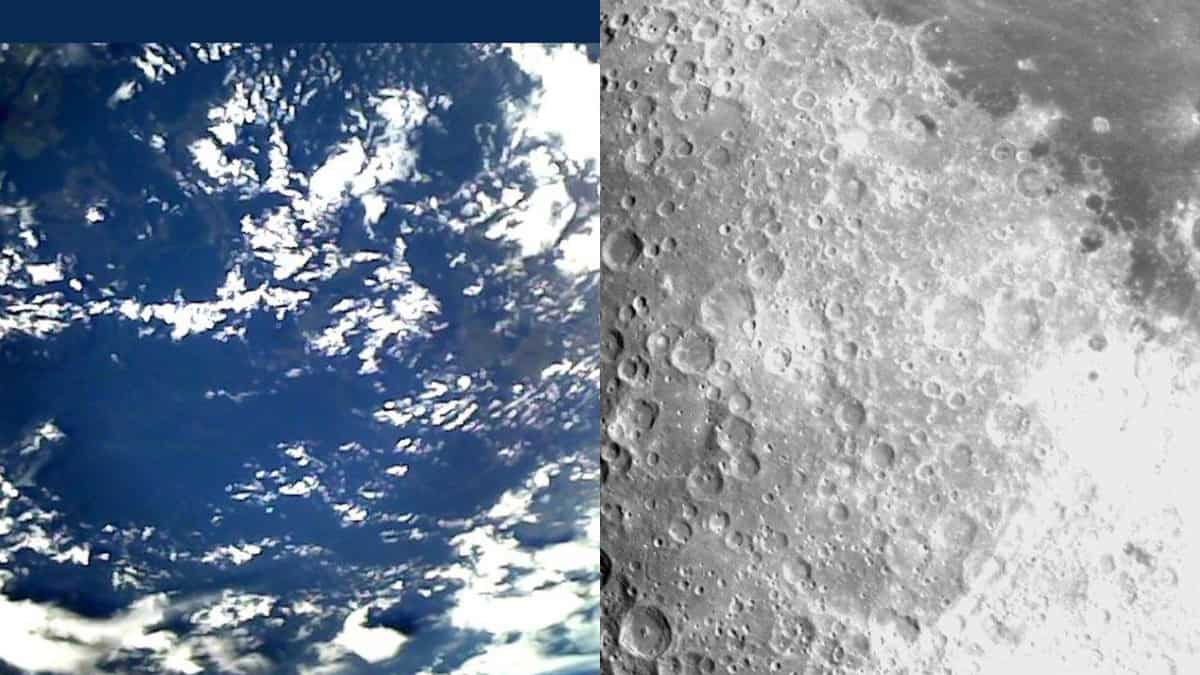
The images released by Chandrayaan-3
Ahead of the highly anticipated Chandrayaan-3 landing, scheduled to take place later this month, theIndian Space Research Organisation (ISRO) on Thursday (August 10) shared a set of fresh images of the Moon and Earth captured by the lunar spacecraft.
One of the first images has been taken on July 14 when the mission was launched from theSatish Dhawan Space Centre in Sriharikota, located in the southern Indian state of Andhra Pradesh. The first image shows Earth as viewed by the Lander Image Camera.
The second image, captured by Lander Horizontal Velocity Camera (LHVC) showed the craters Aristarchus, Eddington and Pythagoras along with one of the dark plains on the lunar surfaceOceanus Procellarum.

Netizens applaud the pictures
Netizens and admirers of ISRO were truly awestruck by the images released and took to X, formerly known as Twitter, to share their happiness.
"No Matter how far we venture into otherworldly realms, the allure of Earth's beauty remains unparalleled..," posted one while another added, "We've been waiting for this. Image of Earth from Lander and Moon. #ISRO #Chandrayaan3. Perhaps we were a bit too eager in our demands for photos from @isro. Proud to be witnessing this."
"Sending all my positive energy and heartfelt wishes to the incredible team behind Chandrayaan 3! You are true pioneers, and I believe in your courage and determination to achieve great things. Reach for the stars!," posted another.
)
Harry Brook targets long reign at top of T20I rankings after Sri Lanka sweep
)
North Korea's nuclear tests triggered 1,399 earthquakes: Earth is still shaking | Gravitas
)
China now makes advanced memory chips without the machines it was banned from buying
)
Ed Sheeran addresses Macklemore's removal, Gaza conflict during Philadelphia concert: 'I cannot hide how I feel'
)
Sikh bus driver assaulted, bus stolen and rammed into cars in England; video surfaces
)
Munich Mayor taps first keg to kick off Oktoberfest
)
Trump in ‘deciding mode’ on Iran, says ‘very big things’ going to happen soon
&im=FitAndFill=(700,400))
Top 10 countries in mathematics: See the world’s best performers in 2026
)
Saudi vs Houthis: Houthis claim missiles & drones used in attack on key Saudi sites
)
Trump defends AI amid growing alarm, announces new 'AI force' and promises an 'AI czar'
)
'Lot of things to learn from experienced players': Jayasuriya backs Rohit, Virat for 2027 ODI World Cup
)
BTS' fans question iHeartRadio’s treatment of group after brief festival set
)
Arvind Kejriwal, family members, Delhi CM Rekha Gupta get SIR notices
&im=FitAndFill=(700,400))
What TSMC's 2nm technology means for Apple
)
Iran sets 7 conditions to end war with US: What are Tehran’s demands?
)
S Jaishankar, former Army chief among high-profile names issued Delhi SIR notices
)
'Were you here to sell chickpeas?': Wasim Akram criticises Babar Azam's captaincy
)
West Indies Squad for India Series: Hetmyer included for T20Is, Holder rested
)
Mark Carney mimics Trump in hilarious moment over C$70 billion clean-energy investment; room erupts in laughter
)
US ships in Indian Ocean ‘will be attacked’ if war resumes, warns Iran
)
‘0% chance’: Nvidia CEO Jensen Huang dismisses AI extinction fears by 2030
)
Saudi Arabia exits China-led mBridge digital currency platform amid Saudi-Houthi conflict
)
Several petrol pumps, other businesses to refuse UPI payments above Rs 2,000 from Oct 16: Is it legal?
)
AUS vs ZIM, 3rd ODI: Ellis stars as Australia edge Zimbabwe by one wicket in last-over thriller
)
Israeli President pardons combat medic who shot dead a badly wounded Palestinian attacker
)
Samsung raises Galaxy S26 prices by Rs 20,000: Here’s what each model now costs
)
Trump announces ‘AI Force’ as debate grows over AI risks and regulation
)
Kampala-Ankara rift deepens: Uganda suspends military ties, seeks Fred Lumbuye's extradition
)
Trump signs Russia sanction bill. How will it impact India? WION Explains
)
Asian Games 2026: India win first medal as women’s 10m air rifle team claims silver
)
AI actress Tilly Norwood glitches mid-interview, switches from English to Chinese | Watch
)
9 women found dead near Johannesburg: South Africans rally, demand 'enough' to femicide
)
Bessent meets China’s He Lifeng to prepare for Trump-Xi summit
)
Trump says he'll build an 'AI Force' and appoint a czar, for 'high IQ' people only
)
Italy to ban burqa and hijab in schools, limit foreign students per class: PM Giorgia Meloni
ISRO chairman confident about landing
ISRO Chairman Dr S Somnath has assured that the Vikram lander will be able to make a soft landing on the Moon's surface, come August 23. He added that the landing is certain even if all the sensors and two of its engines do not work. The Vikram lander is expected to descend on the moon on August 23.
"If everything fails, if all the sensors fail, nothing works, still it (Vikram) will make a landing. That's how it has been designed -- provided that the propulsion system works well," Somnath told PTI.
Watch |Chandrayaan-3 now within moon's gravitational orbit | India | ISRO
Somnathsaid the mission's most critical phase will be the orbit determination process when the spacecraft starts moving closer to the moon from the 100 km circular orbit.
"Up to 100 km we do not see any difficulty. The issues are only an estimation of the position of the lander accurately from Earth. This measurement is a very critical measurement, we call it the orbit determination process. If it is correct, the rest of the process can be done."
(With inputs from agencies)
WATCH WION LIVE HERE: