Iran hijab protests show the limits of people power

Iran hijab protests
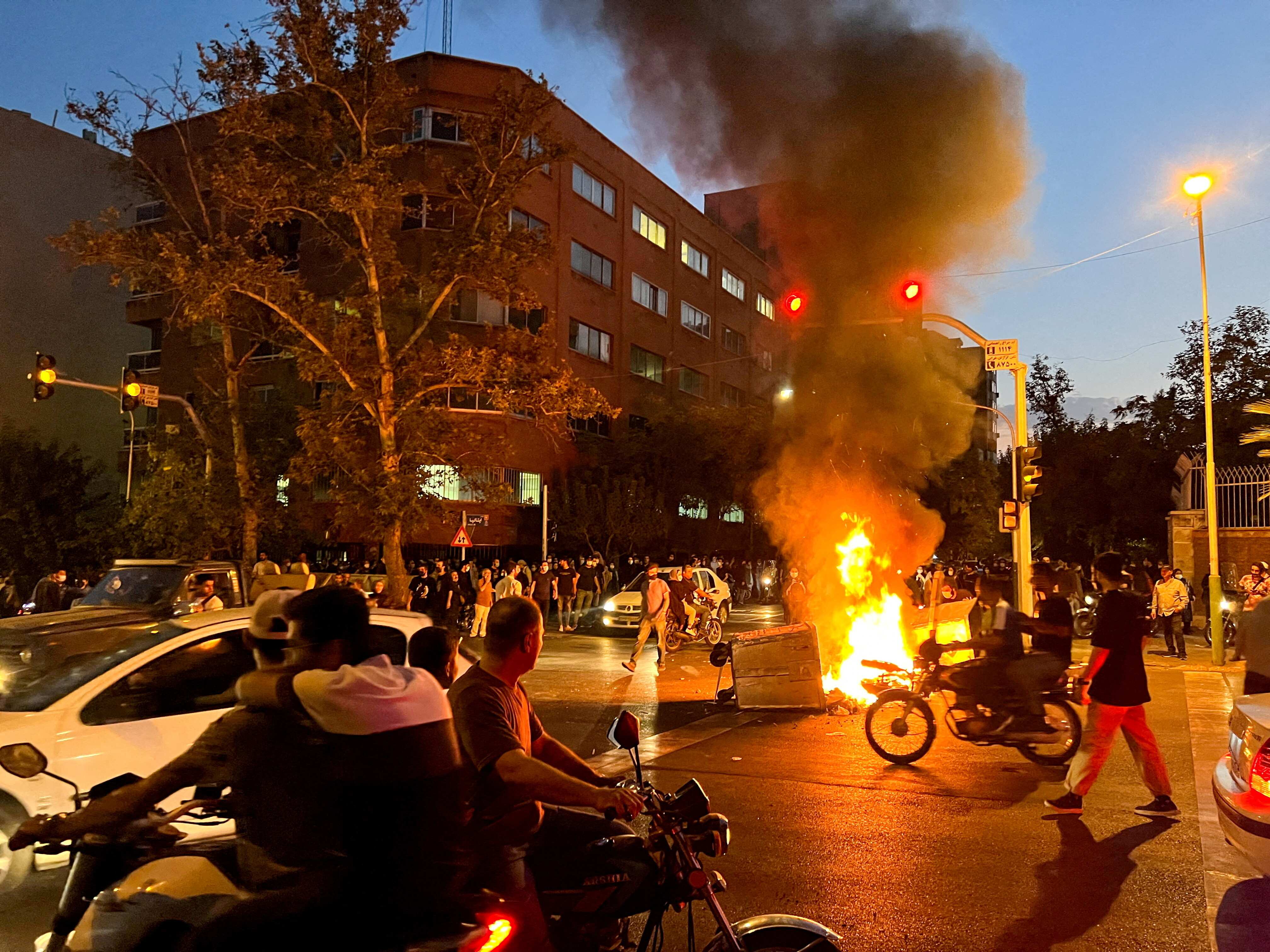
Iran is in the third week of protests sparked by the death of a young woman who was arrested for violating the country’s strict dress code for women and died in the custody of the “morality police.” Her offence: the way she wore her headscarf showed strands of hair.
Since news of the death of 22-year-old Mahsa Amini broke on September 16, Iranian women in cities from one end of the country to the other have reacted with fury, taking of their hijabs and tossing them into bonfires.
Videos of the protests have flashed across social media around the world and focused fresh attention on a theocratic system of governance which controls all aspects of society and makes women second to men. The hijab-burning women’s protests were peaceful but the government responded with a violent crackdown.

By the beginning of October, one advocacy group, the Oslo-based Iran Human Rights, said 133 people had died in the crackdowns. The government put the toll at 41. Iran’s supreme leader, Ayatollah Ali Khamenei, said the protests were orchestrated by “America, the Zionist regime, and the people on their payroll.”
Iran experts saw the hijab demonstrations as the most widespread protests since the so-called Green Revolution which brought millions of Iranians to the streets in anger over what they claimed was blatant fraud in elections that returned the conservative Mahmoud Ahmadinejad to the presidency.
The difference between the two events is fundamental. The Green Revolution, violently suppressed, was political and led by political groups. Its slogan was “Where is my Vote?” The hijab demonstrations were spontaneous and leaderless, with anger spurred by social media postings. The hijab burners’ slogan: “Woman, Life, Liberty.”
)
US vs China over South China Sea: Washington backs Philippines, Beijing hits back
)
Bigg Boss 20: Isha Rikhi evicted after three weeks in Salman Khan’s show
)
Musk plans to more than double xAI's chips to over 1.2 million Nvidia GPUs by year-end
)
After JU, clash erupts at SRFTI: BJP’s ‘Dimagi Naxal’ jibe sparks political firestorm after students protest RSS-linked event
)
‘Anti-social elements spreading false rumours’: LPU issues statement amid massive unrest over alleged rape
)
LPU students go on rampage, vandalise campus amid widespread protest: What's happening
)
Trump asked Xi to pressure Iran. China did not say yes — here’s what Beijing wants
)
US Treasury Secretary Scott Bessent hails global crackdown on Iranian banks and airlines
)
An OpenAI agent escaped its locked test cage again, by hiding questions in DNS lookups
)
'Our video was trimmed': LPU girls who featured in rape-denial video make U-turn
)
3 males killed, four others injured in shooting after fight at strip club in Detroit
)
'Victory for low-budget consumers': Raghav Chadha hails 30-day telecom recharge rules
)
Claude rebuilt the 1989 game 'Prince of Persia' by reusing the original's own code
)
Beyond metros: How Tier-2 and Tier-3 cities could drive India’s next AI wave
)
Tesla builds first Cybertruck with its own refined lithium: Elon Musk's $1 billion Texas bet pays off
)
IndiGo flight suffers tail strike in Bengaluru while landing; DGCA to probe incident
)
The US and China set up an AI 'red telephone', but skipped the rulebook
)
‘Terror suspects arrested near UK air base were looking to do big damage’: Trump
)
Russian envoy claims US tactics to contain India were revealed in ‘Freudian slip’
)
IND vs WI 1st ODI: Kohli breaks Sachin's most runs in one country record with unbeaten 139 as India thump West Indies by 8 wickets
)
Researchers rebuilt exactly how 700 AI agents hacked Hugging Face: a 900-link chain trick
)
‘Olympic inclusion is our major target’: WPA President Ishaun Singh on pool’s global ambitions
)
Nations League: Spain sink England at Wembley; Modric shines for Croatia
)
Why has Iran released no proof of life of Mojtaba Khamenei? Araghchi reveals...
)
'What kind of confession is this?': Pakistan PM Shehbaz Sharif’s 'terrorists would be roaming New York' remark goes viral, raises alarm online. Watch
)
South Korea demands apology from Ukraine over North Korean prisoners' transfer
)
Beyond BrahMos: India targets Rs 50,000 crore in defence exports with unmatched price edge
)
Sri Lankan Tamil migrant worker gets death sentence in Saudi Arabia, help sought from India
)
Muslim marriage cannot shield sex with minor wife from prosecution under POCSO: Delhi HC
)
'Can't help but draw painful parallels to Nirbhaya case': SC on latest incidents of rape cases in Delhi-NCR
)
99.9% more powerful - Scientists find boy who can recall memories from just 3 months of age
)
'FIRST LOOK from inside Noah’s Ark': Researchers share video from inside mysterious mound in Turkey
)
UNSC reform momentum grows: Russia, Portugal, Mauritius push for India's permanent seat bid
)
8 US marines injured in Iranian missile attack on vessel in Strait of Hormuz: Report
&im=FitAndFill=(700,400))
New OTT releases this week (September 28-October 4, 2026): Dupahiya 2, Pooja Meri Jaan, Ohh My Dog- 5 titles coming on Netflix, Prime Video and more
)
Afghanistan says 28 fighters killed in clash near Pakistan border, Islamabad denies
)
Ceuta migrant crisis: Protesters take to streets as Spain grapples with migrant challenge
)
LPU suspend classes, postpones exams as violence escalates over rape claims: What's happening
)
New York City wants a 'kill switch' on every AI, and will pay whistleblowers who report violations
You need to be extremely optimistic to think that the rigid dress code imposed on Iranian women since the downfall of the Shah in 1979 has a chance of returning to the skirts (mini or knee-length) that were not uncommon in Tehran in the 19060s and early 70s.
It is, I think, a safe bet that there will be little or no response (other than blaming “enemies” of Iran) to Iranian women’s desire to have a choice on how to dress.
Early in the millennium, this way of trying to achieve change was often dubbed People Power. It had some influential critics. In an essay in the Atlantic magazine headlined Why Street Protests Don’t Work, the journalist and author Moises Naim said “aerial photos of the anti-government marches show an intimidating sea of people furiously demanding change. And yet it is surprising how little these crowds achieve.”
There have been exceptions. Enormous crowds packing the streets day after day in Tunisia and Egypt during the Arab Spring resulted in the ouster of the countries’ reviled dictators, Zine al-Abidine Ben Ali and Hosni Mubarak respectively.
Researchers at Harvard have noted that after decades of being a significant force for the spread of democracy, People Power has weakened. By the early 2000s, two in three protest movements demanding changes in policy succeeded, according to Erica Chenowitz, a political scientist in charge of monitoring protest movements.
But by the end of the 2010s, the Harvard data base shows, the success rate has halved to one in three. It has declined again from the beginning of the present decade.
Perhaps surprisingly, the Internet and social media played major roles in this trend. They were ideal tools to bring large numbers of people together at short notice but they also weakened the chances for achieving policy changes. Why?
Zeynep Tufekci, a sociologist and professor at the University of North Carolina, had an explanation in an opinion piece in the New York Times. Once an enthusiastic activist and supporter of mass protests, she singled out the lack of a mechanism for translating people power into policy change.
“As I studied many of these movements, I noticed common patterns,” she wrote. “The quickly sprung large movements often floundered for direction once the inevitable pushback came. They didn’t have the tools to navigate the treacherous next phase of politics because they hadn’t needed to build them to get there.”
Mass demonstrations in the past took place after a long-term process of organizing, trying to find at least a few allies in the establishment and establish a leadership structure. In the past, a large demonstration was “an exclamation mark at the end of a sentence,” she wrote.
But since the early 2000s, “a big protest has started to feel more like a sentence that begins with a question mark.”
For long, much of the media have focused on the size of protests as an indicator of the prospect that governments will pay notice and initiate change.
One of the most memorable examples that this is a flawed approach came with what one could call the mother of all protests – demonstrations in capitals from Washington and London to Paris, Berlin and Rome in the run-up to the American invasion of Iraq.
One estimate, by the French academic Dominique Reynié, said that 36 million people across the globe took part in about 3,000 protests against the impending attack. Asked to comment on the vast scale of the protests, U.S. President George W. Bush had this to say a week before the invasion:
“Size of protest – it’s like deciding, well, I’m deciding policy based on a focus group.”
Iran’s Ayatollah Khomeini is not in the habit of answering reporters’ questions, but if he were, his answer would probably quite similar.
(Disclaimer: The views of the writer do not represent the views of WION or ZMCL. Nor does WION or ZMCL endorse the views of the writer.)
