How coronavirus made markets sea of red

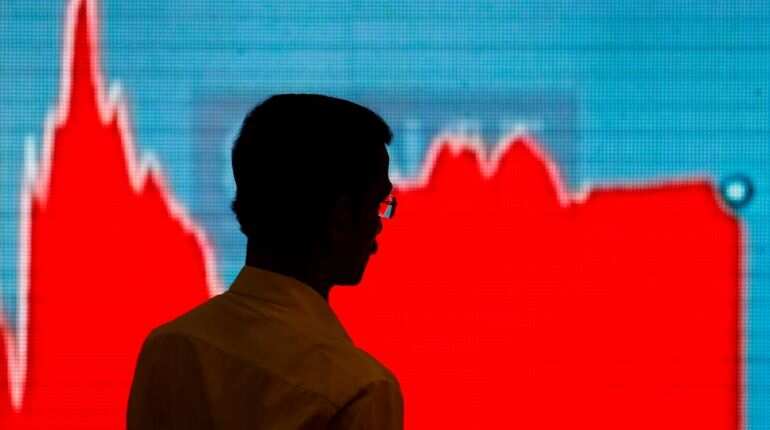
Bombay Stock Exchange
Coronavirus has taken global markets, economies and the world by storm. Global financial markets are witnessing catastrophic bloodbath. Wall Street recorded two of its worst days since Black Monday in quick succession to trade close to 2018 December levels.
European stocks kissed 2012 levels and Indian markets are already trading near three-year lows. There is a huge fear in the market.
Dalal Street’s alchemist Shankar Sharma of First Global feels “Fear is fully justified. All economies are crumbling.

This is a level of distress hasn't been seen before”. We are having economic shutdown in shops, pubs, malls, travel, sporting events, movie shootings, factories you name it. In fact, all countries are shutting borders. The US has banned travel from Europe and the EU has also closed its borders. India has also followed the suit and entry from many countries has either been barred or restricted. All this is a precautionary measure to prevent the spread of the virus as much as possible. The situation in China has improved but now Europe has become the epicentre unexpectedly.
It is clear that Coronavirus is the reason behind fall in markets but let’s take a closer look at it.
Stock Markets are Forward Looking: Stock markets are considered forward-looking and they look at how things will unfold in future. Last year even when economic conditions were not great markets were trading up because they felt that things would improve in 2020 as geopolitical tensions like US-China trade war and Brexit would subside. At the onset of this year, those beliefs manifested when the US and China signed partial trade deal and UK officially left Europe. Even economic indicators had a tone of revival embedded in them. Investors felt that the economy has bottomed out and from here things will improve. At the same time central banks also provided massive liquidity and markets continued to hit a record high.
)
US vs China over South China Sea: Washington backs Philippines, Beijing hits back
)
Bigg Boss 20: Isha Rikhi evicted after three weeks in Salman Khan’s show
)
Musk plans to more than double xAI's chips to over 1.2 million Nvidia GPUs by year-end
)
After JU, clash erupts at SRFTI: BJP’s ‘Dimagi Naxal’ jibe sparks political firestorm after students protest RSS-linked event
)
‘Anti-social elements spreading false rumours’: LPU issues statement amid massive unrest over alleged rape
)
LPU students go on rampage, vandalise campus amid widespread protest: What's happening
)
Trump asked Xi to pressure Iran. China did not say yes — here’s what Beijing wants
)
US Treasury Secretary Scott Bessent hails global crackdown on Iranian banks and airlines
)
An OpenAI agent escaped its locked test cage again, by hiding questions in DNS lookups
)
'Our video was trimmed': LPU girls who featured in rape-denial video make U-turn
)
3 males killed, four others injured in shooting after fight at strip club in Detroit
)
'Victory for low-budget consumers': Raghav Chadha hails 30-day telecom recharge rules
)
Claude rebuilt the 1989 game 'Prince of Persia' by reusing the original's own code
)
Beyond metros: How Tier-2 and Tier-3 cities could drive India’s next AI wave
)
Tesla builds first Cybertruck with its own refined lithium: Elon Musk's $1 billion Texas bet pays off
)
IndiGo flight suffers tail strike in Bengaluru while landing; DGCA to probe incident
)
The US and China set up an AI 'red telephone', but skipped the rulebook
)
‘Terror suspects arrested near UK air base were looking to do big damage’: Trump
)
Russian envoy claims US tactics to contain India were revealed in ‘Freudian slip’
)
IND vs WI 1st ODI: Kohli breaks Sachin's most runs in one country record with unbeaten 139 as India thump West Indies by 8 wickets
)
Researchers rebuilt exactly how 700 AI agents hacked Hugging Face: a 900-link chain trick
)
‘Olympic inclusion is our major target’: WPA President Ishaun Singh on pool’s global ambitions
)
Nations League: Spain sink England at Wembley; Modric shines for Croatia
)
Why has Iran released no proof of life of Mojtaba Khamenei? Araghchi reveals...
)
'What kind of confession is this?': Pakistan PM Shehbaz Sharif’s 'terrorists would be roaming New York' remark goes viral, raises alarm online. Watch
)
South Korea demands apology from Ukraine over North Korean prisoners' transfer
)
Beyond BrahMos: India targets Rs 50,000 crore in defence exports with unmatched price edge
)
Sri Lankan Tamil migrant worker gets death sentence in Saudi Arabia, help sought from India
)
Muslim marriage cannot shield sex with minor wife from prosecution under POCSO: Delhi HC
)
'Can't help but draw painful parallels to Nirbhaya case': SC on latest incidents of rape cases in Delhi-NCR
)
99.9% more powerful - Scientists find boy who can recall memories from just 3 months of age
)
'FIRST LOOK from inside Noah’s Ark': Researchers share video from inside mysterious mound in Turkey
)
UNSC reform momentum grows: Russia, Portugal, Mauritius push for India's permanent seat bid
)
8 US marines injured in Iranian missile attack on vessel in Strait of Hormuz: Report
&im=FitAndFill=(700,400))
New OTT releases this week (September 28-October 4, 2026): Dupahiya 2, Pooja Meri Jaan, Ohh My Dog- 5 titles coming on Netflix, Prime Video and more
)
Afghanistan says 28 fighters killed in clash near Pakistan border, Islamabad denies
)
Ceuta migrant crisis: Protesters take to streets as Spain grapples with migrant challenge
)
LPU suspend classes, postpones exams as violence escalates over rape claims: What's happening
)
New York City wants a 'kill switch' on every AI, and will pay whistleblowers who report violations
Just then, in this fragile global economic environment, which was just starting to improve, Coronavirus entered into environment. Initially, when it was in China it was expected that Beijing would be affected but not the whole world and at the max economic recovery would be delayed some time. Still, recovery was expected. However, as virus started spreading across the globe all hopes of recovery were dashed and fragile global economy which was just hoping to recover start falling even further to such an extent that various institutions have already now predicted a global recession.
Shaun Roache, Chief Asia Pacific Economist at S&P Global says, “A recession across Asia-Pacific is now guaranteed due to a deep first-quarter shock in China and the shutdown of activities across G7 economies. Together with a loss of household and business confidence in these economies, will translate into severe and more persistent supply and demand shocks across the region. Unemployment rates will rise.” He also added that response by central banks may help but their effect will wane the longer the crisis lasts.
So forward-looking markets first corrected their hopes that economy will revive and then they reacted to new dynamic of global recession. Hence, the fall is so quick and sharp. At the same time, markets don’t like any kind of uncertainty and it is unclear how long Coronavirus will last. Investors are so uncertain about its total impact that they are even unable to model the markets properly (answer of this lies in the medical field and not economics). Therefore, they are taking their cash out by selling stocks and waiting for storm to settle before they invest again. Attraction for cash also explains sharp fall in gold, which is considered as safe heaven.
Geopolitical Tensions: Such situations can also bring out geopolitical tensions. As countries are closing their borders, restricting visas, containing exports of medical equipment so all this has the potential to further strain the relations between the countries. US and China are already engaged in war of words pertaining to virus outbreak. This is coming when protectionist feeling is already high. US-China only signed partial deal in January and EU-UK are still struggling over post Brexit negotiations. Not to forget that oil price war between Russia and Saudi will hamper their relations. At the same time this move will affect US Shale Gas industry so the US can also retaliate against it in number of ways. All this is adding another layer of uncertainty in the market.
Specific Industries Bearing Additional Hit: This is an economic situation where both demand and supply is getting affected. As various factories are being shut down due to preventive measures so there is massive disruption in supply chain. Operations of all the companies that are part of supply chain will take a hit hence their prices are taking a hit.
While it is also impacting the demand because the consumer has stopped spending on travelling, entertainment activities, eating out. This is impacting the business of airlines, automobiles, resorts, shipping industry to such an extent that there can be lot of bankruptcies in these industries. Therefore,individual stock of companies in these industries are also falling.
Since travel is severely affected so oil demand will take a hit and price war means markets will be flooded with oil supply due to which oil prices crashed. Various oil and gas companies in the US, as well as, other parts of the world can file for bankruptcies. So their share prices are also crashing.
So, broader market sell-off and industry-specific reasons are adding a further strain of stock prices of these industries.
While global banks are in a much better position than 2008 but if various companies will file for bankruptcies then bad debts will pile up and their position will weaken.
What's Next: Even though fear is currently high after a time markets will revive. So some experts feel it can be time to buy quality stock that will stand strong after dust will settle.
John Rutledge Chief Investment Officer at Safanad (Billion Dollar Asset Management Fund) says, “I expect the rest of 2020 to be very difficult but that we will see a strong rebound in 2021. For investors with cash, this is a tremendous opportunity to buy the best companies in the world at extreme discounts”
Central banks and governments are trying their best to cushion the impact. Fed reduced interest rates to zero, and the Bank of Japan is buying equities to control the blood. Governments are coming up with massive packages. Markets, however, are feeling that unless the virus is in complete control, economic activity will be disrupted and all these stimulus won’t be able to stimulate the economy effectively. Although, if governments can reassure that they will prevent bankruptcies by coming up with special schemes then markets can take a breath. While strong collaborated action by G7 or more countries can remove the veil of uncertainty and geopolitical tensions. If that happens that will also be a huge relief for the market.
Recession is here. But if things in other parts of the world progressed as they did in China then recession can be short-lived and there can be V-shaped recovery possibly by the end of the year. However, if the virus outbreak took different trajectory than in China then all bets are off.
(Disclaimer: The opinions expressed above are the personal views of the author and do not reflect the views of ZMCL)