
&imwidth=800&imheight=600&format=webp&quality=medium "When guns fall silent, India trades art: From Moscow to Venice, India’s NGMA presents arts Journey @72")
Missiles are flying over West Asia. Troops are dug into European soil. In Washington, a president openly muses about annexing neighbours. The world in 2025-26 is running dangerously short on the language of peace, and dangerously long on the grammar of force. India, characteristically, is trying something else.
A New Chapter on the World Stage
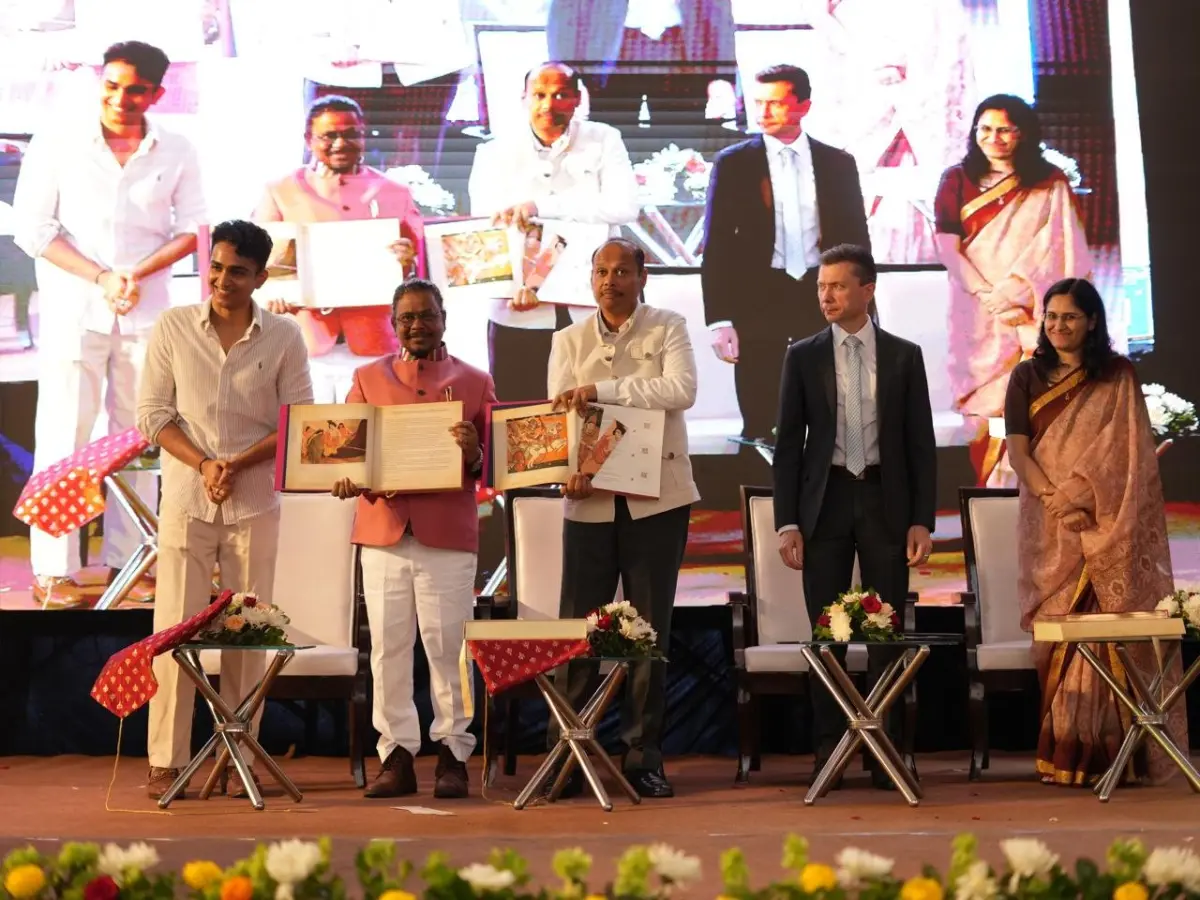
As global powers race to project hard power, New Delhi is quietly expanding its cultural footprint, using art, heritage, and civilisational memory as instruments of foreign engagement. The ambition is no longer confined to domestic walls. At the 72nd Foundation Day of the National Gallery of Modern Art, Director General Dr. Sanjeev Kishor Goutam confirmed that NGMA will carry India’s artistic identity to the world’s most prestigious contemporary art stage, the Venice Biennale, with the institution itself serving as Commissioner of the India Pavilion for the first time in years.

The Case for Civilisational Gold
Dr. Goutam framed the larger argument in terms that cut through diplomatic abstraction. “India is known as a sone ki chidia,” he said. “And when we call it a sone ki chidia, ‘sona’, gold, we are not talking about material things. Sona means something very exclusive, very special. India has a great culture and legacy. From the very beginning, we are very spiritual towards nature, we do prakriti puja, nature worshippers.” He drew a pointed contrast with the Western artistic tradition. “Europe has always had an understanding about physical appearance, nudity, muscles, and the physique, like David, you know very well. But we never showcase our physical things, we always prefer spiritual understanding of the material world. Spirituality comes from one’s inner side. This is the big difference between European, other art forms compared to India. That’s why people have great respect for Indian culture and art.”
Trending Stories
&im=FitAndFill=(700,400))
National Handloom Day 2026: From Alia Bhatt to Samantha Ruth Prabhu; Actresses who celebrated India's textile heritage as brides
)
The Royals enter the Doctor Who universe: King Charles and Queen Camilla beam into Commonwealth Games in TARDIS
)
Unitree Robotics targets $9 billion valuation in landmark IPO backed by DeepSeek and Tencent
)
India names 27 sites in Arunachal Pradesh
)
Bharat Bhhagya Viddhaata OTT: When will Kangana Ranaut's film stream online?
&im=FitAndFill=(700,400))
How many soldiers operate one S-400 battery?
)
Shakib Al Hasan ready to return to Bangladesh—under one condition
)
‘Fake news’: MEA rejects report claiming India sought defence pact with Israel after Pakistan, Saudi Arabia, Turkey deal
)
Rockstar to unveil GTA 6 extended look ahead of November launch
)
Russia forms Ukrainian Volunteer Spetsnaz Brigade to fight Ukraine
)
Drug-resistant fungus that hides in hair and enters bloodstream reported in 23 US states
)
Technology transfer deal boosts India's defence manufacturing ambitions
)
Border row erupts in Europe after Ceuta crossings, Spain imposes border controls on Italy
)
Morale plummets on USS Abraham Lincoln: Are US sailors reaching a breaking point? | GRAVITAS
)
'Security can't be bought with Pakistan, Turkey deal': Iran tells Saudi Arabia
)
Baba Vanga's 2026 prophecy: 2 predictions 'already came true', 3 terrifying ones remain. Details inside
)
Colombia’s new president Abelardo de la Espriella vows to ‘defeat narco-terrorists’, signals hardline shift
&im=FitAndFill=(700,400))
New Friday OTT releases (August 7, 2026): Operation Safed Sagar, Vadhandhi, Main Vaapis Aaunga- 6 movies and TV shows on Netflix, Prime Video and more
)
Squadron Leader Bhawana Kanth scripts history as Indian Air Force gets its first woman ‘Top Gun’ pilot
)
RSS says Gen Z protests reflect genuine distress
)
Trump says Iranian school bombing photos could be AI-generated - 'I don’t think...'
)
IAF officer held for sharing sensitive information in 'honey trap' case, booked under Official Secrets Act
)
Stray Kids under scrutiny? Fans react to Grammy submission silence after BTS boycott
&im=FitAndFill=(700,400))
Why the Su-30MKI doesn't need external fuel tanks to fly vast distances
)
Jugal Hansraj reunites with Shekhar Kapur after 40 years for Masoom: The Next Generation
)
New speed limits, automatic challans: Big traffic change coming to Delhi-Meerut Expressway. All you need to know
)
India officially names 27 places in Arunachal to counter China's renaming claims
)
Trump calls White House ballroom ruling a 'national disgrace' as court says Congress approval needed
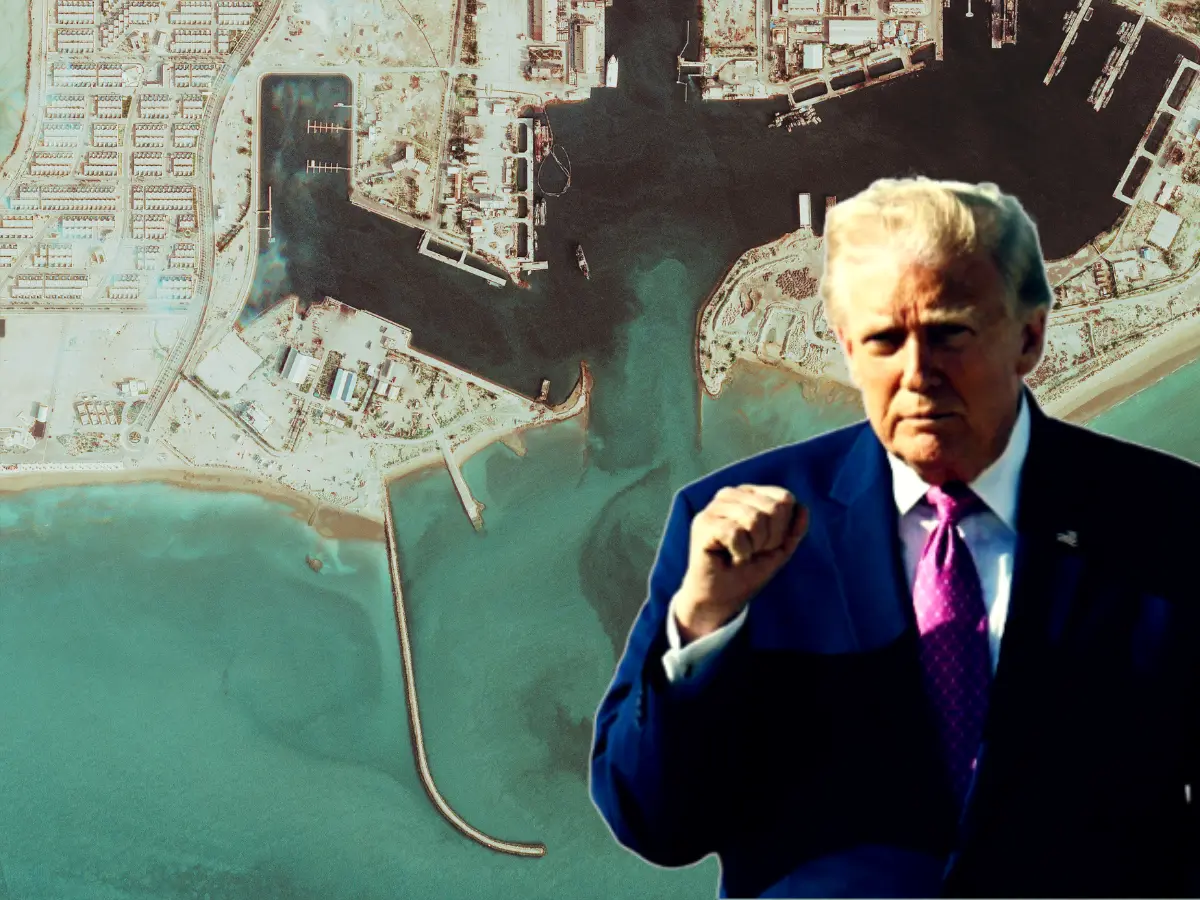)
US sanctions Iran’s crypto network after Strait of Hormuz attacks, offers $15m bounty for intel on IRGC finance
&im=FitAndFill=(700,400))
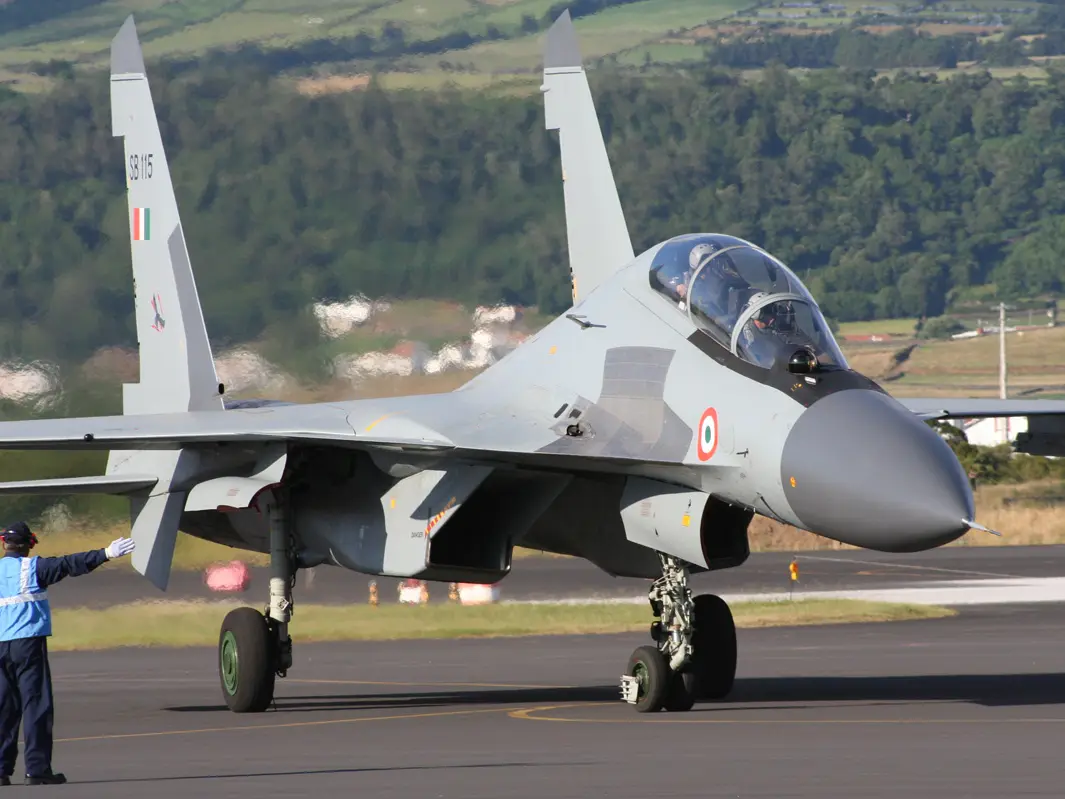
Why the Su-30MKI is one of the heaviest fighters ever built
)
Uttarakhand young innovator builds India's own flying vehicle, conducts first test flight: WATCH
)
Chilling video shows students take cover as teen opens fire at Thai school
)
Reese Witherspoon's father hospitalised after poolside incident in Nashville: Report
Roerich’s Journey from Russia to India
The Roerich story is perhaps the most tangible proof of India's spiritual pull. Nicholas Roerich, Russian by birth, modernist by training, mystic by instinct, came to India and found something he could not leave behind. He settled in the Kullu valley, painted its mountains with a fervour that was less artistic than devotional, and spent his remaining decades in a country he understood as the last keeper of a spiritual intelligence the industrialised world had discarded. On the Foundation Day, NGMA released two major catalogues of the Roerich family’s paintings alongside a documentary film on his Indian chapter. Roman Babushkin, Deputy Chief of Mission at the Embassy of the Russian Federation in India, called the legacy nothing less than a civilisational bond. “It is a very, very special occasion since we are dedicating our evening to the cultural legacy, which we are enjoying today not as pieces of art, but also as a continuity in the legacy which our previous generations are leaving to us,” he said. “Roerich’s legacy is very special since it is the civilizational bond between our two countries. Because we are very similar, in terms of how diverse we are. And staying here in India, he fell in love with this country, like we do. And this is a lifetime journey. Therefore, the books which were released today, the catalogues of their paintings, the endeavors which are making these collections come together, this is something which is a huge step and the next chapter in what we do in preserving this legacy.”
Building the Infrastructure of Art
Under Dr. Goutam's two-year tenure, NGMA has moved with unusual pace. The Dikshit Bharat camp drew more than 15,000 artists, from senior masters to first-time exhibitors, to work collectively on the Viksit Bharat theme, a scale of creative mobilisation with few precedents. The Seva Parv initiative, held simultaneously across 75 locations nationwide, brought together over 70,000 participants, each receiving awards that they deserve truly. On the Foundation Day itself, NGMA inaugurated its first-ever Printmaking Studio, followed by the announcement of a 7-day Printmaking Workshop running March 30 to April 4, a direct investment in the next generation of practitioners. The occasion also saw the integration of the Bhagavad Gita for All initiative, founded by Prithviraaj Shetty, bringing India's philosophical tradition into the gallery's public engagement framework.
Reclaiming What Was Always There
There is a deeper argument running beneath all the programming. Dr. Goutam’s first project as DG was Chitrakavyam Ramayanam, a sweeping exhibition that reclaimed the Ramayana as a living artistic tradition, weaving together modern and contemporary art, folk and tribal forms, indigenous practices, and immersive elements. It was a deliberate act of cultural recovery. For generations shaped by British colonial aesthetics, the show was a reminder that India had its own visual vocabulary long before it was told otherwise. The decolonisation of the Indian artistic imagination, Goutam suggests, is not a political statement. It is a curatorial one.
