
&imwidth=800&imheight=600&format=webp&quality=medium "Ukrainian plane with US' Bluebird satellite lands in India; launch by ISRO soon")
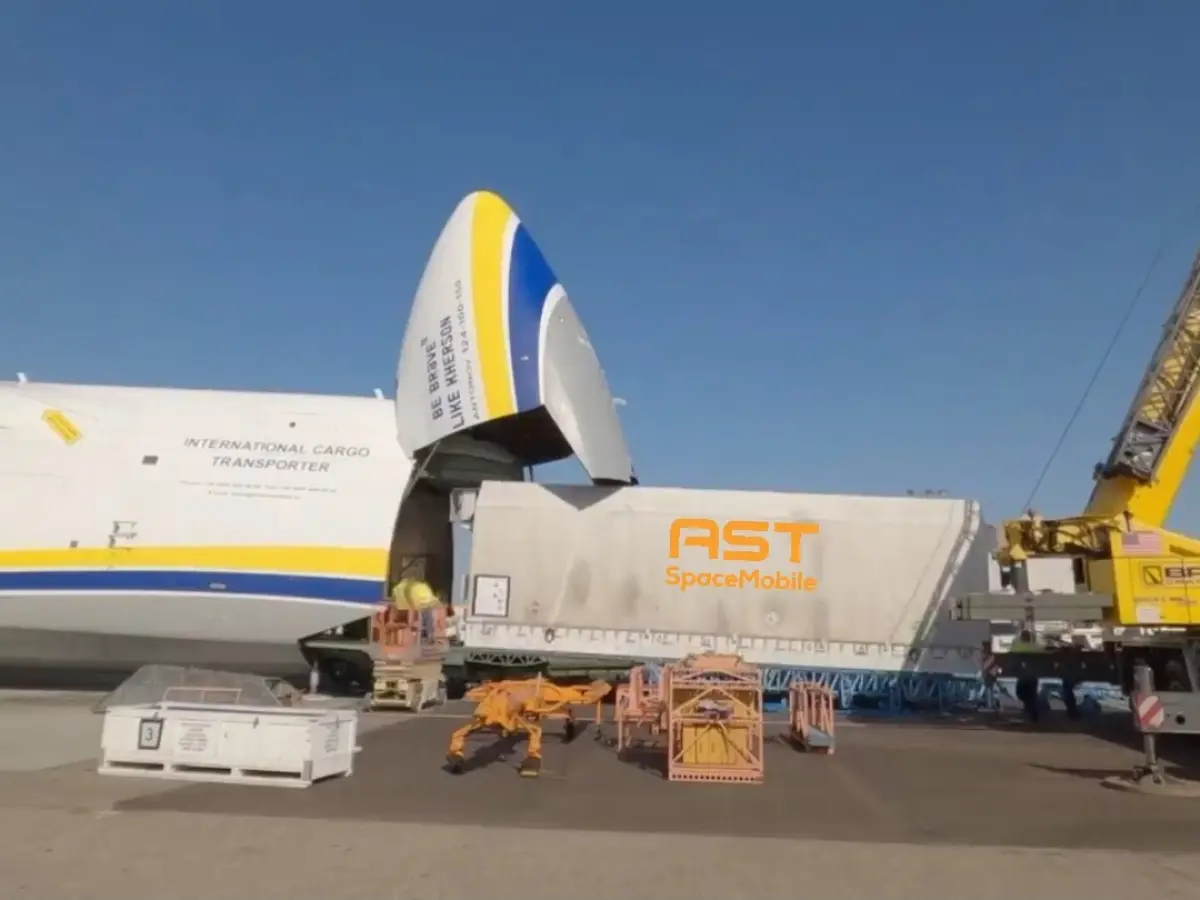
Ukraine's Antonov-124 'Ruslan' cargo plane carrying US firm AST SpaceMobile's BlueBird 6 communication satellite landed at the southern Indian city of Chennai on Thursday, 16th October. Chennai Airport Director Raja Kishore told WION that the long-haul cargo plane, the largest operational cargo aircraft in the world, landed at 7am in the city airport. Over the next 24 hours, the satellite is to be trucked to the Indian Space agency ISRO's spaceport Satish Dhawan Space Centre, about 90kms north of Chennai. Almost all foreign satellites scheduled for launch with ISRO are flown to Chennai, the nearest airport, before being trucked to the spaceport in Sriharikota, Andhra Pradesh.
ISRO's largest rocket the LVM3 is meant to carry the 6,500kg BlueBird 6 to orbit(about 550kms above earth). The 6,500kg satellite would be the heaviest satellite to be carried by an Indian rocket. This mission is being executed as part of a commercial deal between ISRO's business arm NewSpace India Limited(NSIL) and the Texas-based AST SpaceMobile. As a launch services provider(rocket builder and operator), ISRO launches foreign-origin satellites to space on a commercial basis.These commercial space missions are like a taxi ferrying a passenger. In this case, the passenger is the US firm, which will pay the Indian Government for the launch service.
Once the satellite reaches the Indian spaceport, it would be safe to assume that the launch would be carried out in 45-60 days, which means the BlueBird 6 could take to the skies by December or January. In the intervening period, the assembly activities of the rocket and satellite, the testing and fuelling of the satellite, other pre-launch preparations are carried out.

Notably, ISRO is gearing up for the launch of an Indian communications satellite CMS-02 by the end of October or early November. Like the BlueBird 6, CMS-02 would also fly on an LVM3 rocket. As it stands, the CMS-02 would be launched on a rocket designated as LVM-M5, and the BlueBird would fly on LVM3-M6. Therefore, it would be safe to assume that ISRO would be executing two LVM3 launches in a span of 3-4 months, something that has not been done before.
About AST SpaceMobile and their internet-beaming satellites
ASTSpaceMobile is a Texas-based telecom company that aims to build andlaunch a fleet of satellites that can directly provide internet connectivity to mobile phones. Typically, only purpose-built satellite phones are capable of communicating with satellites. These traditional satellite phone handsets are bulky and require visible antennas, they offer voice connectivity, and low-bandwidth texting and data services. Such services are offered by firms such as Iridium, Thuraya, among others., and are widely used in the defence and maritime sectors for providing connectivity where no communications infrastructure exists.
Trending Stories
&im=FitAndFill=(700,400))
National Handloom Day 2026: From Alia Bhatt to Samantha Ruth Prabhu; Actresses who celebrated India's textile heritage as brides
)
The Royals enter the Doctor Who universe: King Charles and Queen Camilla beam into Commonwealth Games in TARDIS
)
Unitree Robotics targets $9 billion valuation in landmark IPO backed by DeepSeek and Tencent
)
India names 27 sites in Arunachal Pradesh
)
Bharat Bhhagya Viddhaata OTT: When will Kangana Ranaut's film stream online?
&im=FitAndFill=(700,400))
How many soldiers operate one S-400 battery?
)
Shakib Al Hasan ready to return to Bangladesh—under one condition
)
‘Fake news’: MEA rejects report claiming India sought defence pact with Israel after Pakistan, Saudi Arabia, Turkey deal
)
Rockstar to unveil GTA 6 extended look ahead of November launch
)
Russia forms Ukrainian Volunteer Spetsnaz Brigade to fight Ukraine
)
Drug-resistant fungus that hides in hair and enters bloodstream reported in 23 US states
)
Technology transfer deal boosts India's defence manufacturing ambitions
)
Border row erupts in Europe after Ceuta crossings, Spain imposes border controls on Italy
)
Morale plummets on USS Abraham Lincoln: Are US sailors reaching a breaking point? | GRAVITAS
)
'Security can't be bought with Pakistan, Turkey deal': Iran tells Saudi Arabia
)
Baba Vanga's 2026 prophecy: 2 predictions 'already came true', 3 terrifying ones remain. Details inside
)
Colombia’s new president Abelardo de la Espriella vows to ‘defeat narco-terrorists’, signals hardline shift
&im=FitAndFill=(700,400))
New Friday OTT releases (August 7, 2026): Operation Safed Sagar, Vadhandhi, Main Vaapis Aaunga- 6 movies and TV shows on Netflix, Prime Video and more
)
Squadron Leader Bhawana Kanth scripts history as Indian Air Force gets its first woman ‘Top Gun’ pilot
)
RSS says Gen Z protests reflect genuine distress
)
Trump says Iranian school bombing photos could be AI-generated - 'I don’t think...'
)
IAF officer held for sharing sensitive information in 'honey trap' case, booked under Official Secrets Act
)
Stray Kids under scrutiny? Fans react to Grammy submission silence after BTS boycott
&im=FitAndFill=(700,400))
Why the Su-30MKI doesn't need external fuel tanks to fly vast distances
)
Jugal Hansraj reunites with Shekhar Kapur after 40 years for Masoom: The Next Generation
)
New speed limits, automatic challans: Big traffic change coming to Delhi-Meerut Expressway. All you need to know
)
India officially names 27 places in Arunachal to counter China's renaming claims
)
Trump calls White House ballroom ruling a 'national disgrace' as court says Congress approval needed
)
US sanctions Iran’s crypto network after Strait of Hormuz attacks, offers $15m bounty for intel on IRGC finance
&im=FitAndFill=(700,400))
Why the Su-30MKI is one of the heaviest fighters ever built
)
Uttarakhand young innovator builds India's own flying vehicle, conducts first test flight: WATCH
)
Chilling video shows students take cover as teen opens fire at Thai school
)
Reese Witherspoon's father hospitalised after poolside incident in Nashville: Report
Firms like AST and Starlink are attempting to change this by ensuring direct connectivity between smartphones and satellites. Therefore, the popular phones Android and Apple devices available in the market can be directly used to communicate with the support of satellites, without any extra or special hardware. Thanks to the global coverage planned using a fleet of satellites, such services would eventually enable cell phone connectivity almost anywhere on Earth. In simple terms, one need not worry about being "not reachable" or "out of coverage area".
As per reports, AST presently has a fleet of five first-generation (Block-1) satellites in orbit. The firm plans to launch a fleet of 45-60 second-generation (Block-2)satellites to offer services in major global regions, it is said.
The firm has announced that they have a series of satellites that will be launching in the coming months. BlueBird 7 has shipped to the Cape Canaveral, Florida launch site this month, BlueBirds 8-16 are in various stages of production, with launches planned every 1-2 months on average during 2025 and 2026, the firm announced.
They expect to have 45-60 satellites in orbit by year-end 2026. It is touted that these BlueBird satellites(by size) will be the largest commercial satellites ever deployed in Low Earth orbit (about 600kms above earth). Each of these satellites would carry a 2,400sq feet phased array antenna with true direct-to-cell broadband, with a claimed capability of up to 10,000 MHz of processing bandwidth and claimed peak speeds of 120 Mbps per cell.
The firm says they have partnered with 50+ mobile network operators serving nearly 3 billion subscribers, supported by a flexible spectrum strategy blending our own licensed spectrum with partner spectrum.

