'Smuggling disguised as trade': US claims India part of 40-nation 'shadow network' helping China evade tariffs

&imwidth=600&imheight=450&format=webp&quality=medium "'Smuggling disguised as trade': US claims India part of 40-nation 'shadow network' helping China evade tariffs")
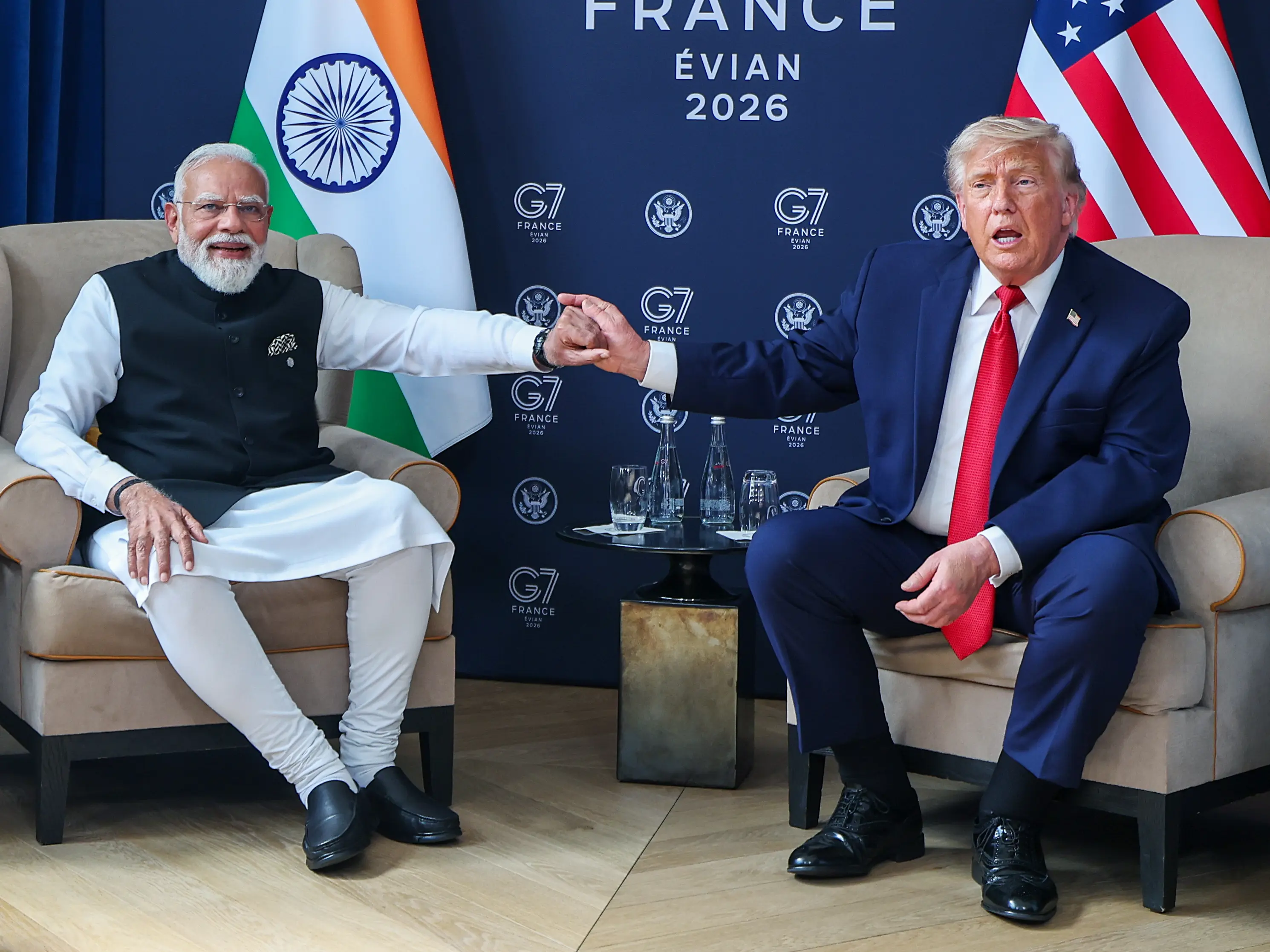
Prime Minister Narendra Modi and US President Donald Trump hold a bilateral meeting on the sidelines of the G7 Summit 2026, in Evian on Jun 17, 2026. Photograph: (ANI)
A new US report has put India among more than 40 countries exposed to a global "shadow transshipment network" involving China-linked goods. But does the report accuse India of helping China evade tariffs? Here's what it actually says.
The United States has placed India among more than 40 countries it says are part of a global "Shadow Transshipment Network" being used to move China-linked goods into the American market while avoiding higher tariffs imposed on Chinese imports.
The claim comes from a new report titled The Great Transshipment Scam, which examines how Chinese goods are allegedly being rerouted through third countries before reaching the US. India is listed in the report's top tier of countries considered to have significant exposure to China-linked transshipment.
The report does not, however, say that India, as a government, is deliberately helping China evade tariffs. Instead, it says the risk is embedded within legitimate trade flows and points to India as one of several major trading and manufacturing hubs through which such goods may pass.
Why is India on the US list?
The report says China adapted to the tariffs imposed by US President Donald Trump during his first term in 2018 by increasingly routing goods through countries with lower tariff exposure.
Trending Stories
)
)
)
)
)
)
)
)
)
)
)
)
)
)
)
)
)
)
)
)
)
)
)
)
)
)
)
)
)
)
)
)
)
)
&im=FitAndFill=(700,400))
)
)
)
)
According to the report, Chinese goods can undergo limited processing, repackaging, relabelling, or documentation changes in a third country before being shipped to the US. Such practices can create the appearance that the goods originated somewhere other than China.
It describes this as "smuggling disguised as trade - fraud cloaked in paperwork" and says the system has grown into a global network.
India is grouped alongside Canada, the European Union, Israel, Japan, Mexico, South Korea, and Taiwan in Tier 1, described as "Diversified Scale Leaders". The report says these economies have large volumes of China-linked trade and major export platforms, meaning transshipment risks can exist alongside legitimate commerce.
$67 billion passed through India, Mexico, and Vietnam: US
One of the report's key findings comes from the US Commerce Department's Office of Trade and Economic Analysis. Using transaction-level customs data, the analysis estimates that around $67 billion worth of US-bound goods were transshipped from China through Mexico, India, and Vietnam in 2025.
The report estimates that this resulted in around $28 billion in lost US tariff revenue. It stresses that this narrower estimate was based on strict transaction matching and therefore provides only one measure of the wider problem.
"OTEA estimates that approximately $67 billion in U.S.-bound goods were transshipped from China through the top hubs—Mexico, India, and Vietnam—in 2025, producing an estimated $28 billion in lost tariff revenue."
The report says the wider network now spans more than 40 "lower-tariff jurisdictions", with China-linked goods moving through production hubs, logistics centres, free zones and re-export platforms.
Pune, Gujarat and Chennai: India's "ugly sister"?
The report uses India's Pune-Gujarat-Chennai production belt as one of its "ugly sister" examples. "These are not sister cities in the cultural sense. They are the “ugly sisters” of modern zero-sum global trade, paired not by civic partnership, but by the logic of American jobs lost to unfair trade," reads the report.
It identifies the corridor as a major route for pumps and compressors, which fall under HS codes 8413 and 8414. The concern is that China-linked goods moving through this Indian manufacturing network could ultimately compete with US producers in Cincinnati, Dayton and Columbus, putting pressure on American orders, factory utilisation, and jobs. The report stresses that these are not literal sister-city relationships, but product-to-industry comparisons showing how trade diversion in one country can affect manufacturing communities in another.
US plans AI-powered crackdown
Washington says it is turning to artificial intelligence to detect such activity. The report describes an "AI-enabled Detective Border" that would examine shipping routes, declared origins, components and production capacity to identify suspicious patterns.
It says the system is intended to catch cases where "the paperwork changed faster than the product did" and identify false-origin claims and unusual routing patterns.
The report also warns that the scale of tariff evasion could be far larger than the most conservative estimates, putting renewed pressure on countries including India that have become important links in global supply chains.

