'Spy in the sky': How India's high-altitude balloon by DRDO is a 'spy in the sky'

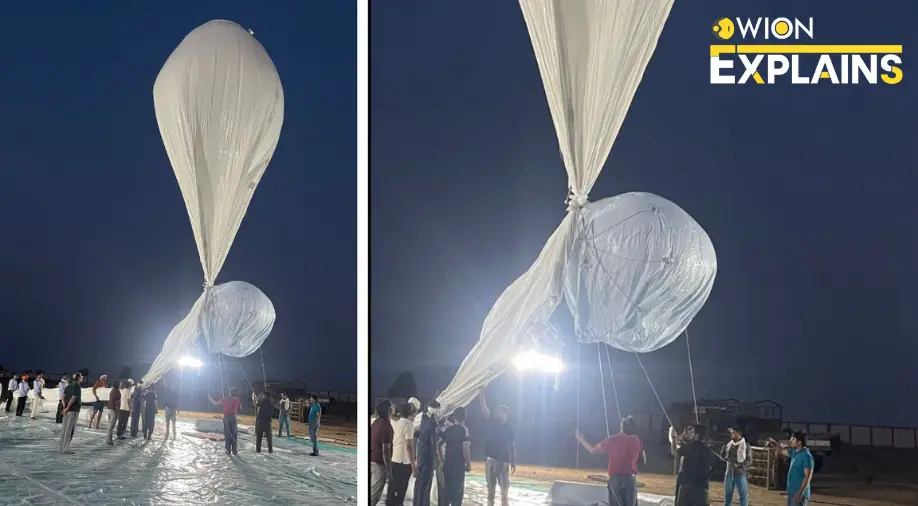
Recently, India's Defence Research and Development Organisation (DRDO) announced the maiden test flight of the Stratospheric Airship Platform. India news
Recently, India's Defence Research and Development Organisation (DRDO) announced the maiden test flight of the Stratospheric Airship Platform.
In simple terms, this is a high-altitude balloon that has the potential to enhance India’s earth observation and Intelligence, Surveillance & Reconnaissance capabilities. Developed by the Aerial Delivery Research and Development Establishment, Agra, the successful test flight of this platform was conducted from the Sheopur Trial site in central Indian state of Madhya Pradesh.

Though a prototype, this variant carried an instrumental payload to an altitude of around 17 km (55,700 feet). After a total flight that lasted 62 minutes, the DRDO team also recovered the balloon. DRDO has said that the data from the balloon's onboard sensors was received and would be utilised to develop simulation models for future high-altitude flights.
Though it might be unrelated, this test is being conducted at a time when tensions are on the rise between nuclear-armed neighbours India and Pakistan, following the terror attack that killed 26 Indian tourists in Jammu and Kashmir's Pahalgam.
Here are the capabilities and limitations of the Stratospheric Airship Platform, which can serve as a potential 'Spy in the sky':
&im=FitAndFill=(700,400))
National Handloom Day 2026: From Alia Bhatt to Samantha Ruth Prabhu; Actresses who celebrated India's textile heritage as brides
)
The Royals enter the Doctor Who universe: King Charles and Queen Camilla beam into Commonwealth Games in TARDIS
)
Unitree Robotics targets $9 billion valuation in landmark IPO backed by DeepSeek and Tencent
)
India names 27 sites in Arunachal Pradesh
)
Bharat Bhhagya Viddhaata OTT: When will Kangana Ranaut's film stream online?
&im=FitAndFill=(700,400))
How many soldiers operate one S-400 battery?
)
Shakib Al Hasan ready to return to Bangladesh—under one condition
)
‘Fake news’: MEA rejects report claiming India sought defence pact with Israel after Pakistan, Saudi Arabia, Turkey deal
)
Rockstar to unveil GTA 6 extended look ahead of November launch
)
Russia forms Ukrainian Volunteer Spetsnaz Brigade to fight Ukraine
)
Drug-resistant fungus that hides in hair and enters bloodstream reported in 23 US states
)
Technology transfer deal boosts India's defence manufacturing ambitions
)
Border row erupts in Europe after Ceuta crossings, Spain imposes border controls on Italy
)
Morale plummets on USS Abraham Lincoln: Are US sailors reaching a breaking point? | GRAVITAS
)
'Security can't be bought with Pakistan, Turkey deal': Iran tells Saudi Arabia
)
Baba Vanga's 2026 prophecy: 2 predictions 'already came true', 3 terrifying ones remain. Details inside
)
Colombia’s new president Abelardo de la Espriella vows to ‘defeat narco-terrorists’, signals hardline shift
&im=FitAndFill=(700,400))
New Friday OTT releases (August 7, 2026): Operation Safed Sagar, Vadhandhi, Main Vaapis Aaunga- 6 movies and TV shows on Netflix, Prime Video and more
)
Squadron Leader Bhawana Kanth scripts history as Indian Air Force gets its first woman ‘Top Gun’ pilot
)
RSS says Gen Z protests reflect genuine distress
)
Trump says Iranian school bombing photos could be AI-generated - 'I don’t think...'
)
IAF officer held for sharing sensitive information in 'honey trap' case, booked under Official Secrets Act
)
Stray Kids under scrutiny? Fans react to Grammy submission silence after BTS boycott
&im=FitAndFill=(700,400))
Why the Su-30MKI doesn't need external fuel tanks to fly vast distances
)
Jugal Hansraj reunites with Shekhar Kapur after 40 years for Masoom: The Next Generation
)
New speed limits, automatic challans: Big traffic change coming to Delhi-Meerut Expressway. All you need to know
)
India officially names 27 places in Arunachal to counter China's renaming claims
)
Trump calls White House ballroom ruling a 'national disgrace' as court says Congress approval needed
)
US sanctions Iran’s crypto network after Strait of Hormuz attacks, offers $15m bounty for intel on IRGC finance
&im=FitAndFill=(700,400))
Why the Su-30MKI is one of the heaviest fighters ever built
)
Uttarakhand young innovator builds India's own flying vehicle, conducts first test flight: WATCH
)
Chilling video shows students take cover as teen opens fire at Thai school
)
Reese Witherspoon's father hospitalised after poolside incident in Nashville: Report
High Altitude balloons operate in the upper reaches of Earth's atmosphere, it is a region where most fighter jets and Unmanned Aerial Vehicles (UAVs) cannot operate. From this vantage spot, they can obtain a wide view of the area of interest beneath them.
In its maiden flight, the DRDO prototype has flown at an altitude of 55,700 feet or 17 km, whereas typical fighter jets fly at altitudes of 50,000 feet. Staying in the upper reaches of the atmosphere puts these balloons out of reach of most surface-to-air missiles. From this altitude and beyond, they can operate various kinds of sensors and equipment to gather intelligence on the area beneath. Unlike, fighter jets that can remain airborne only for a few hours at very high altitudes, the balloons can remain there for an extended period.
A spy satellite placed in a typical Sun Synchronous Polar orbit would be able to monitor an area of interest once in few days. Satellite passes over an area of interest would barely last a minute or two, as Low Earth Orbit satellites travel at speeds of over 28,000 kmph. Therefore, it can only gather images or videos during the very short instance that it flies over the area of interest.
For example, if the satellite passes over that area on a Monday, then its next movement in that area would be after a couple of days. In contrast to this, a high-altitude balloon can stay airborne for several hours to several days over a certain region of interest, enabling constant surveillance. Owing to weather and wind conditions, it is quite challenging to maintain the balloon over a specific area of interest, but it can offer persistent surveillance, the kind that is required to gather intelligence on troop movements, infiltration etc.
Fighter jets and Unmanned Aerial Vehicles that can operate at altitudes of over 50,000feet to conduct intelligence gathering, offensive operations cost over $50million apiece. The cost of maintaining and operating these platforms over a period of time, crew training is also significantly higher. Further, there is the risk of loss due to enemy fire or technical issues, which can lead to the destruction of the platform itself. In comparison, a high-altitude balloon would cost around a $1million and can be deployed in large numbers. In most cases, the missile that is meant to take down the balloon would cost as much as the balloon or cost significantly more. Given their slow-moving nature and surface, material characteristics, balloons are harder to detect on radar.
High altitude balloons are used for meteorology, upper atmospheric studies, and a host of strategic purposes. Depending on the mission, they can be configured with the required sensors and payloads. Most spy satellites fly at placed 400-700kms above the earth's surface, whereas balloons are barely 20-25kms above the surface. Being closer enables better resolution imagery and requires smaller and lighter sensors, when compared to the relatively larger and more expensive radiation hardened equipment used on satellites. Depending on the payload carrying capacity of the balloon, it can host multiple sensors and payloads that serve the Intelligence, Surveillance, Reconnaissance roles.
High-altitude balloons can serve both civilian and military use. They can capture images(optical or infrared or synthetic aperture radar), intercept and analyze signals emanating from enemy systems/radars, offer communications relay support, carry signal jammers that disrupt enemy communications etc. Given the very nature of balloons and their operations, related logistics, its operational cost would be negligible when compared to a space rocket launch that aims to put a satellite in orbit. Building and launching satellites and rockets is a long-term process that costs a lot of money and consumes time, requires a lot of infrastructure. In comparison, balloons are easier to deploy at scale.
High-altitude balloons are dependent on upper atmospheric wind patterns for horizontal navigation, which could make them drift off course, making precise positioning and navigation quite challenging. While the altitude can be changed in order to adjust the direction of movement, precise control and manoeuvring is not possible. Once detected on radar or by visual imaging, it is easy to take down the balloons as they are slow-moving and don't have evading capabilities like fighter aircraft. Balloons can only carry limited payloads and sensors when compared to aircraft and drones. Even accidentally overflying another nation can be seen as a serious violation of airspace and sovereignty.
