&imwidth=800&imheight=600&format=webp&quality=medium "‘Our traditions did not begin in...’: NC leader Tanvir Sadiq joins shrine practices debate")
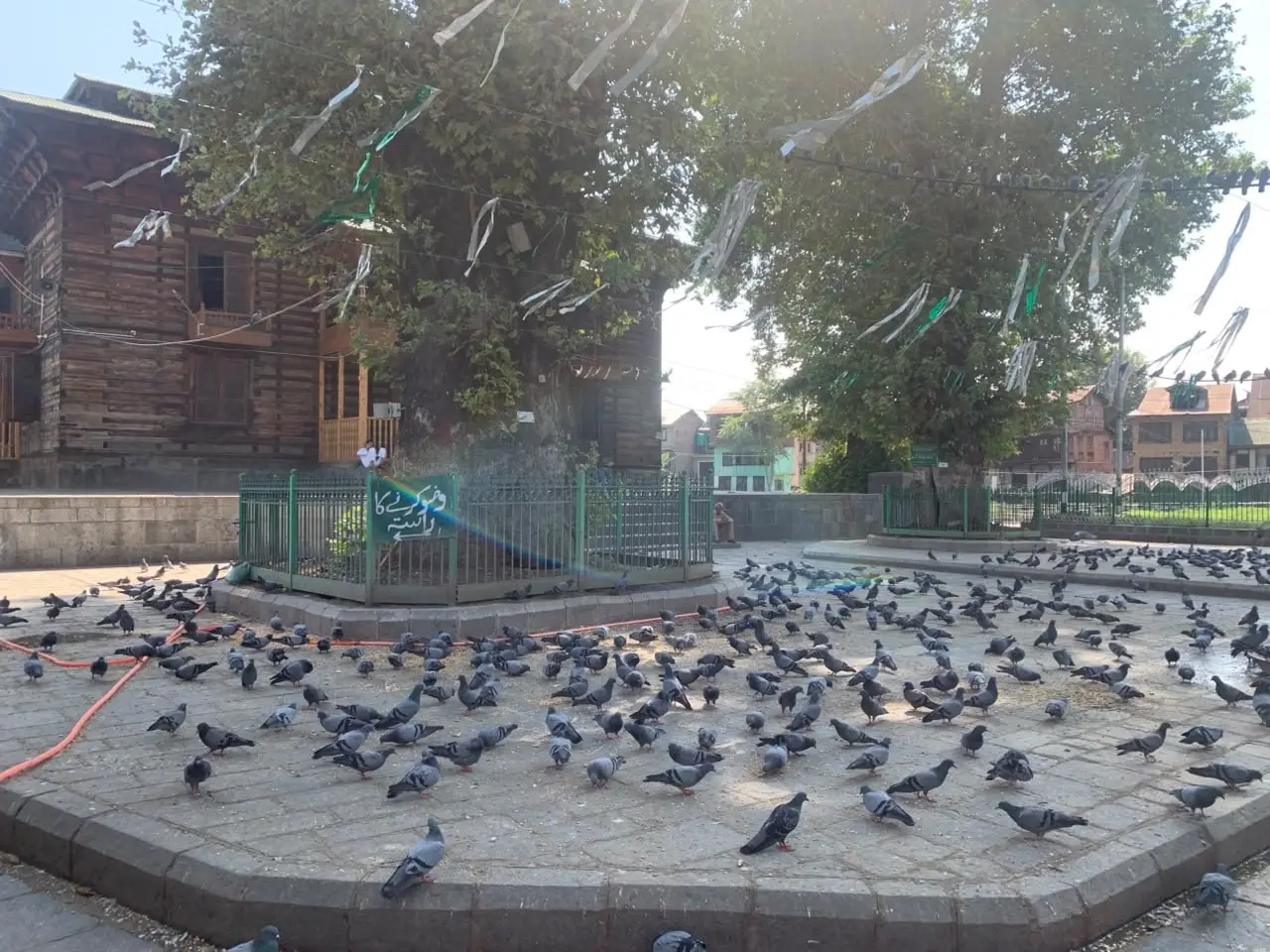
Srinagar: A controversy over the distribution of Tahri, Nazr-o-Niyaz and bird feeding at shrines in Jammu and Kashmir has triggered an uproar, with political leaders, devotees and community members stressing that centuries-old religious traditions cannot be dealt with in a manner that risks hurting people’s sentiments.
The controversy erupted after remarks attributed to Jammu and Kashmir Waqf Board Chairperson Dr. Darakhshan Andrabi regarding the distribution of Tahri and feeding of birds at Dargahs went viral on social media. The remarks sparked reactions from sections of the public, who argued that offering food and feeding birds at shrines are deeply rooted practices associated with faith, devotion and tradition.
However, Andrabi has since clarified that Tahri has not been completely banned, saying the restriction applies only to bringing and distributing it inside Dargah premises.

She explained that devotees can continue bringing Nazr-o-Niyaz, Tahri and other offerings but should distribute them at designated sheds and spaces created outside the shrine premises.
Andrabi said the arrangement was intended to maintain cleanliness and preserve the sanctity of shrine premises, rather than interfere with religious practices.
Despite the clarification, the controversy has opened a wider debate over how religious traditions should be managed at shrines without offending the sentiments of devotees.
Trending Stories
)
War is making Russia stronger? How Ukraine is shaping Moscow’s next generation of weapons
)
PM Modi and China's Xi offered to help resolve Russia-Ukraine war: Kremlin
)
Turkish Airlines plane flies through a storm three times, triggering severe turbulence
)
Humans may lose control of AI: Anthropic CEO calls for slowdown, Altman, Musk back him
)
Crude oil prices jump more than $107 per barrel following Houthi attacks on Saudi
)
‘India did extremely well’: South African President Cyril Ramaphosa praises BRICS leadership
)
Russian drone hits Warsaw-bound train near Polish border, Zelensky accuses Moscow of ‘deliberate’ targeting
)
NEET-UG to move to computer-based test soon, NTA DG says ‘CBT is the future’
&im=FitAndFill=(700,400))
Why Chinese PL-15 air-to-air missiles use dual-pulse motors compared to European interceptors
)
Iran, India agree to deepen humanitarian and political ties, President Pezeshkian says
)
Delhi’s balancing act: BRICS serves as a stage for West Asia diplomacy
)
First naval drone battle? Ukraine says Sargan 3000 sank Russian unmanned boat
)
Trump says Canada eager to reach a deal, it could come ‘fairly soon’ if Ottawa treats US farmers better
&im=FitAndFill=(700,400))
Why European Meteor missiles use ramjet engines compared to standard US solid rockets
)
Practical Magic 2 breaks Spidey spell over North American box office
)
Pakistan puts Pak Rs 70 lakh bounty on UN terrorist Masood Azhar; move draws skepticism in Delhi
)
800 million years old - Scientists discover 'fingerprints' of supercontinent Gondwana in ancient rocks
)
Indian importers urge Bangladesh to lift export ban on 'Hilsa' fish ahead of Durga Puja
&im=FitAndFill=(700,400))
New OTT releases this week (September 14-20, 2026): Lust Stories 3, Waiting Hai, Irumudi- 5 new titles coming on Netflix, Prime Video and more
)
Russia proposes to build 360 kmph Ivolga FG trains in India: What happened on sidelines of BRICS
)
Liam Neeson sparks romance rumours after holding hands with Stella Stocker at TIFF 2026
&im=FitAndFill=(700,400))
From Rinku Singh to Mayank Yadav, 5 players dropped from India’s squad for Afghanistan T20Is
)
'Huge destructive power': North Korea calls its latest missile launches 'live-fire drill' even as US dismisses 'immediate threat'
)
‘Let’s go’: Newly declassified videos show dramatic rescue of US Air Force officers downed in Iran
)
Did China give Iran intel before US base strike that killed 3 troops? Trump says, 'You’re right...'
&im=FitAndFill=(700,400))
Meet top 5 batters fastest to 3000 runs in T20Is
)
Women's Asia Cup 2026: India denied trophy once again despite winning the title
)
Woman removes all her clothes on American Airlines flight, performs 'indecent acts'; arrested
)
Israeli minister calls to strip Gaza film directors of citizenship
)
‘Want to reset ties with India, have engagement based on mutual interests,’ says Bangladesh minister
)
China thinned Himalayan troop presence in 2025, India defence report says; terms border situation 'stable'
)
China discovers vast gold and silver 'mine' in the Pacific with unheard-of deposits
)
Meghan Markle shares first glimpse of family life with Prince Harry and children in UK
)
Did India risk its US trade deal despite softer stance at BRICS?
PDP leader Iqbal Tramboo said he did not agree with stopping practices that have been followed for generations, arguing that better cleanliness and management should be the solution.
“I actually don’t agree with what she has said,” Tramboo said, while pointing out that practices such as bird feeding and distribution of food are seen at religious places across the world.
“Even if you go to Mecca and Medina, there also you will see bird feeding is done,” he said, adding that similar traditions have continued around shrines for hundreds of years.
According to Tramboo, religious sentiments are deeply attached to such practices, and authorities should focus on management rather than stopping them.
“Despite all of this, cleanliness is always looked after. The staff is so efficient that you will see absolute cleanliness. That’s what needs to be done in our shrine,” he said.
He argued that improving the efficiency of staff and ensuring proper arrangements would be a better remedy.
“That’s the remedy. This is not a remedy to stop the act, particularly with which our emotions or sentiments are connected,” Tramboo said.
He cautioned that authorities need to be particularly careful when dealing with religious traditions.
Abdul Aziz, a devotee, said distributing yellow rice, or Tahri, and feeding birds at times of difficulty is an established tradition for many people.
“Whenever we are facing problems, this is a tradition to come here to distribute yellow rice or feed the birds. This also gives us satisfaction,” Aziz said.
He said people have continued the practice for years and often bring whatever they can afford as an offering.
Meanwhile, Tariq Bedaba said the Waqf Board Chairperson’s remarks may have been misunderstood or misquoted, arguing that there was no blanket ban on Tahri or the distribution of offerings.
“I think the Waqf Board has been misquoted a little. She meant not to litter around,” Bedaba said.
He said devotees should continue to be allowed to distribute Tehri, or yellow rice, while ensuring that the practice does not create hygiene or cleanliness problems.
Bedaba also defended bird feeding as a religiously rooted practice. “Bird feeding is a part of our religion. No one in the world can stop us from doing this,” he said.
At the same time, he suggested that devotees exercise caution about where they place bird feed.
Tanvir Sadiq of National Conference, meanwhile, said the traditions surrounding shrines predate the present institutional arrangements and cannot be viewed as practices that began with any particular administration.
“Our traditions and culture did not begin in 2019, nor with the present Waqf Board,” Tanvir said.
“People have offered Niyaz, Tahri and food at shrines for generations. We grew up seeing it,” he said, describing the practices as being rooted in generations of faith and devotion.
Tanvir said the focus should be on providing alternatives and improving management rather than imposing blanket restrictions.
The controversy has therefore brought two concerns into sharp focus: the need to maintain cleanliness, hygiene and the sanctity of shrine premises, and the importance of protecting traditions that devotees regard as an integral part of their faith.