Medical oxygen: Why is it vital and does India produce enough?

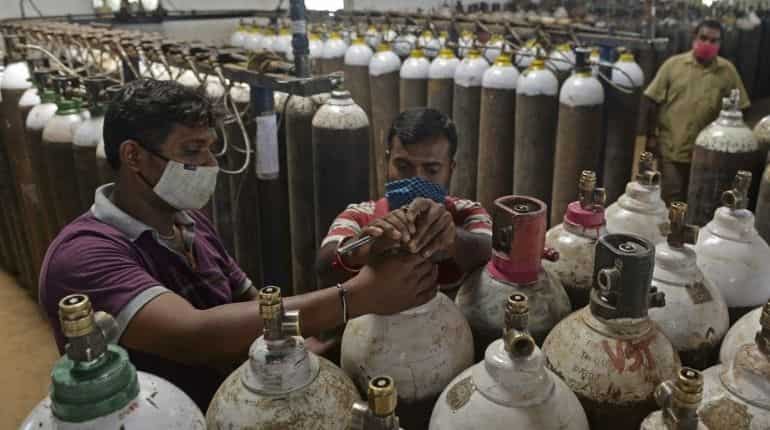
Workers check medical oxygen cylinders to be transported to hospitals amid Covid-19 coronavirus pandemic at a facility on the outskirts of Chennai on April 24, 2021.
India is facing the brunt ofoxygenshortage with serpentine lines seen outsideoxygenmanufacturing units as the second wave of COVID-19 has completely overwhelmed health infrastructure of the country.
The world's second-most populous nation is in deep crisis, with its hospitals and morgues overwhelmed as healthcare professionals struggle to cope with streams of patients.
Apart from the megacities, medicaloxygenand beds have become scarce in smaller cities, with major hospitals putting up notices saying they have no room for any more patients and asking relatives to arrange for medicaloxygen.

Long queues were seen atoxygenplants in several cities of India's most populous Uttar Pradesh state, including its capital Lucknow, with people from private hospitals, isolation centres, and even individuals visiting the plant with their empty cylinders in the hopes of getting some life-saving gas for patients.
Oxygenproduction and filling facilities in rural India are also overburdened with high-demand. They have shut regular industrial filling ofoxygenand are only focused on filling up cylinders for medicaloxygen.
Why ismedicaloxygenvital?
)
US vs China over South China Sea: Washington backs Philippines, Beijing hits back
)
Bigg Boss 20: Isha Rikhi evicted after three weeks in Salman Khan’s show
)
Musk plans to more than double xAI's chips to over 1.2 million Nvidia GPUs by year-end
)
After JU, clash erupts at SRFTI: BJP’s ‘Dimagi Naxal’ jibe sparks political firestorm after students protest RSS-linked event
)
‘Anti-social elements spreading false rumours’: LPU issues statement amid massive unrest over alleged rape
)
LPU students go on rampage, vandalise campus amid widespread protest: What's happening
)
Trump asked Xi to pressure Iran. China did not say yes — here’s what Beijing wants
)
US Treasury Secretary Scott Bessent hails global crackdown on Iranian banks and airlines
)
An OpenAI agent escaped its locked test cage again, by hiding questions in DNS lookups
)
'Our video was trimmed': LPU girls who featured in rape-denial video make U-turn
)
3 males killed, four others injured in shooting after fight at strip club in Detroit
)
'Victory for low-budget consumers': Raghav Chadha hails 30-day telecom recharge rules
)
Claude rebuilt the 1989 game 'Prince of Persia' by reusing the original's own code
)
Beyond metros: How Tier-2 and Tier-3 cities could drive India’s next AI wave
)
Tesla builds first Cybertruck with its own refined lithium: Elon Musk's $1 billion Texas bet pays off
)
IndiGo flight suffers tail strike in Bengaluru while landing; DGCA to probe incident
)
The US and China set up an AI 'red telephone', but skipped the rulebook
)
‘Terror suspects arrested near UK air base were looking to do big damage’: Trump
)
Russian envoy claims US tactics to contain India were revealed in ‘Freudian slip’
)
IND vs WI 1st ODI: Kohli breaks Sachin's most runs in one country record with unbeaten 139 as India thump West Indies by 8 wickets
)
Researchers rebuilt exactly how 700 AI agents hacked Hugging Face: a 900-link chain trick
)
‘Olympic inclusion is our major target’: WPA President Ishaun Singh on pool’s global ambitions
)
Nations League: Spain sink England at Wembley; Modric shines for Croatia
)
Why has Iran released no proof of life of Mojtaba Khamenei? Araghchi reveals...
)
'What kind of confession is this?': Pakistan PM Shehbaz Sharif’s 'terrorists would be roaming New York' remark goes viral, raises alarm online. Watch
)
South Korea demands apology from Ukraine over North Korean prisoners' transfer
)
Beyond BrahMos: India targets Rs 50,000 crore in defence exports with unmatched price edge
)
Sri Lankan Tamil migrant worker gets death sentence in Saudi Arabia, help sought from India
)
Muslim marriage cannot shield sex with minor wife from prosecution under POCSO: Delhi HC
)
'Can't help but draw painful parallels to Nirbhaya case': SC on latest incidents of rape cases in Delhi-NCR
)
99.9% more powerful - Scientists find boy who can recall memories from just 3 months of age
)
'FIRST LOOK from inside Noah’s Ark': Researchers share video from inside mysterious mound in Turkey
)
UNSC reform momentum grows: Russia, Portugal, Mauritius push for India's permanent seat bid
)
8 US marines injured in Iranian missile attack on vessel in Strait of Hormuz: Report
&im=FitAndFill=(700,400))
New OTT releases this week (September 28-October 4, 2026): Dupahiya 2, Pooja Meri Jaan, Ohh My Dog- 5 titles coming on Netflix, Prime Video and more
)
Afghanistan says 28 fighters killed in clash near Pakistan border, Islamabad denies
)
Ceuta migrant crisis: Protesters take to streets as Spain grapples with migrant challenge
)
LPU suspend classes, postpones exams as violence escalates over rape claims: What's happening
)
New York City wants a 'kill switch' on every AI, and will pay whistleblowers who report violations
Oxygentherapy is crucial for severe Covid-19 patients with hypoxaemia whenoxygenlevels in the blood are too low.
According tocommunity health specialist Rajib Dasgupta,"Some clinical studiesshow that up to a quarter of hospitalised (Covid-19) patients requireoxygentherapy and upwards to two-thirds of those in intensive care units."
"This is why it is imperativeto fixoxygensupply systems in hospital settings as this is a disease that affects lungs primarily."
India's toll from the coronavirus surged past 200,000 on Wednesday, the country's deadliest day, as shortages ofoxygen, medical supplies and hospital staff compounded a record number of new infections.
What is an oximeter and oxygen concentrator?
Pulse oximetry is a non-invasive and painless test that measures your oxygen saturation level or the oxygen levels in your blood. It can rapidly detect even small changes in how efficiently oxygen is being carried to the extremities furthest from the heart, including the legs and the arms.
During a pulse oximetry reading, a small clamp-like device is placed on a finger, earlobe, or toe. Small beams of light pass through the blood in the finger, measuring the amount of oxygen. It does this by measuring changes in light absorption in oxygenated or deoxygenated blood. This is a painless process.
Meanwhile, in the case of oxygenconcentrator, airis filled with various gases such as carbon dioxide, oxygen, hydrogen and nitrogen. So to separate oxygen from these gases Oxygen Concentrator comes into being, it is a medical device that supplies pure oxygen. As per the WHO report published in 2015, this device was developed to help patients admitted to hospital with respiratory illness. Oxygen Concentrator produces oxygen for 24 hours, seven days a week, for up to five years or more. Also, they can supply five to ten litres of oxygen per minute. Unlike the oxygen cylinder, this device doesn't need to get refiled, is portable and can run with the help of an inverter. However, they are quite expensive, compared to oxygen cylinders.
Does India produce enoughoxygen?
Yes. Experts say the vast nation of 1.3 billion people is producing enoughoxygen, just over 7,000 tonnes a day. Most is for industrial use but can be diverted formedicalpurposes.
The bottlenecks are in transport and storage.
Liquidoxygenat very low temperatures has to be transported in cryogenic tankers to distributors, which then convert it into gas for filling cylinders.
But India is short of cryogenic tankers.
And such special tankers, when filled, have to be transported by road and not by air for safety reasons.
Mostoxygenproducers are in India's east, while the soaring demand has been in cities including financial hub Mumbai in the west and the capital Delhi in the north.
According tothe head of one of India's biggestmedicaloxygensuppliers Inox Air Products, Siddharth Jain, "The supply chain has to be tweaked to movemedicaloxygenfrom certain regions which have excess supply to regions which need more supply."
Meanwhile, many hospitals do not have on-siteoxygenplants, often because of poor infrastructure, a lack of expertise and high costs.
Late last year, India issued tenders for on-siteoxygenplants for hospitals. But the plans were never actioned, local media report.
Why the long waits foroxygenin developing nations?
India is only the latest country to confront a lack ofmedicaloxygensupplies. Earlier in the pandemic there were similar scenes of long lines in countries such as Brazil, the Democratic Republic of Congo, Peru and Venezuela.
Unitaid, a global initiative that helps low- and middle-income countries confront public health challenges, puts the lack of supplies ofmedicaloxygendown to its cost, limited infrastructure and logistical difficulties.
Medicaloxygenis key to treating people in respiratory distress, whether at home or in hospitals. According to the World Health Organization (WHO), one person in five suffering from Covid-19 needsmedicaloxygento ensure that the level ofoxygenin their blood is sufficient.
How much is needed in countries facing shortages?
In February, the WHO estimated that half a million people needed 1.2 millionoxygencanisters a day.
Unitaid put the price tag of helping the countries facing the greatest need at $1.6 billion this year.
"This is a global emergency that needs a truly global response," said Unitaid's Executive Director, Dr Philippe Duneton, in February.
It has identified some 20 countries facing the greatest difficulties withoxygensupplies, including Malawi, Nigeria and Afghanistan.
How isoxygenmade?
Oxygenis made in two ways:
Medicaloxygen: is made by separating theoxygenfrom other gases and impurities found in air by repeated steps of compression, filtration and purification, according to Air Liquide Sante France.
Suchmedicaloxygenreaches more than 99.5 percent purity and is rigorously tested.
It can be highly compressed into a liquid form, but has to be maintained below -182°C, which according to Air Liquide Sante France is the best way to meet variations in demand as one litre of liquidoxygenis the equivalent to around 800 litres when it is in normal gas form.
Canisters that can travel with patients with one litre of compressed litres ofoxygencontain about 200 litres of normaloxygen.
- Compressedoxygen: machines that can separate out nitrogen from ambient air can raiseoxygenlevels to around 93 percent.The machines can be portable or larger to serve a hospital. However, these machines cannot meet surges in demand -- which rose by a factor of five or six in French hospitals as waves of Covid patients peaked. They are require lots of electricity and need to be regularly maintained by a technician.
Who are the main producers?
Outside of China, the three main producers ofmedicaloxygenare the German firm Linde, which is allied with Praxair in the US; the French firm Air Liquide and the US company Air Products.
But there are a large number of local and regional producers ofmedicaloxygengiven that it is difficult to shop long distances.
Industrialised countries are better served as production facilities were designed to serve more than just themedicalsector, such as the steel and chemicals industries.
What's being done for India?
The Indian military has used its cargo aircraft to transportoxygentanker trucks where supplies are lacking, and a train called theOxygenExpress was put into service on April 22.
The military has also said it plans to import 23 mobile production units from Germany.
France plans to send eight such units that will be able to produce enoughoxygento serve 10,000 patients a day. It also plans to ship 200 tonnes of liquidoxygento Indian hospitals.
What's happening on the ground?
Oxygenshortages are still affecting badly hit regions despite the measures to boost supply, transport and storage.
Reports have emerged of hospitals asking patients to arrange for their owncylinders and of people dying even after being admitted due to lowoxygensupplies.
Social media platforms have been filled with posts by desperate families hunting for cylinders and refills.
Meanwhile, there is a growing black market for cylinders and concentrators sold far above their usual retail prices.
(With inputs from agencies)