

&imwidth=800&imheight=600&format=webp&quality=medium "India Budget 2026 had 11 mentions of Artificial Intelligence: What are the AI- and IT-linked proposals by Finance Minister Nirmala Sitharaman?")
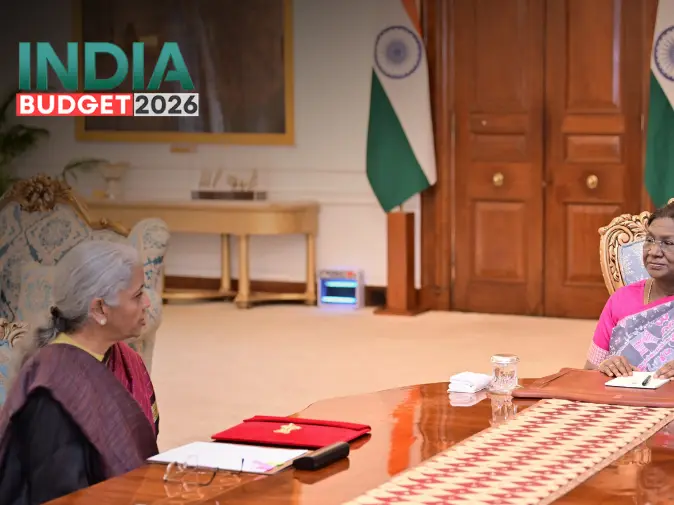
With at least 11 mentions of AI in the Union Budget 2026–27, Finance Minister Nirmala Sitharaman stressed how technology is a key driver of economic growth and announced significant allocations and initiatives targeted at the information technology and AI sectors. A key vision of the budget she presented on Sunday (Feb 1) was to “Make AI in India and Make AI work for India”, with several proposals aimed at creating a robust AI ecosystem while addressing challenges related to jobs, skills and infrastructure.
Measures to boost semiconductor production and data centres
Boosting the fledgling semiconductor sector in India, attracting investments in data centres, increasing research funding and promoting sector-specific AI applications are among the key proposals in the budget.
A total R&D fund of ₹1 trillion has been spread over six years, out of which ₹20,000 crore has already been deployed.
Also read: Union Budget 2026 | 'Ambitious and aspirational': PM Modi hails FM Sitharaman's 'futuristic' budget
AI as the catalyst for India's growth
Trending Stories
&imwidth=180&imheight=135&format=webp&quality=medium)
'My name has always been Ilhan Omar': Congresswoman hits back at Trump, calls him a 'creep'
&imwidth=180&imheight=135&format=webp&quality=medium)
Gravitas | US attack could trigger WW III: Russian planes in Tehran, Israeli jets, US warships in action
&imwidth=180&imheight=135&format=webp&quality=medium)
Viral video shows cross falling on Colombia priest, no official confirmation | WATCH
&imwidth=180&imheight=135&format=webp&quality=medium)
US Navy, Marine Corps boards defy Trump's transgender military ban, vote to retain troops
&imwidth=180&imheight=135&format=webp&quality=medium)
Will the US attack Iran this weekend? Trump's envoy says, 'absolutely'
&imwidth=180&imheight=135&format=webp&quality=medium)
Fauzi teaser out: Prabhas takes on the British Empire in patriotic avatar | Watch
&imwidth=180&imheight=135&format=webp&quality=medium)
India-China face-off continues near Arunachal’s Taksing, reveals ITBP chief in first official confirmation of tensions
&imwidth=180&imheight=135&format=webp&quality=medium)
Nairobi building collapse: Several feared trapped after 16-storey structure crumbles; rescue operation underway
&imwidth=180&imheight=135&format=webp&quality=medium)
Pakistan airline PIA unveils new crew uniforms, faces online criticism
&imwidth=180&imheight=135&format=webp&quality=medium)
Did Neha Bora call for Bangladesh-like GenZ protest, 'anarchy' in India? WION Fact-checks viral claim
&imwidth=180&imheight=135&format=webp&quality=medium)
Scientists make digital nose that can sniff and send scents over the internet
&imwidth=180&imheight=135&format=webp&quality=medium)
'Already tired of his 9-to-5': Baby born with a moustache becomes internet sensation, video goes viral | Watch
&imwidth=180&imheight=135&format=webp&quality=medium)
Horrific video shows the moment 18-year-old fell to her death from Mexico amusement park ride
&imwidth=180&imheight=135&format=webp&quality=medium)
IND-W vs ZIM-W, 1st ODI: Rawal, Charani star in India’s nine-wicket win over Zimbabwe
&imwidth=180&imheight=135&format=webp&quality=medium)
Massive 7.2 magnitude quake off Vanuatu triggers tsunami warning for coasts within 300 km
&imwidth=180&imheight=135&format=webp&quality=medium)
Microsoft AI diagnoses complex medical cases more than twice as accurately as doctors, study finds
&imwidth=180&imheight=135&format=webp&quality=medium)
Google Fitbit Air’s new health guardian feature tracks trends: How it works
&imwidth=180&imheight=135&format=webp&quality=medium)
US midterms 2026: Trump revises Canada tariffs as Susan Collins faces tight re-election race in Maine
&imwidth=180&imheight=135&format=webp&quality=medium)
US midterms 2026: Viral video claims Lindsey Graham paid underage men for sex; clip released weeks before his sister's Senate race
&imwidth=180&imheight=135&format=webp&quality=medium)
IND vs NZ 2nd T20I: Shreyas Iyer on brink of breaking Rohit Sharma’s record
&imwidth=180&imheight=135&format=webp&quality=medium)
AI deepfakes are spreading online: Why is removing them so difficult?
&imwidth=180&imheight=135&format=webp&quality=medium)
China's dancing robot turns violent bodyguard, lifts cars and fights intruders - Watch
&imwidth=180&imheight=135&format=webp&quality=medium)
Global cybersecurity alert: PHP flaws trigger website shutdowns as hack attempts surge into millions
&imwidth=180&imheight=135&format=webp&quality=medium)
'You’re a horrible little reporter, aren’t you?': Trump snaps at NBC reporter questioning his support for Ramaswamy's campaign ad
&imwidth=180&imheight=135&format=webp&quality=medium)
Chemical warehouse explosion in Mexico: Several injured in multiple blasts, 1,000 evacuated in León
&imwidth=180&imheight=135&format=webp&quality=medium)
US charges two former FBI officials with lying to Congress about Hunter Biden probes. 'Politically motivated' Trump grievance or something else?
&im=FitAndFill=(700,400)&imwidth=180&imheight=135&format=webp&quality=medium)
New Friday OTT releases (October 23, 2026): Gajab Raat, Dorothy, Chaar Yaar- Watch these 6 new movies and TV shows on Netflix, Prime Video and more
&imwidth=180&imheight=135&format=webp&quality=medium)
Anthropic security chief issues grim cyberattack warning: ‘It’s going to get a lot worse’
&imwidth=180&imheight=135&format=webp&quality=medium)
Tu Hai Meri Kiran film review: Sonakshi Sinha and Zaheer Iqbal's thriller gets tangled in its own twists
&imwidth=180&imheight=135&format=webp&quality=medium)
First Lady Melania Trump secures ceasefire between Russia, Ukraine in Oleshky: White House
&imwidth=180&imheight=135&format=webp&quality=medium)
Jenna Ortega plans TV break after Wednesday: ‘I want to leave time for new things’
&imwidth=180&imheight=135&format=webp&quality=medium)
Five killed, several injured after explosion in Bihar's Siwan as firecrackers catch fire
&imwidth=180&imheight=135&format=webp&quality=medium)
Iran targeting US diplomats? Intelligence warns of 'advanced' assassination plots: Report
&imwidth=180&imheight=135&format=webp&quality=medium)
Emmanuel Macron calls Paris suburb shooting a 'racist terrorist attack' after one killed, several injured
This year's budget saw the highest number of mentions of AI to date, with focus across governance, agriculture, healthcare and education.
The budget will continue supporting the IndiaAI Mission with an allocation of ₹2,000 crore, alongside the National Quantum Mission with ₹6,003 crore.
These initiatives, along with the Anusandhan National Research Fund, aim to promote AI adoption, research and development, and commercialisation in priority areas such as quantum computing, biotechnology, the digital economy and deep technologies.
In the agriculture sector, the budget envisions Bharat-VISTAAR (Virtually Integrated System to Access Agricultural Resources), a new multilingual AI tool integrating AgriStack portals and Indian Council of Agricultural Research (ICAR) packages. This system is intended to provide customised advisory support, enhance farm productivity and reduce risks for farmers.
A committee on AI impact on economy
A High-Powered Standing Committee has been proposed to assess the impact of AI and emerging technologies on jobs, skills and the services sector. This includes embedding AI in education, teacher training, reskilling technology professionals and labour market analysis.
The budget has also allocated ₹500 crore for AI Centres of Excellence and envisions the establishment of 80 IndiaAI Labs to foster innovation and skills development.
AI applications ranging from governance to logistics; Deep Tech Fund and Semiconductor Mission 2.0
The budget views AI as a “force multiplier” for public service delivery in governance, healthcare, logistics and agriculture.
It also highlights AI-driven solutions for energy transition, climate action and strategic sectors such as defence and space.
A Deep Tech Fund has been proposed as part of efforts to position India as a global AI leader, dedicated to supporting AI and deep-tech start-ups.
Proposals for information technology: tax incentives, infrastructure boosts and reforms
The India Semiconductor Mission 2.0 was mentioned in the budget, with Phase II focusing on producing semiconductor equipment and materials, designing full-stack Indian intellectual property, strengthening supply chains, and establishing industry-led research and training centres for skilled workforce development.
To support self-reliance in hardware, a budget allocation of ₹40,000 crore was made for the manufacture of electronic components, nearly doubling the outlay under previous schemes.
Tax holiday for data centres and cloud services; safe harbour reforms for IT
A tax holiday until 2047 for foreign companies providing cloud services through Indian data centres or resellers featured prominently in the budget.
The proposals include a 15 per cent safe harbour margin for related entities to attract global investment and strengthen India’s digital infrastructure.
For safe harbour computation, software development, IT-enabled services (ITES), knowledge process outsourcing (KPO) and contract R&D will be consolidated under a single “Information Technology Services” category. The uniform safe harbour margin will be 15.5 per cent, while the eligibility threshold has been raised from ₹300 crore to ₹2,000 crore to benefit more firms and reduce tax disputes.
Creative economy boost: The orange sector gets a mention
The finance minister also acknowledged the creator economy, or orange economy, encompassing animation, visual effects, gaming and comics (AVGC).
The budget proposals for this sector includesestablishing labs in 15,000 schools and 500 colleges to build talent capacity and address a projected demand for 2 million professionals by 2030.
IT in the broader economy
The integration of AI and IT in areas such as rare earths, biopharma and cybersecurity was also mentioned in the budget.
Overall, the minister appears to have emphasised a push towards an “intelligence-first” economy, combining immediate incentives with long-term investments to position India as a global hub for IT and AI.

