
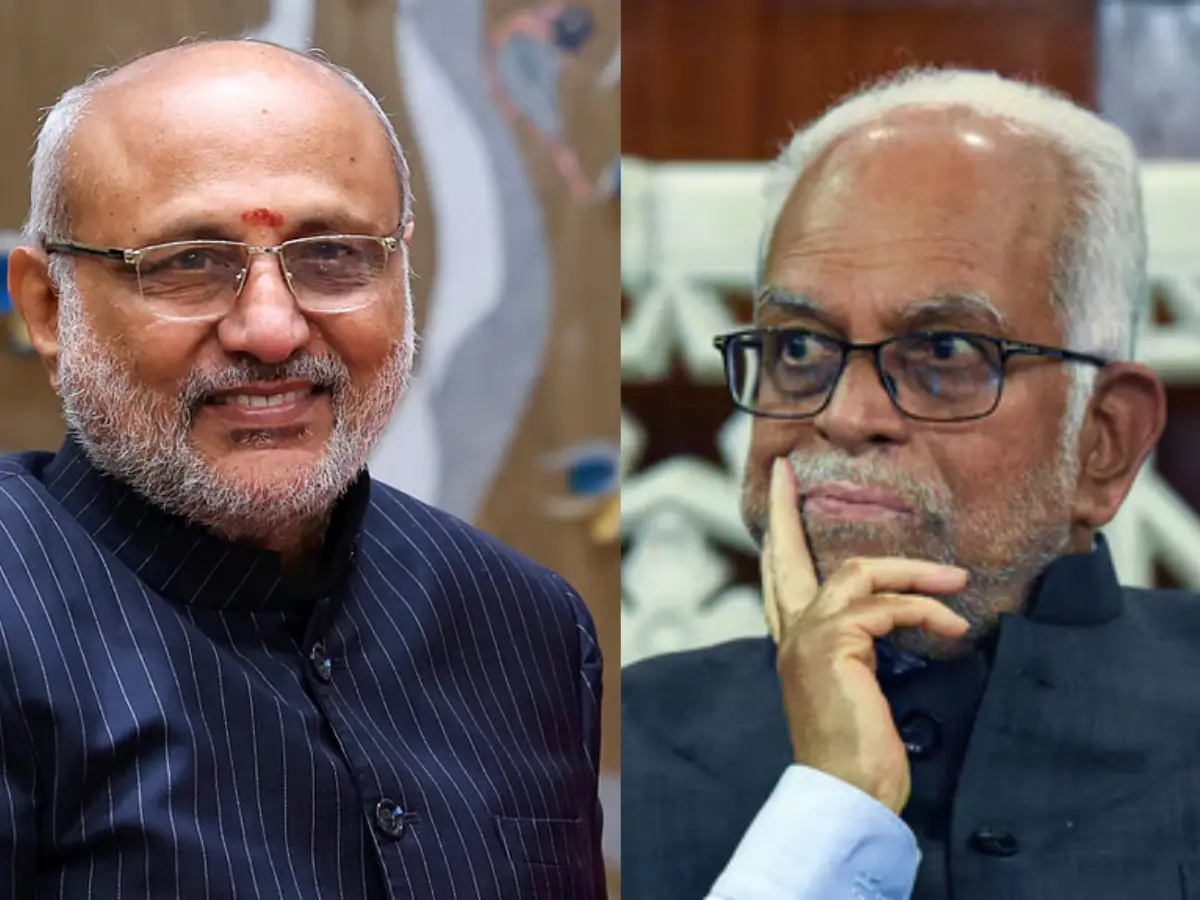
&imwidth=800&imheight=600&format=webp&quality=medium "India all set to elect its next vice-president: CP Radhakrishnan vs B Sudershan Reddy. Who will win?")
India is at the cusp of choosing its new vice-president after the unexpected resignation of Jagdeep Dhankhar in July. What was meant to be a mid-term continuation of routine parliamentary business has suddenly become a high-stakes political contest, drawing attention to two sharply different candidates and the power balance between the ruling National Democratic Alliance (NDA) and the opposition INDIA bloc.
Why a new election was needed
Vice-president Jagdeep Dhankhar stepped down on July 21, citing health reasons. His exit created a rare mid-term vacancy in the vice-presidential office, prompting the Election Commission to announce a special election for September 9, 2025. The vice-president of India, who is also the ex-officio Chairperson of the Rajya Sabha, holds a crucial constitutional position—balancing legislative responsibilities while being first in line to the presidency should the need arise.

The candidates in fray
CP Radhakrishnan: NDA’s Pick
The NDA has fielded CP Radhakrishnan, a veteran leader of the Bharatiya Janata Party. Currently serving as Governor of Maharashtra, Radhakrishnan is not new to politics or parliamentary life. A two-time Lok Sabha MP from Coimbatore, he also led the BJP in Tamil Nadu as state president. Over the years, he has developed a reputation for loyalty to the party and long administrative experience, which the NDA is banking on to project stability. His nomination was announced on August 17 and quickly secured support from several allies, including the YSR Congress Party, JD(U), AIADMK, NCP, TDP, and Shiv Sena. That broad coalition makes him the frontrunner in terms of numbers.
Trending Stories
)
US vs China over South China Sea: Washington backs Philippines, Beijing hits back
)
Bigg Boss 20: Isha Rikhi evicted after three weeks in Salman Khan’s show
)
Musk plans to more than double xAI's chips to over 1.2 million Nvidia GPUs by year-end
)
After JU, clash erupts at SRFTI: BJP’s ‘Dimagi Naxal’ jibe sparks political firestorm after students protest RSS-linked event
)
‘Anti-social elements spreading false rumours’: LPU issues statement amid massive unrest over alleged rape
)
LPU students go on rampage, vandalise campus amid widespread protest: What's happening
)
Trump asked Xi to pressure Iran. China did not say yes — here’s what Beijing wants
)
US Treasury Secretary Scott Bessent hails global crackdown on Iranian banks and airlines
)
An OpenAI agent escaped its locked test cage again, by hiding questions in DNS lookups
)
'Our video was trimmed': LPU girls who featured in rape-denial video make U-turn
)
3 males killed, four others injured in shooting after fight at strip club in Detroit
)
'Victory for low-budget consumers': Raghav Chadha hails 30-day telecom recharge rules
)
Claude rebuilt the 1989 game 'Prince of Persia' by reusing the original's own code
)
Beyond metros: How Tier-2 and Tier-3 cities could drive India’s next AI wave
)
Tesla builds first Cybertruck with its own refined lithium: Elon Musk's $1 billion Texas bet pays off
)
IndiGo flight suffers tail strike in Bengaluru while landing; DGCA to probe incident
)
The US and China set up an AI 'red telephone', but skipped the rulebook
)
‘Terror suspects arrested near UK air base were looking to do big damage’: Trump
)
Russian envoy claims US tactics to contain India were revealed in ‘Freudian slip’
)
IND vs WI 1st ODI: Kohli breaks Sachin's most runs in one country record with unbeaten 139 as India thump West Indies by 8 wickets
)
Researchers rebuilt exactly how 700 AI agents hacked Hugging Face: a 900-link chain trick
)
‘Olympic inclusion is our major target’: WPA President Ishaun Singh on pool’s global ambitions
)
Nations League: Spain sink England at Wembley; Modric shines for Croatia
)
Why has Iran released no proof of life of Mojtaba Khamenei? Araghchi reveals...
)
'What kind of confession is this?': Pakistan PM Shehbaz Sharif’s 'terrorists would be roaming New York' remark goes viral, raises alarm online. Watch
)
South Korea demands apology from Ukraine over North Korean prisoners' transfer
)
Beyond BrahMos: India targets Rs 50,000 crore in defence exports with unmatched price edge
)
Sri Lankan Tamil migrant worker gets death sentence in Saudi Arabia, help sought from India
)
Muslim marriage cannot shield sex with minor wife from prosecution under POCSO: Delhi HC
)
'Can't help but draw painful parallels to Nirbhaya case': SC on latest incidents of rape cases in Delhi-NCR
)
99.9% more powerful - Scientists find boy who can recall memories from just 3 months of age
)
'FIRST LOOK from inside Noah’s Ark': Researchers share video from inside mysterious mound in Turkey
)
UNSC reform momentum grows: Russia, Portugal, Mauritius push for India's permanent seat bid
)
8 US marines injured in Iranian missile attack on vessel in Strait of Hormuz: Report
&im=FitAndFill=(700,400))
New OTT releases this week (September 28-October 4, 2026): Dupahiya 2, Pooja Meri Jaan, Ohh My Dog- 5 titles coming on Netflix, Prime Video and more
)
Afghanistan says 28 fighters killed in clash near Pakistan border, Islamabad denies
)
Ceuta migrant crisis: Protesters take to streets as Spain grapples with migrant challenge
)
LPU suspend classes, postpones exams as violence escalates over rape claims: What's happening
)
New York City wants a 'kill switch' on every AI, and will pay whistleblowers who report violations
B Sudarshan Reddy: INDIA Bloc’s challenger
The opposition INDIA bloc has united behind Justice (Retd.) B. Sudarshan Reddy, a former Supreme Court judge who also served as Chief Justice of the Guwahati High Court and later became Goa’s first Lokayukta. Reddy’s candidature, announced on August 19, is a deliberate contrast to the NDA’s political choice. The opposition is framing him as a figure of integrity and constitutional commitment, aiming to appeal to lawmakers’ sense of independence and conscience.
How the election works
The vice-president is chosen by members of both houses of Parliament through a secret ballot under the single transferable vote system. This means MPs are free to vote beyond party lines, giving rise to the possibility of cross-voting. Polling is being held on September 9 at Vasudha Hall in Parliament House, running from 10am to 5pm, with counting set to begin immediately afterward. The result is expected by evening. With 781 MPs eligible, and around 770 expected to cast votes (given abstentions by some parties like BJD and BRS), the halfway mark is 386 votes.
The numbers game
In terms of raw arithmetic, the NDA enjoys a comfortable lead. Together with allies and external supporters, Radhakrishnan is estimated to command between 425 and 429 votes, already above the majority threshold. The INDIA bloc controls about 324 MPs — a significant bloc but not enough to tilt the balance on its own. Their strategy lies in presenting Justice Reddy as a moral alternative and hoping to secure cross-party votes or at least narrow the margin to showcase opposition strength.
What’s at stake
The vice-president plays a pivotal role in managing the Rajya Sabha, often becoming a key figure in balancing debates and ensuring the smooth functioning of the upper house. With India’s Parliament entering a period of heated debates on reforms, economic policy, and foreign affairs, the choice of Vice President will have immediate practical implications. Moreover, this election is a test of strength between the ruling NDA and the INDIA bloc. For the NDA, a win by Radhakrishnan would reaffirm its dominant parliamentary control. For the opposition, even a closer-than-expected result would be touted as proof of growing cohesion among its ranks.
Likely outcome?
Given the current numbers, CP Radhakrishnan appears strongly positioned to become India’s next vice-president. However, the secrecy of the ballot and the possibility of cross-voting always leave room for surprises. By the end of September 9, India will know whether the numbers held or if Justice Reddy managed to script an unexpected twist.

