India @ 80: From carrying rockets on bicycles to first private satellite launch, India's space journey

&imwidth=600&imheight=450&format=webp&quality=medium "India @ 80: From carrying rockets on bicycles to first private satellite launch, India's space journey")
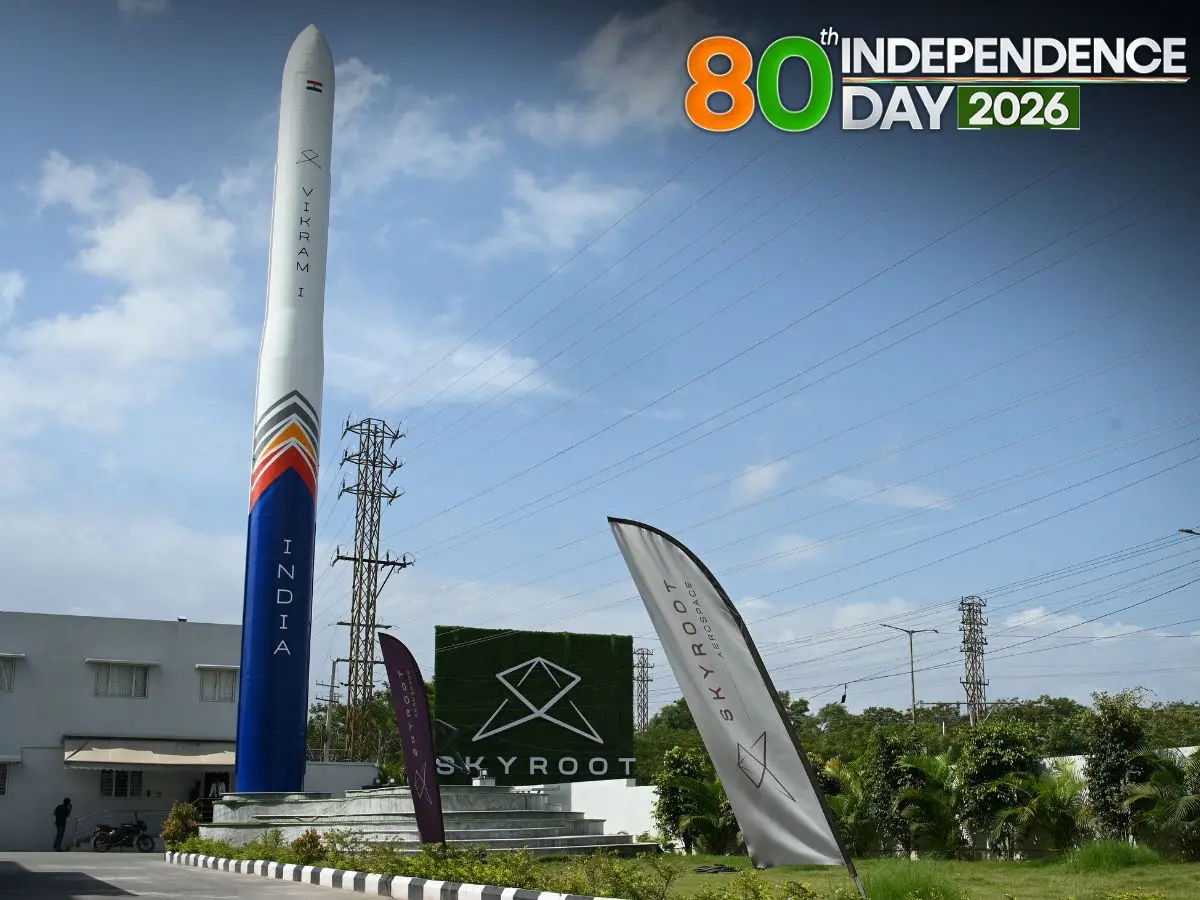
Vikram-1 orbital rocket model displayed at Skyroot Aerospace facility on the outskirts of Hyderabad. Photograph: (AFP)
India's space journey has evolved from transporting rocket parts on bicycles and launching its first sounding rocket at Thumba to major lunar and Mars missions and the successful orbital flight of the private rocket Vikram 1.
As India celebrates its 80th Independence Day on August 15, the country is also marking a major milestone in its space exploration journey. India has now entered a new phase, with its private space sector making its mark in orbital missions.
Skyroot Aerospace's Vikram 1 Test Flight 1 successfully reached orbit on July 18, 2026, marking the maiden flight of India's first privately developed orbital-class rocket. The rocket was built by a team of young Indian engineers with an average age of 28.
On its maiden orbital mission, Vikram 1 successfully reached a Low Earth Orbit of about 450 kilometres and deployed its payloads. With this achievement, Skyroot became the first Indian private company to place a rocket into orbit.
But India's space journey began with far more humble beginnings.
From bicycles to India's first rocket
In 1962, under the patronage of Vikram Sarabhai and physicist Kalpathi Ramakrishna Ramanathan, the Indian National Committee for Space Research, or INCOSPAR, was established. It marked a pivotal moment in India's space exploration journey.
Trending Stories
)
)
)
)
)
)
)
)
)
)
)
)
)
)
)
)
)
)
)
)
)
)
)
)
)
)
)
)
)
&im=FitAndFill=(700,400))
)
)
)
)
Just a year later, in 1963, India made its debut in space exploration with the launch of its first rocket. The sounding rocket was designed for upper atmospheric studies and was launched from the Thumba Equatorial Rocket Launching Station in the fishing village of Thumba, Kerala. The site is now known as the Vikram Sarabhai Space Centre.
Dr APJ Abdul Kalam, who was part of the rocket launch team at the time, later recounted the enormous efforts required to prepare for the historic launch. INCOSPAR had to negotiate the acquisition of land from a local church and resettle villagers before preparations could begin.
The team also faced basic logistical challenges. Rocket components were initially transported to the launch pad using bicycles.
All these efforts culminated on November 21, 1963, when India successfully launched the rocket in the presence of several distinguished scientists, including Dr Homi Bhabha.
Building India's space programme
India's space programme gradually expanded from its early years under INCOSPAR. The organisation later paved the way for the formation of the Indian Space Research Organisation, or ISRO, in 1969.
From INCOSPAR in 1962 to ISRO in 1969, India's space programme continued to live up to its motto of "reaching for the stars".
Visionaries such as Vikram Sarabhai, regarded as the father of India's space programme, and Satish Dhawan played a key role in shaping the country's space programme.
India's journey produced several major milestones, beginning with Aryabhata in 1975 and eventually transforming the country into a major global space technology player.
Soviet partnership and the rise of PSLV
Collaboration with the erstwhile Soviet Union also played an important role in India's early space programme. This partnership began with the launch of Aryabhata in 1975, India's first satellite, using a Soviet Kosmos 3M rocket. The Soviet Union also provided training to Indian scientists in satellite communications and mission operations during the 1960s and 1970s.
A major leap came in the 1990s with the development of the Polar Satellite Launch Vehicle, or PSLV.
Despite an initial setback in 1994 and a couple of partial failures later, the PSLV went on to achieve a streak of more than 50 successful missions.
From Aryabhata to the Moon and Mars
In 1996, India approved its first astronomical satellite, two decades after Sarabhai's death. The satellite was eventually launched in 2015, marking another milestone in India's space programme.
India also turned its focus towards lunar exploration in the early 2000s. By 2003, the Chandrayaan project had been officially named.
Chandrayaan 1, launched in 2008, marked a critical stage in India's space programme and helped move the country's lunar ambitions forward. The Mars Orbiter Mission, launched in 2013, further demonstrated India's growing capabilities in space exploration and brought global recognition to the country's space programme.
However, the Chandrayaan missions remain among India's most significant space achievements. In 2009, Chandrayaan 1 detected water ice on the Moon.
Then, on August 23, 2023, Chandrayaan 3 created history by becoming the first spacecraft to successfully land near the Moon's unexplored South Pole. The historic achievement is now commemorated as National Space Day.
A new chapter with private space companies
From transporting rocket components on bicycles to successfully landing a spacecraft near the Moon's South Pole, India's space programme has travelled a remarkable distance.
The successful orbital mission of Skyroot Aerospace's Vikram 1 now marks another important chapter in that journey. India's space story, which began with a small sounding rocket in Thumba, has expanded into a growing ecosystem involving both the country's national space agency and private space companies.