Here’s how Indian Coast Guard is cleaning up oil spill off Kerala

&imwidth=600&imheight=450&format=webp&quality=medium "Here’s how Indian Coast Guard is cleaning up oil spill off Kerala")
As of 11 am Sunday, the oil slick was observed drifting in an east-southeast direction at an estimated speed of 3.6 kmph. The prevailing active Southwest monsoon, with rough seas and strong winds, presented challenging conditions for responders.
Since the morning hours of Sunday, 25th May, when the Liberian-flagged cargo vessel MSC ELSA3 sank off the Kerala coast, Indian Coast Guard (ICG) assets have been combating the resultant oil spill and marine pollution. Oil spills are major maritime disasters that have the potential to cause serious damage to the economy and biodiversity of the affected region. Notably, the Kerala coast, which is at direct risk from this marine accident is rich in marine life and is a popular tourist hub.
According to the ICG, within 2-3 hours of the cargo vessel’s sinking, their surveillance aircraft detected the presence of an oil slick at the site.
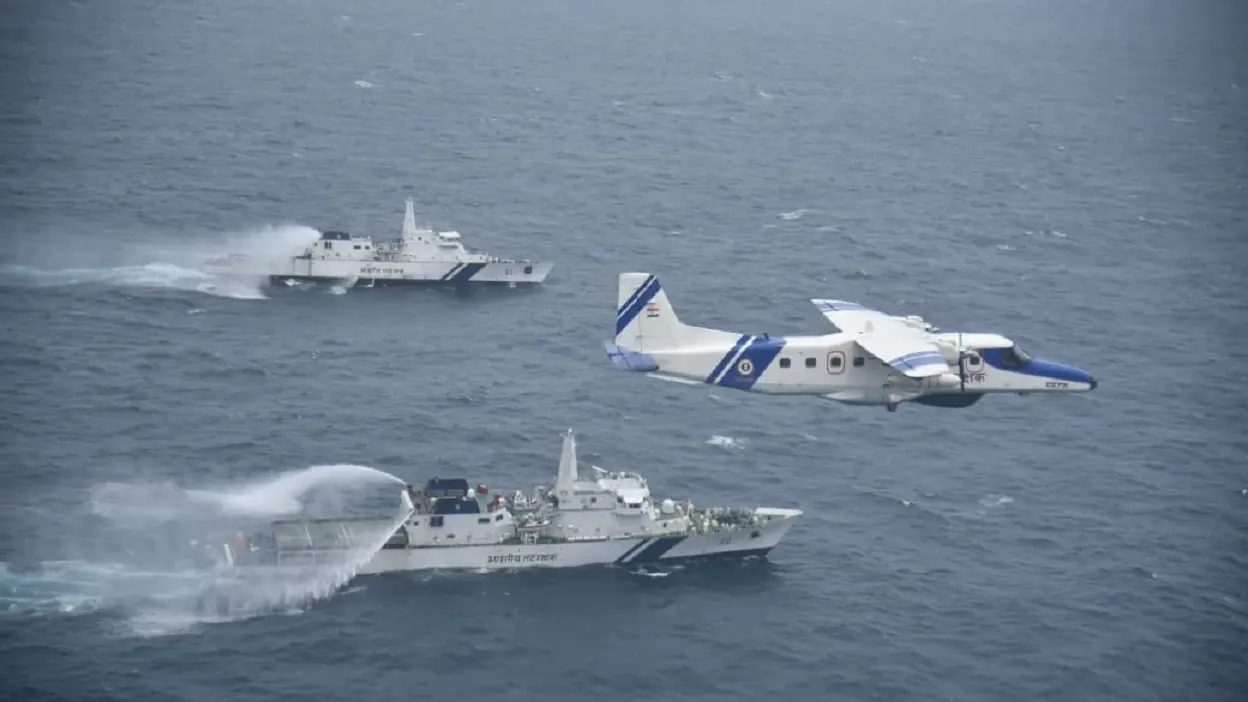
Following which, ICG ship Saksham, already on standby in Pollution Response (PR) configuration, was immediately deployed to begin counter-pollution operations. In parallel, a Dornier aircraft was launched for aerial assessment and the dispersal of Oil Spill Dispersant (OSD) across a wide area.
As of 11 am Sunday, the oil slick was observed drifting in an east-southeast direction at an estimated speed of 3.6 kmph. The prevailing active Southwest monsoon, with rough seas and strong winds, presented challenging conditions for responders.
Despite the adverse conditions, ICG personnel continued their operations with resilience, navigating dangerous waters littered with floating containers and ensuring safe diversion of all merchant traffic away from the affected zone. By 2 pm Sunday, the spill was assessed to have spread over an area of approximately two square kilometres.
Further, more than 100 containers were observed floating near the site, with some breaking apart and their contents scattered in adjacent waters. Mariners have been issued advisories to maintain a sharp lookout and exercise caution, as metallic shipping containers coming in contact with a vessel’s propeller or other systems could cause serious damage.
Trending Stories
)
)
)
)
)
)
&im=FitAndFill=(700,400))
)
)
)
)
)
)
)
)
)
)
)
)
)
)
)
)
)
)
)
)
)
)
)
)
)
&im=FitAndFill=(700,400))
&im=FitAndFill=(700,400))
)
&im=FitAndFill=(700,400))
)
)
)
)
)
)
ICG continues intensive surveillance and spill mitigation through air operations and deployment of Oil Spill Dispersant Chemicals using specialised equipment. Two ICG Offshore Patrol Vessels (OPVs) remain on-site for ongoing monitoring, assessment, and pollution response. In addition, the ICG has mobilised ICG Ship Samudra Prahari, a specialised Pollution Response Vessel carrying significant quantities of Oil dispersing chemicals, along with additional OPVs in Pollution Response configuration.
On Sunday, a coordination meeting was convened by the Directorate General of Shipping, bringing together key stakeholders including ICG, vessel owners, managers, Kerala state authorities, and others to implement an integrated response strategy. Ship managing firm MSC has appointed T&T Salvage for cleanup and recovery operations, including container and cargo retrieval and oil removal from the wreck.
As per directives under the Merchant Shipping Act, 1958, the Mercantile Marine Department (MMD), Kochi, has issued a warning to the sunken vessel’s owners regarding pollution liability. The ICG has also advised the state administration to prepare for shoreline cleanup operations and to caution local communities against handling any debris or cargo that may wash ashore.
