Explained | India's Chandrayaan-3 loses Russian co-traveller Luna-25. What are its implications?

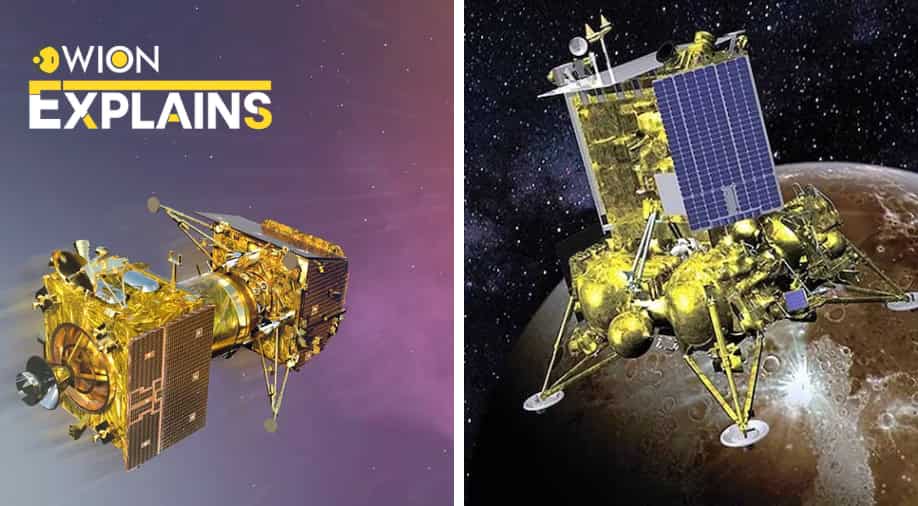
India's Chandrayaan-3 loses its Russian co-traveller Luna-25
This week would have been a historic one in Lunar exploration - with two landers (one from Russia and one from India) touching down near the Lunar south pole, within a few days of each other. However, it is not to be as historic as it should have been. Russia's maiden moon lander Luna-25 has crashed on the Lunar surface after suffering a mishap on Saturday, August 19, said the Russian Space agency. In preparation for an expected lunar soft-landing on Monday,August 21, the Russian lander was moving into its final, pre-landing orbit, when the mishap took place.
"On August 19, in accordance with the flight programme of the Luna-25 spacecraft, an impulse was provided for the formation of its pre-landing elliptical orbit. At about 14:57 Moscow time, communication with the Luna-25 spacecraft was interrupted.The measures taken on August 19 and 20 to search for the craft and get into contact with it did not produce any results," said the statement from Russian space agency Roscosmos.
"According to the results of the preliminary analysis, due to the deviation of the actual parameters of the impulse from the calculated ones, the device switched to an off-design orbit and ceased to exist as a result of a collision with the lunar surface," the agency said, thereby indicating that all hopes of the maiden Russian Lunar landing are over. (The erstwhile Soviet Union conducted multiple robotic Lunar landing missions, the last of which was in 1976).

The journey of Chandrayaan-3 and Luna-25, thus far...
July 14- India launches its Chandrayaan-3 spacecraft to soft-land on the moon and all eyes are on the proposed soft-landing date - 23rdAugust.
)
WATCH | China President Xi Jinping lands in US as Trump greets him ahead of high-stakes summit
)
Open AI, Anthropic CEO urges caution over rapid AI development at UN Security Council, call for 'extreme care'
&im=FitAndFill=(700,400))
New OTT releases this week (September 21-27, 2026): Shaque: Trust No One, Hunkkaar, Don’t Be Shy- 5 new titles coming to Netflix, Prime Video and more
)
US citizen injured in Illinois after ICE agents mistook him for fugitive, hospitalised
)
WION Iconic Tourism Summit: How local tourism MSMEs must upskill for AI integration
)
Bomb scare in New York amid UNGA: Suspicious suitcase found near UN headquarters
)
Elephants hide behind trees, stage surprise attack on poachers targeting rhinos in South Africa
)
Xi-Trump meeting: China’s human rights red line and past protests explained
)
American manufacturing is reshoring faster than its factory floors can absorb
)
Hours before Xi-Trump meeting, US announces visa curbs targeting birth tourism: What is it?
)
China to test supersonic jet that moves at Mach 2, double the speed of sound
)
Trump-Xi state dinner 2026: Who is invited? Full guest list of tech CEOs, business leaders and officials
)
'AI got into my speech': Prince Harry jokes after teleprompter failure at event in New York
)
TMC revives impeachment push against CEC Gyanesh Kumar after report of internal dissent
)
Trump signs Greenland security deal with Denmark, paving way for two new US military bases
)
Trump-Xi Summit: Trade, Taiwan and the red lines shaping US-China talks | Race To Power
)
WION Iconic Tourism Summit: Is India's travel boom outrunning its airports, airlines and hotels?
&im=FitAndFill=(700,400))
Trump welcomes Xi Jinping in rare airport gesture: Photos from Chinese President's arrival in US
)
'Putin is patient zero': Zelensky slams Russian president at UNGA, accuses him of using fighters from 47 countries
)
WION Iconic Tourism Summit 2026: Union Minister Shekhawat on 'experiential travel', peace diplomacy
)
IIT Bombay CCTV footage emerges: Sahil Wakode seen looking at phone in examination hall
)
Cyclone Arnab: Landfall expected before midnight tomorrow as IMD issues orange alerts across six states
&im=FitAndFill=(700,400))
National Film Awards 2026: Kartik Aaryan, Mammootty, Yami Gautam, Randeep Hooda and other key winners
)
Pilot recreates Mona Lisa in sky over Oklahoma and Arkansas in four-hour flight: VIDEO
)
Afghan woman cyclist who disguised herself as a boy to escape Taliban, wins Asian Games medal
)
WION Iconic Tourism Summit: Seychelles envoy says India partnership is important for Seychelles
)
Anne Hathaway to run in supporting race for Nolan's epic
)
US judge questions Trump’s decision to ban CNN, MS NOW and Politico from White House
)
WION Iconic Tourism Summit: 'Hanuman Ansh' Director on blockbuster success
)
Scientists detect first radio signals directly from faraway planet
)
Australian PM Anthony Albanese calls OpenAI AI incident 'unacceptable' after restricted data access
)
El Niño 2026 heats up to become strongest in 1,000 years
)
'What kind of confession is this?': Pakistan PM Shehbaz Sharif’s 'terrorists would be roaming New York' remark goes viral, raises alarm online. Watch
)
NBA player Steven Adams shares hilarious GTA VI theory
)
Israeli envoy to US Yechiel Leiter’s son critically injured in West Bank ramming attack
)
ICC plans T20I expansion and fewer ODIs in 2027–2031 FTP cycle: Report
)
WION Iconic Tourism Summit and Awards 2026: Key voices to discuss India’s tourism future
August 11- Russia launches it Luna-25 spacecraft to soft-land on the moon, which could soft-land on the moon, a couple of days ahead of Chandrayaan-3.
Launch vehicle and time taken to the moon
Launched onJuly 14, Chandrayaan-3 is taking almost 40 days to soft-land on the moon. Why so? Because, the Indian LVM3 rocket can only impart a certain amount of departure energy to its 3.9 tonne Chandrayaan-3 craft. While this departure energy is sufficient to put it into a parking orbit (170km x 36000km) around the earth, it cannot put the craft directly on a Lunar Transfer trajectory (direct path to rendezvous with the moon insix days). Knowing its limitations fully well, the Indian space agency has gradually slingshot its craft further and further away from the earth (over a span of more than two weeks) and then put it on Lunar transfer trajectory. ISRO is making up for its limitations by using an energy-efficient and frugal method to achieve its objectives.
Luna-25 has been launched on a Soyuz-2 rocket with a Fregat upper stage. The launch on August 11th put the 1.8 tonnecraft through a few orbits around the earth and directly on the Lunar Transfer Trajectory, thereby ensuring that it can rendezvous with the moon in around 6 days. The Luna-25 craft weighing just half as much of India's Chandrayaan-3 also gaveit the added advantage of being able to reach faster. Think of it as a lighter shotput ball being thrown further and faster. While the Russian rocket is similar in terms of power and capability, when compared to India's LVM3, the lighter mass of Luna-25 makes a difference.
Also watch |Chandrayaan-3: Second and final de-boosting of Vikram Lander successful
Coincidence or competition?
There are hundreds of news reports pitting Chandrayaan-3 and Luna-25 as a reflection of rivalry. Here are the facts - India decided upon Chandrayaan-3, almost immediately after its maiden Lunar soft-landing attempt Chandrayaan-2 failed in September 2019. In the case of Luna-25, it is more of a continuation of the Soviet-era Luna-series of missions, the last of which was Luna-24. It is after decades of delay that Luna-25 has taken flight, so it would outlandish to claim that the Russians are competing with the Indians.
When launching scientific probes and spacecrafts to other planets, celestial bodies, space agencies have to look at an ideal launch date and time. These are based on precise calculations and not based on the intention to compete with another agency. If you think it's like a James Bond chase sequence in space, it is far from that!
Orbital Mechanics is the science that determines when to launch spacecrafts, the path they must take, the energy efficient route it must follow, the gravitational influence of earth and other celestial bodies, the specific date when the craft must reach its destination etc. Therefore, space agencies plan a certain launch window, within which they must carry out a mission. For a mission to each celestial body, there is an ideal window - weeks or months-long, during which it is possible to carry out a mission in an energy-efficient manner (based on the position of the earth, other celestial bodies etc.). Therefore, when the time is ideal, whoever is ready with a mission will launch - sooner or later (depending on their rocket and mission specifications and preferred landing time).
The landing date - Which one wastoreach earlier ?
For the Indian Space agency ISRO, Chandrayaan-3 must land on August 23. Why? Because, Chandrayaan-3 is meant to be operational for one Lunar day (two weeks on earth) and the Lunar day commences on August 23rd. Landing on the Lunar day will help Chandrayaan-3 harness the sunlight, use it to charge its batteries and thereby operate all the scientific payloads on-board the craft (for at least the planned duration). Solar-power is crucial for Chandrayaan-3's lander and rover, as that is its lone power source. This is why ISRO determined its launch date well in advance and made it public.
Luna-25 did not depend completely on Solar power. Though it weighed less, Luna-25 useda radioactive isotope, a sort of nuclear battery, that helpedit stay powered for at least one earth year. Therefore, it was theoretically possible for Luna-25 to land ahead of Chandrayaan-3. While the Russian Space agency Roscosmos did not announce the exact landing date, it was widely expected to land on August 21, two days prior to Chandrayaan-3.
While many claimed that it was a space rivalry or competition between India and Russia, the prospective landing dates being so close to each other, is a merecoincidence.
What this means for the Russian space programme?
The crash-landing and loss of Luna-25 would certainly be a jolt to the Russian space programme, amid the ongoing geopolitical crises that stemmed from the Ukraine-Russia war. Without doubt, Russia can bounce back and learn from their mistakes and re-attempt this mission. But it would cause significant delay. Notably, Luna-25 itself was delayed by several decades and there are even reports of successor missions in the Luna series.
The setback caused by Luna-25 would warrant a closer look and many modifications to future Russian Lunar missions. It is notable that standalone Russian space-exploratory missions have not had a great track record, in recent decades.
High hopes on Chandrayaan-3
With its Russian co-traveller gone, Chandrayaan-3's Vikram lander will be attempting its scheduled Lunar soft-landing. The Indian Space agency ISRO has announced that Vikram lander is expected to perform its soft-landing at 6:04 pm IST, August 23. Leaders from within ISRO are confident that 'Vikram' will perform a feather-like soft-landing. It would be a fitting tribute to the fallen Chandrayaan-2 and Luna-25(both of which crash-landed in 2019 and 2023, respectively), when ISRO does so on Wednesday.
WATCH WION LIVE HERE:
