Air quality worsens in Delhi; is the national capital heading toward desertification?

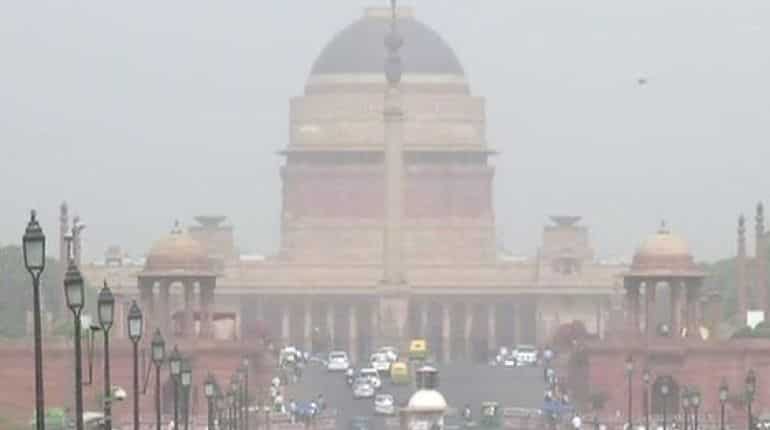
Air quality
When air gets extremely dry, its moisture content depletes and sand storms become more frequent adding to air pollution
With air quality dipping beyond 'Severe' level in the national capital over the last three days, experts fear that Delhi, most likely, may experience desertification. Reports of intensifying desertification and degrading land across the country is nothing new. Studies suggest vast expanse of country's land under the grip of desertification for over decades now. What worsens the situation even more for Delhi is the fact that the city has already been grappling with high air pollution during colder months, which has now been coupled with the menace of intensified sandstorms.
United Nations Convention on Combating Desertification (UNCCD) describes desertification as “land degradation in arid, semi-arid, and dry sub-humid areas resulting from various factors, including climatic variations and human activities”.Therefore, when air gets extremely dry, its moisture content depletes and sand storms become more frequent adding to air pollution.
A 2016 report stated nearly 30% of agricultural land in India to be gradually eaten up by desertification. A mix of climate change, mining and industrial and commercial activities are to blame for depleting dense vegetation cover that helps avert pollution and desertification advances from the West.

Indian Space Research Organisation report, published in 2016, estimates nearly 96 million hectares, or nearly 30% of land under degradation.
“As a country, we should be more than alarmed by this data,” noted SJanakarajan, chairman of the South Asia Consortium for Interdisciplinary Water Resources Studies.
“There is no coherent plan to reverse this process or its impact,” he added.
&im=FitAndFill=(700,400))
National Handloom Day 2026: From Alia Bhatt to Samantha Ruth Prabhu; Actresses who celebrated India's textile heritage as brides
)
The Royals enter the Doctor Who universe: King Charles and Queen Camilla beam into Commonwealth Games in TARDIS
)
Unitree Robotics targets $9 billion valuation in landmark IPO backed by DeepSeek and Tencent
)
India names 27 sites in Arunachal Pradesh
)
Bharat Bhhagya Viddhaata OTT: When will Kangana Ranaut's film stream online?
&im=FitAndFill=(700,400))
How many soldiers operate one S-400 battery?
)
Shakib Al Hasan ready to return to Bangladesh—under one condition
)
‘Fake news’: MEA rejects report claiming India sought defence pact with Israel after Pakistan, Saudi Arabia, Turkey deal
)
Rockstar to unveil GTA 6 extended look ahead of November launch
)
Russia forms Ukrainian Volunteer Spetsnaz Brigade to fight Ukraine
)
Drug-resistant fungus that hides in hair and enters bloodstream reported in 23 US states
)
Technology transfer deal boosts India's defence manufacturing ambitions
)
Border row erupts in Europe after Ceuta crossings, Spain imposes border controls on Italy
)
Morale plummets on USS Abraham Lincoln: Are US sailors reaching a breaking point? | GRAVITAS
)
'Security can't be bought with Pakistan, Turkey deal': Iran tells Saudi Arabia
)
Baba Vanga's 2026 prophecy: 2 predictions 'already came true', 3 terrifying ones remain. Details inside
)
Colombia’s new president Abelardo de la Espriella vows to ‘defeat narco-terrorists’, signals hardline shift
&im=FitAndFill=(700,400))
New Friday OTT releases (August 7, 2026): Operation Safed Sagar, Vadhandhi, Main Vaapis Aaunga- 6 movies and TV shows on Netflix, Prime Video and more
)
Squadron Leader Bhawana Kanth scripts history as Indian Air Force gets its first woman ‘Top Gun’ pilot
)
RSS says Gen Z protests reflect genuine distress
)
Trump says Iranian school bombing photos could be AI-generated - 'I don’t think...'
)
IAF officer held for sharing sensitive information in 'honey trap' case, booked under Official Secrets Act
)
Stray Kids under scrutiny? Fans react to Grammy submission silence after BTS boycott
&im=FitAndFill=(700,400))
Why the Su-30MKI doesn't need external fuel tanks to fly vast distances
)
Jugal Hansraj reunites with Shekhar Kapur after 40 years for Masoom: The Next Generation
)
New speed limits, automatic challans: Big traffic change coming to Delhi-Meerut Expressway. All you need to know
)
India officially names 27 places in Arunachal to counter China's renaming claims
)
Trump calls White House ballroom ruling a 'national disgrace' as court says Congress approval needed
)
US sanctions Iran’s crypto network after Strait of Hormuz attacks, offers $15m bounty for intel on IRGC finance
&im=FitAndFill=(700,400))
Why the Su-30MKI is one of the heaviest fighters ever built
)
Uttarakhand young innovator builds India's own flying vehicle, conducts first test flight: WATCH
)
Chilling video shows students take cover as teen opens fire at Thai school
)
Reese Witherspoon's father hospitalised after poolside incident in Nashville: Report
Satellite images show parts of Jammu and Kashmir and areas in states like Odisha and Jharkhand turning arid.In states like Jharkhand, Rajasthan, Delhi, Gujarat and Goa, more than 50% of the land is under desertification, Reuters reported.
“Population pressure has resulted in overexploitation of land for cultivation, grazing, water resources and deforestation leading to degradation of drylands,” minister Jitendra Singh wrote in the report.
"In the Indian context, as per the assessment made by the Ministry of Agriculture in 1985, of the total geographical area of about 329 mha, approximately 173.6 mha (53%) are subject to moderate to severe form of degradation for planning, implementation and monitoring of programmes," states National Action Programme to Combat Desertification submitted to UNCCD, 2001.
Environmentalists and experts now draw attention to the ever-degrading Aravallis in order to make sense of the alarming frequency of dust and sandstorm episodes in north India. Reports suggest a remarkable increase in the intensity and frequency of such storms in the past few decades.
The Energy and Resources Institute (TERI), in its study on Economics of Desertification, Land Degradation and Drought (DLDD) in India, explains how land degradation cost around 2.5 per cent of India's GDP in 2014/15.
The lush range of Aravallisprawls from Delhi to Gujarat, protecting the national capital and neighbouring areas from harsh climatic battering. However, the rapid degradation and denudation of the green cover of the mountainous range pose a severe threat to the environment.
Desertification triggers a host of problems ranging from depleted vegetative cover, soil erosion, pressure on forest resources, impact on biodiversity and livestock to harming water management and over-abstraction of groundwater. A recent report by NITI Aayog already lists out alarming levels of water supply shortage and water contamination across India.
Air quality in the national capital remained "hazardous" in many areas on Friday prompting authorities to alert people to avoid stepping outdoors. Strong-anti cyclonic winds, blowing from Rajasthan, are the reason behind the worsening air quality.
According to AQICN, on Friday morning, PM10 (particles with the diameter less than 10mm) level was over 700 in most of the areas in Delhi-NCR areas, leading to hazy conditions and limiting visibility.
The AQI of R.K. Puram and Anand Vihar were recorded 948 and 999 respectively.
Lieutenant Governor Anil Baijal on Thursday ordered to stop all civil construction activities across the national capital from June 15 to 17 to bring down the severe dust pollution.