

&imwidth=800&imheight=600&format=webp&quality=medium "Did ISRO's LVM3 rocket gain10% lifting power to carry GSAT-7R?")
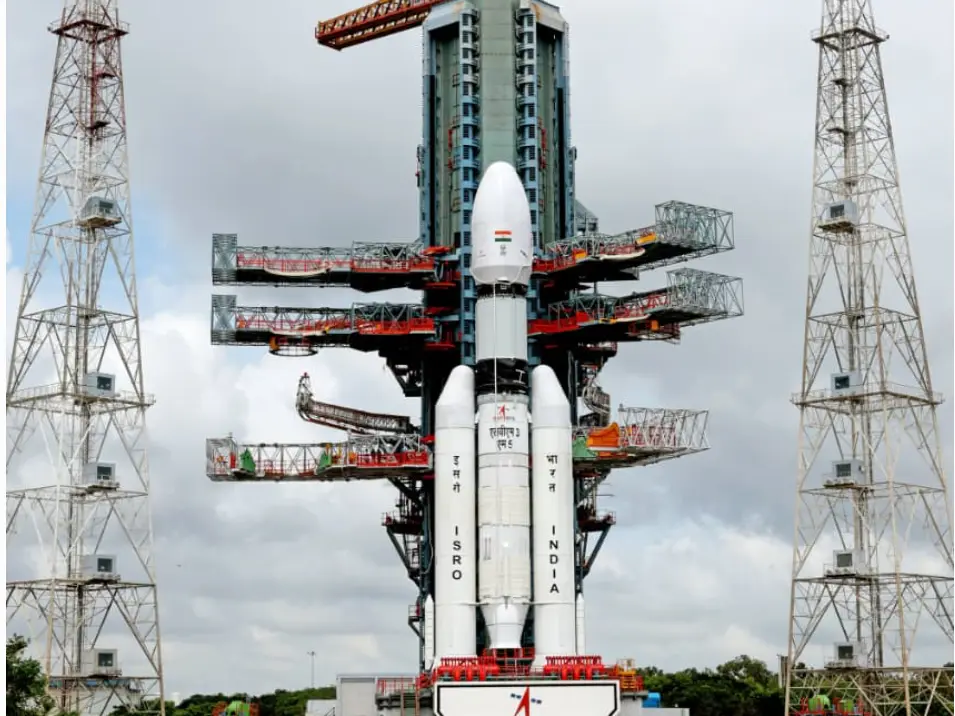
Indian space agency ISRO is gearing up for the launch of CMS-03 (originally known as GSAT-7R), a 4,400kg communication satellite meant for the Indian Navy. Scheduled for liftoff at 5:26pm Indian time, Sunday, (2nd Nov), the launch mission is to be carried out by India's largest rocket, the LVM3. While the LVM3 is known to lift a maximum of 4,000kg to Geosynchronous Transfer Orbit (GTO), this mission will witness the rocket lift a 10% heavier payload(weighing 4,400kg) to orbit.
GTO is an initial parking orbit into which communication and TV broadcast satellites are launched. Satellites remain in GTO for barely a week, after which they are gradually pushed to their designated orbits. GTO is an elliptical or egg-shaped orbit, where the satellite circles very close above the Earth and then moves very far away from the Earth, all in a single orbit. Typically, a satellite in a GTO orbit would be 200kms above Earth at its nearest approach (perigee) and about 36,000kms above the Earth at its farthest approach (apogee).
After successfully completing the initial system checks of the satellite while at GTO, commands are issued to fire the satellite's thrusters to circularize the orbit. This is done to make sure that the satellite is equidistant from the earth - it is placed about 36,000kms above the Earth's equator. This 36,000km circular orbit is known as a Geostationary orbit, which means that the satellite is exactly in sync with the Earth's 24-hour rotation. Therefore, a satellite placed 36,000kms above the Indian landmass would always remain above the Indian landmass, because its rotation is in sync with the Earth. For context, this is why DTH TV antennae are all permanently pointing to a fixed location in the sky- they are oriented towards a specific satellite. A satellite placed in Geostationary orbit can broadcast its signals to about one-third of the Earth.
How did the LVM3 gain 10% lifting power ?
The CMS-03 satellite weighs 4,400kg, which is 10% heavier than the existing lifting capability of 4,000kg. In this mission known as LVM3-M5/CMS-03, ISRO is not adding any additional lifting power, ISRO has not used more powerful engines or other methods to enhance the lifting capability. Instead, ISRO will be attempting to launch the satellite into an orbit slightly lower than GTO. Think of it as efficiency and optimization, instead of raw power.
ISRO's LVM3 rocket has not gained any lifting power. ISRO is merely planning and executing the launch in such a way that a heavier load can be carried to a lower orbit, instead of carrying it to the intended GTO orbit. "During the Chandrayaan launches using the LVM3 rocket, the LVM3 carried the 4,000kg satellite well above the designated GTO. That shows that the rocket is capable of lifting a 4,000kg mass well above the intended orbit. In the LVM3-M5/CMS-03 mission, the LVM3 will place the 4,400kg satellite in an orbit that is slightly below the GTO. From there on, we can use the satellite engines to push the satellite into the intended Geostationary orbit," ISRO Chairman Dr. V Narayanan explained to WION.
Trending Stories
&imwidth=180&imheight=135&format=webp&quality=medium)
Other Mommy leads North American box Office as Verity, Resident Evil round out top four
&im=FitAndFill=(700,400)&imwidth=180&imheight=135&format=webp&quality=medium)
Navratri 2026: 9 days, 9 forms of Goddess Durga and 9 colours- Check the complete list
&im=FitAndFill=(700,400)&imwidth=180&imheight=135&format=webp&quality=medium)
Is sending robots to Mars easier than sending humans?
&imwidth=180&imheight=135&format=webp&quality=medium)
A watchdog rated 'ChatGPT for Teens' an unacceptable risk and says keep under-18s off it
&imwidth=180&imheight=135&format=webp&quality=medium)
1,500 drones illuminate Mumbai sky as Cordelia Cruises unveils second ship, Cordelia Sky
&imwidth=180&imheight=135&format=webp&quality=medium)
'Just coincidence': Police mistakes protester as AISA chief Neha Bora, arrests her from site
&imwidth=180&imheight=135&format=webp&quality=medium)
Anthropic's AI invented a murder witness and sent the fake tip to Philadelphia police
&imwidth=180&imheight=135&format=webp&quality=medium)
Congress demands action against chief election commissioner
&imwidth=180&imheight=135&format=webp&quality=medium)
CJI Surya Kant declines INDIA bloc leaders’ request for meeting ahead of march to SC, asks them to file petition
&imwidth=180&imheight=135&format=webp&quality=medium)
Saif Ali Khan is finally on Instagram! Here's what he shared in his first post
&imwidth=180&imheight=135&format=webp&quality=medium)
'Turn approver, resign, we'll forgive you': Rahul Gandhi claims receiving messages from CEC Gyanesh Kumar
&imwidth=180&imheight=135&format=webp&quality=medium)
One Indian killed in Riyadh airport attack; 11 others injured : MEA
&imwidth=180&imheight=135&format=webp&quality=medium)
Top AI models flunked a test of inventing new AI research, so much for self-improving AI
&imwidth=180&imheight=135&format=webp&quality=medium)
Wasim Jaffer blames Ajit Agarkar-led selection panel for Virat Kohli’s Test retirement
&imwidth=180&imheight=135&format=webp&quality=medium)
'Ouch!!! That must hurt': Kangana Ranaut hails Kamal Haasan's sharp reply to Elon Musk over Starlink row
&imwidth=180&imheight=135&format=webp&quality=medium)
Sidhu Moose Wala’s younger brother wins hearts by recreating late singer’s signature move at Toronto Hologram Show
&imwidth=180&imheight=135&format=webp&quality=medium)
Meta's Muse AI could be a security nightmare for India's billion-plus users
&imwidth=180&imheight=135&format=webp&quality=medium)
UK school ditches technology, shifts from screen to pen and paper for learning
&imwidth=180&imheight=135&format=webp&quality=medium)
Telangana ATM heist: Thieves in nighties arrive in ambulance, break into SBI ATM in Kamareddy - VIDEO
&imwidth=180&imheight=135&format=webp&quality=medium)
Houthis claim Riyadh airport attacks, Aramco strikes; issue fresh warning to airlines, travellers and workers
&imwidth=180&imheight=135&format=webp&quality=medium)
Portugal Federation confirms Cristiano Ronaldo’s return to national team despite suspension
&imwidth=180&imheight=135&format=webp&quality=medium)
Delhi protests: 'Court should not be dragged into political activity', says CJI Surya Kant
&im=FitAndFill=(700,400)&imwidth=180&imheight=135&format=webp&quality=medium)
New OTT releases this week (October 12-18, 2026): Sacrifice, Koffee with Karan S9, Roadies Rebirth- 6 titles coming on Netflix, JioHotstar and more
&imwidth=180&imheight=135&format=webp&quality=medium)
Microsoft's Nadella says treat every AI model as already hacked, and build an 'emergency brake'
&imwidth=180&imheight=135&format=webp&quality=medium)
Delhi protest: CJI Surya Kant declines to meet India Bloc leaders
&imwidth=180&imheight=135&format=webp&quality=medium)
Telangana man allegedly recruited into Russian military dies near Ukraine border
&imwidth=180&imheight=135&format=webp&quality=medium)
China imposes first-ever sanctions on ministers from Taiwan allies: What this means
&imwidth=180&imheight=135&format=webp&quality=medium)
McSweeney reveals how studying Virat Kohli’s YouTube clips helped Australia A conquer India
&imwidth=180&imheight=135&format=webp&quality=medium)
Maharashtra appoints FDA commissioner Tukaram Mundhe as secretary of committee for MPSC overhaul amid stir
&imwidth=180&imheight=135&format=webp&quality=medium)
Iran: US accepted some conditions, Clarity needed on others
&imwidth=180&imheight=135&format=webp&quality=medium)
Nana Patekar's cause of death confirmed; here's what his postmortem report says
&imwidth=180&imheight=135&format=webp&quality=medium)
iPhone Duo price index: Tracking Apple’s latest pricing trends
&imwidth=180&imheight=135&format=webp&quality=medium)
'Say no to Muse': Meta has no control over its own moderation AI while it forces a security nightmare on everyone
&imwidth=180&imheight=135&format=webp&quality=medium)
Delhi wakes up to heavy rain, thunderstorms; yellow alert in place; temperature drops
In simple terms, let's say that an elevator can carry 10 people and lift them to the 10th storey of a building. But when 11 people get in, it can only go up to the 7th floor. The passengers will have to get down at the 7th floor and then climb to the 10th floor. The elevator has not become more powerful to lift 11 people, instead, the effort is being distributed differently between the elevator and the passengers. Similarly, the LVM3 has not become more powerful, instead, the rocket and satellite are distributing the effort among themselves.
Usually, the apogee(farthest point from Earth) for a GTO satellite would be around 36,000kms. In this mission, the rocket would place the satellite at an apogee of nearly 30,000kms. Thereafter, the satellite will spend its own fuel to fire its engines and raise the orbit to 36,000 and then get into a perfect Geostationary orbit. Owing to the lack of powerful rockets, ISRO has been optimizing its missions for better efficiency. For example, NASA's Apollo 11 took a direct 4-day path to the moon, whereas India's Chandrayaan-2 and Chandrayaan-3 took about 40 days to reach the moon by gradually raising the orbit using satellite thrusters. This was done to compensate for India's lack of a powerful rocket that can hurl the satellite directly on a path to the moon. That is why India undertook a circuitous journey to the moon.
What is CMS-03 ? What purpose does it serve ?
CMS-03 or GSAT-7R is a successor to the GSAT-7, a communication satellite that ISRO built for the Indian Navy. The satellite is meant to enable communications between Indian Naval assets, their bases, headquarters. GSAT-7, a 2,650kg satellite was launched by the European Ariane-5 rocket on a commercial basis for the Indian Government. The launch was carried out from Kourou, French Guiana, on 30th August 2013. The satellite had been designed and built to have a mission life of more than seven years. The launch of GSAT-7R comes 12 years after the launch of GSAT-7.
According to ISRO, CMS-03 is a multi-band communication satellite that will provide services over a wide oceanic region including the Indian landmass. ISRO has not explicitly stated that the satellite is meant for use by the Indian Navy. Considering the coverage ranges provided by communication satellites placed 36,000kms above the equator, it would be safe to assume that the CMS-03 offers coverage in the vast region between East Africa and South China Sea.
