

&imwidth=800&imheight=600&format=webp&quality=medium "CJP protest: When does peaceful protest become an unlawful assembly?")
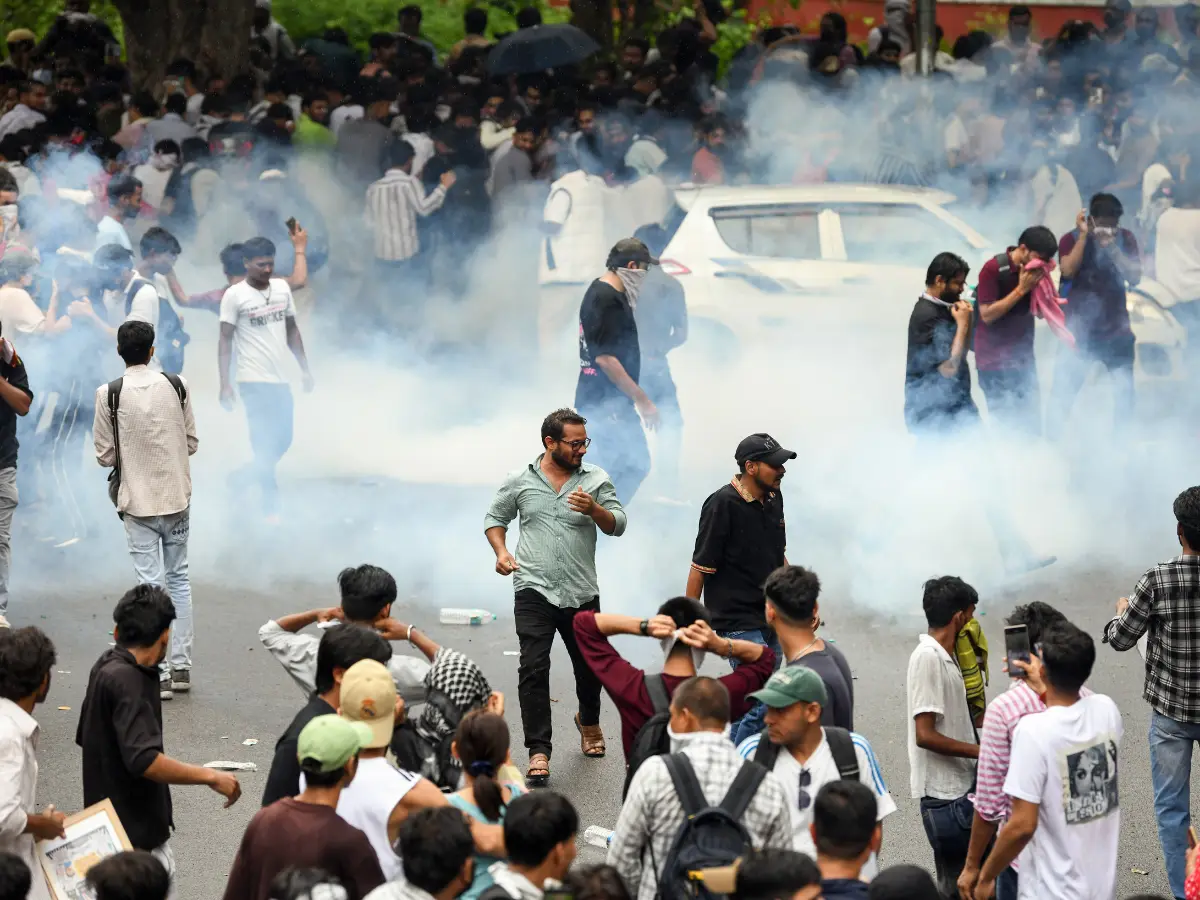
Amid Indian police's heavy crackdown of students' protest in New Delhi, a debate has risen online about the lawful understanding of laws of protesting in the country and difference between a ‘peaceful protest’ and ‘unlawful assembly.’ The Indian Constitution provides its citizens the right to protest peacefully underArticle 19(1)(b) while the ‘unlawful assembly’ is a criminal offence defined underSection 189 of Bharatiya Nyaya Sanhita (BNS), 2023 (formerly Section 141 IPC). According to law, a gathering of five or more people common unlawful object, or despite prohibitory orders is considered ‘unlawful assembly.’
When does peaceful protest become an unlawful assembly?
A ‘peaceful protest’ can also become ‘unlawful assembly’ if protesters are armed, or not in order, and non-violent. It also includes resisting law enforcement authorities or attacking them. It may be considered unlawful also when the protest is not carried out in a designated protest spaces or necessary approvals are not sought from the local law enforcement bodies. Blocking or dmaaging of public infrastructure is also considered as unlawful.
Moreover, even under the rights given in the Constitution, Article 19(3) states that the State may impose reasonable restrictions on the right to assemble peacefully in the interests of public order and the sovereignty and integrity of India. Article 19(2) permits restrictions on free speech on grounds such as public order, security of the State, and related constitutional grounds.
At the same time, authorities cannot use "public order" as a blanket justification to prohibit every protest. Any restrictions must satisfy the test of necessity and proportionality, meaning they should be the least restrictive measures required to address a genuine public order concern.
In Mazdoor Kisan Shakti Sangathan v. Union of India (2018), the Supreme Court held that the right to protest is fundamental but can be regulated to balance competing rights. In Amit Sahni v. Commissioner of Police (2020) (Shaheen Bagh case), the Court ruled that while peaceful protest is protected, public roads and public spaces cannot be occupied indefinitely, as this infringes on the rights of others.
Trending Stories
&im=FitAndFill=(700,400)&imwidth=180&imheight=135&format=webp&quality=medium)
Armoured vehicles vs main battle tanks: What is the real difference?
&imwidth=180&imheight=135&format=webp&quality=medium)
Donald Trump targets Bill Maher in lengthy post after White House dinner, says ‘Don’t call anymore’
&imwidth=180&imheight=135&format=webp&quality=medium)
'Clear overkill': Putin rejects claims Russia is behind mass protests in Europe
&imwidth=180&imheight=135&format=webp&quality=medium)
FIR filed against opposition MPs for ‘trespassing’ amid Jamia Millia students’ protest
&imwidth=180&imheight=135&format=webp&quality=medium)
Delhi's new entry rules for vehicles begin November 1. Here's all you need to know about the ban
&imwidth=180&imheight=135&format=webp&quality=medium)
Israel elections 2026: How the country is gearing up for a crucial vote
&imwidth=180&imheight=135&format=webp&quality=medium)
'He is a red flag': Ex-India strength and conditioning coach on Rohit's fitness regime
&imwidth=180&imheight=135&format=webp&quality=medium)
IND vs NZ: Tilak Varma sets world record with most T20I catches in a year
&imwidth=180&imheight=135&format=webp&quality=medium)
'Already tired of his 9-to-5': Baby born with a moustache becomes internet sensation, video goes viral | Watch
&imwidth=180&imheight=135&format=webp&quality=medium)
Serbia’s student-led movement defeats Vucic’s party after 14 years in power: Why it matters
&imwidth=180&imheight=135&format=webp&quality=medium)
'I promised Gautam & Kotak Sir that...': Tilak Varma opens up on match-winning mindset against NZ
&imwidth=180&imheight=135&format=webp&quality=medium)
Clayface tops North American box office, Elizabeth Holmes documentary follows close behind
&imwidth=180&imheight=135&format=webp&quality=medium)
Fire breaks out at Delhi’s North Block, thick black smoke seen | VIDEO
&imwidth=180&imheight=135&format=webp&quality=medium)
Netanyahu warns Israelis of ‘existential threat’ from Iran, posts AI image of nuclear strike
&imwidth=180&imheight=135&format=webp&quality=medium)
Can Putin cheat death? All about his daughter’s billion-dollar quest for immortality
&imwidth=180&imheight=135&format=webp&quality=medium)
Elon Musk’s Grok releases first AI-generated Odyssey episode, months after promising ‘historically accurate’ full-length film
&imwidth=180&imheight=135&format=webp&quality=medium)
Nagpur man fails to pay rent, allegedly prints fake Rs 500 notes worth Rs 37 lakh
&imwidth=180&imheight=135&format=webp&quality=medium)
Maldives opposition leader demands transparency on Muizzu Govt's Pakistan defence, security deals
&imwidth=180&imheight=135&format=webp&quality=medium)
Daler Mehndi controversy: Mika Singh’s team confirms Subodh Uniyal’s apology
&imwidth=180&imheight=135&format=webp&quality=medium)
Formula 1: Mercedes' Kimi Antonelli one race and ninth spot finish away from title after US Grand Prix win
&im=FitAndFill=(700,400)&imwidth=180&imheight=135&format=webp&quality=medium)
Why does this fighter jet have a golden window that looks like alien technology?
&imwidth=180&imheight=135&format=webp&quality=medium)
'I've done my work sincerely': AR Rahman on facing backlash over Ramayana soundtrack
&im=FitAndFill=(700,400)&imwidth=180&imheight=135&format=webp&quality=medium)
New OTT releases this week (October 26-November 1, 2026): Baththa, Akka, The One About Matthew Perry- 7 titles coming on Netflix, Prime Video and more
&imwidth=180&imheight=135&format=webp&quality=medium)
Harry Kane favourite to win 2026 Ballon d’Or ahead of Lamine Yamal and Kylian Mbappé
&imwidth=180&imheight=135&format=webp&quality=medium)
Who is Eyal Zamir, Israeli army chief, who reportedly clashed with Netanyahu over Iran?
&imwidth=180&imheight=135&format=webp&quality=medium)
'Hire the robot, fire the human': Bill Gates's words hint at a bleak future
&imwidth=180&imheight=135&format=webp&quality=medium)
Brazil re-elects factory worker Lula for fourth term; Indian PM Modi congratulates 'dear friend'
&im=FitAndFill=(700,400)&imwidth=180&imheight=135&format=webp&quality=medium)
Why do some fighter jets have two engines while others use one?
&imwidth=180&imheight=135&format=webp&quality=medium)
Pakistan airline PIA unveils new crew uniforms, faces online criticism
&imwidth=180&imheight=135&format=webp&quality=medium)
Telangana unveils AI avatar of IT minister D Sridhar Babu at Hyderabad DevFest 2026
&imwidth=180&imheight=135&format=webp&quality=medium)
WATCH | Virat Kohli returns to training ahead of New Zealand ODI series
&im=FitAndFill=(700,400)&imwidth=180&imheight=135&format=webp&quality=medium)
How do army night-vision systems see in almost complete darkness?
&imwidth=180&imheight=135&format=webp&quality=medium)
‘That is a miss’: Ravi Ashwin questions Sooryavanshi’s demotion to No. 3 in 2nd T20I vs NZ
&imwidth=180&imheight=135&format=webp&quality=medium)
'Hell of a beautiful a**': Trump compliments Nicki Minaj as rapper joins him in Michigan rally
While Supreme Court rules against blanket ban on protests in name of ‘public order,’ it also gave verdicts against protests to be held directly outside Parliament House or high-security buildings. For example, in Amit Sahni v. CP Delhi (2020), the SC clarified that protests must happen only in designated spots without blocking public thoroughfares or access to sensitive zones.
NEET paper leaks, CJP's and the protests?
New Delhi is witnessing massive protest demanding greater accountability from the ruling government on matters of education. This was triggered after the examination paper of National Eligibility cum Entrance Test (Undergraduate) or NEET UG was leaked in May this year and exam was cancelled. The re-test was conducted late last month. At least 21 students have died by suicide following the leak. Around the same time, Justice Surya Kant who called unemployed youths of the country as “cockroaches” while hearing a case. Though he later clarified that his comments were taken out of context, it led to formation of CJP.
The movement gathered traction online and soon spilled out of the internet. CJP members formed a group and began their protest at New Delhi's Jantar Mantar demanding resignation of the Union Education Minister. Days later, activist Sonam Wangchuk also joined the protesters and started a hunger strike at Jantar Mantar.
On July 20, thousands gathered at the Jantar Mantar to take part in the Parliament march announced by CJP. However, CJP leaders didn't lead the protests and two spokesperson of the group met Union Minister JP Nadda and submitted their written demands to the minister. They said that the minister assured him that he would get back to them after speaking to higher leadership. Even as this unfolded, crowd swelled at the location, and Delhi Police used batons and tear gas to disperse them. Though, police denied “use of force”, videos showed Delhi Police and Rapid Action Force personnel chasing the protesters and using tear gas shells at several locations around Jantar Mantar including Connaught Place.
Later, at night, despite the crackdown, the protesters gathered again at Jantar Mantar with CJP's Abhijit Dipke leading them and apologizing for not being able to save the students. Since then, the protests has continued even as Centre has deployed BSF and other para military forces in the area, alongside Delhi police.

