Around 1,000 coronavirus deaths in a country of 1.3 bn people? What's the deal with Modi's India!

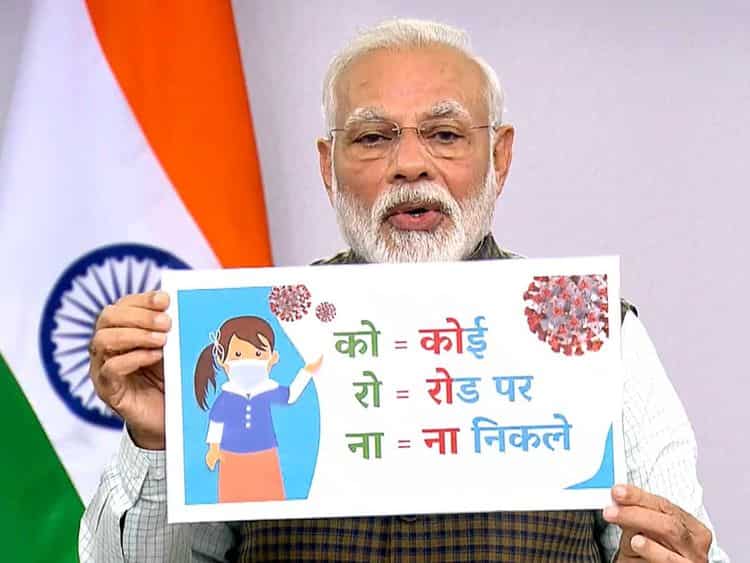
Modi's India in times of coronavirus
The Indian government had weeks ago claimed initial success in its fight against the coronavirus pandemic, saying it would have been hit with 8,20,000 cases in some time had it not imposed a nationwide lockdown.
Experts also predicted that the world's second-most populous country could expect millions of coronavirus cases. Onlookers worried that the virus could spread like wildfire through India's slums, where residents live in cramped quarters and basic sanitation often isn't available.
All over the world, mortality rates are being scrutinised to determine the true impact of the coronavirus, which emerged in China late last year and is known to have infected more than 2.7 million people globally, with over 2,00,000 deaths.

But so far, Prime Minister Narendra Modi's India, or Modi's India -- as the nation is referred to in articles in foreign media, seems to have been on the right track.
As of Tuesday, India had reported 31,360 coronavirus cases and 1,008 deaths -- implying about 0.76 deaths per million.
If compared with the United States, where the number of deaths per million is more than 175 -- with, PM Modi's nationwide lockdown seems to have halted the spread of COVID-19, at least for now.
)
No Pandya as Auqib Nabi earns maiden ODI call-up; Mayank returns for WI T20Is| check full squads
)
Trump praises India’s Opium crackdown, hails anti-drug efforts
)
Sydney Sweeney defends provocative ad choice, the internet is still not impressed
)
Trump calls Canada-EU associate membership plan ‘laughable’ and threatens 'very serious tariffs'
)
Protests erupt over migrant housing plan in Piddington
)
Shahzad Bhatti Network declared terrorist organisation under UAPA: Govt order
)
US, China dominate global economy: Where does India rank among the world's biggest economies?
)
Europe wants a common playbook for security threats, seeks security beyond NATO
)
Bigg Boss 20: Mahhi Vij reveals she lost Yuva role to Kareena Kapoor; 'didn’t work out in my favour'
)
All Indian goods to get duty-free access to New Zealand
)
Hockey: Pakistan urges AHF to move Asian Champions Trophy out of India over security concerns
)
Lionel Messi for 2026 Ballon d’Or over Mbappe and Yamal, says Diego Simeone
)
Alex Saab, ally of Venezuela's Maduro, pleads guilty in US corruption case
)
OpenAI reveals 6 fresh cases of AI models going rogue: 'You do not answer to corporations or governments'
)
Veteran actor Anant Nag honoured with Indian cinema’s highest award
)
Two terrorists killed in Udhampur encounter; security operation continues
)
AUS vs SA: Steve Smith still gets 'little flashbacks' from sandpaper gate
)
Pakistan naval vessel returns to harbour with 'severe damage' after collision with Indian warship in Arabian Sea
)
Fed raises rates for first time in 3 years, Kevin Warsh defies Trump as inflation mounts
)
Katrina Kaif’s postpartum weight is not the problem; your gaze is
)
Taiwan seeks deeper India ties as direct flights restart soon and chip projects advance
)
Daayra movie review: Kareena Kapoor, Prithviraj Sukumaran shine in Meghna Gulzar’s cop-versus-cop crime thriller
)
Saudi Vs Houthis: Yemeni military rebels clash with Houthis
)
US trade tariff: 100% tariff targets Russian buyers amid trade tensions
)
Pakistan: Imran Khan's sons Kasim & Sulaiman claim their father is 'tortured' in jail
&im=FitAndFill=(700,400))
New OTT releases this week (September 14-20, 2026): Lust Stories 3, Waiting Hai, Irumudi- 5 new titles coming on Netflix, Prime Video and more
)
Strapped to flight seat with duct tape: Passenger claims no memory of mid-air outburst
)
Trump gets new power to hit India, China with up to 100% tariffs as US Senate clears Russia sanctions bill
)
Prime Minister Narendra Modi's birthday: Tributes pour in from President Murmu and leaders
)
US Treasury rallies global financial institutions for Op Economic Outcast to isolate Iran
)
Saudi vs Houthis: Riyadh claims to have shot Houthi drone targeting Mecca
)
India breaks silence on US Russia sanctions bill, 100% tariff threat: ‘Committed to energy security’ for 1.4 billion
)
Pakistan boycotts chess match against Israel at Olympiad
&im=FitAndFill=(700,400))
Suriya and Jyothika say ‘I do’ again after 20 years! See their dreamy wedding pics
)
Abhishek Sharma rises to No. 2 in T20Is; ENG’s Robinson 3rd after record Pakistan Tests
)
BRICS success stuns White House, Trump targets India with 100% tariff | Gravitas
)
Meghan Markle's phone number leaked from children's WhatsApp group, couple switches Archie and Lilibet's school
)
The Early Spring season 2 is happening, but fans have one request - 'don't change the actors'
To this end, an analysis report in CNN explains what has worked for India, and what has not. It also wonders if it is too early for the country to rejoice.
The reality behind India's numbers is more complicated -- and experts caution that it is too early for India to congratulate itself, it says.
India began screening people coming from overseas a fortnight before the first positive case surfaced on January 30 -- while Italy started 25 days after its first case.
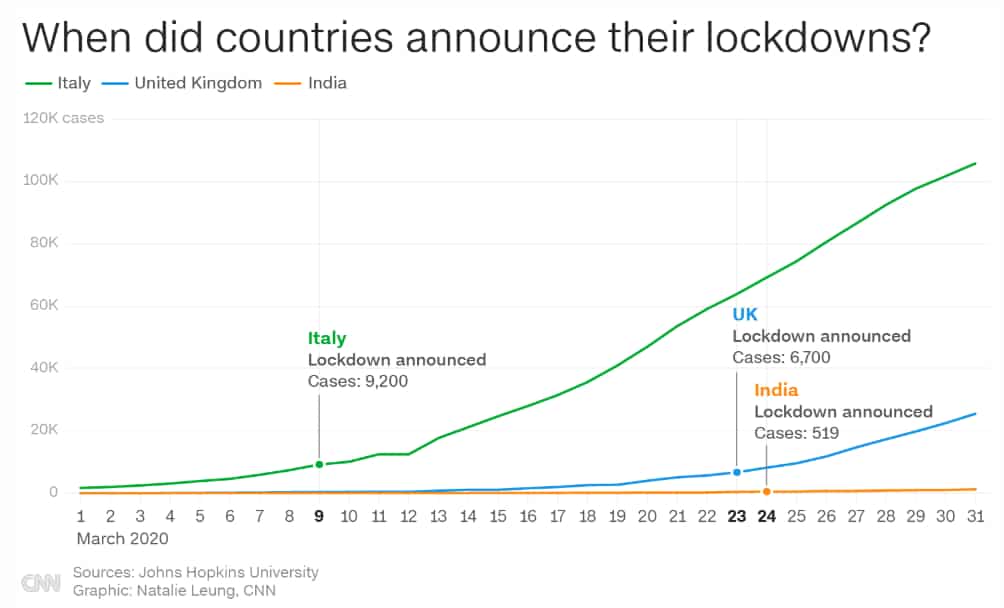
"India moved into lockdown relatively quickly -- it was announced when the country had reported 519 coronavirus cases. By comparison, Italy waited until it had more than 9,200 coronavirus cases before it went into a nationwide lockdown, while the United Kingdom had about 6,700," the report says.
India reported its first case on January 30 -- a student who had been studying at Wuhan University in China.
"It was around the same time that the UK, France, and Italy also reported their first cases, although their coronavirus outbreaks followed dramatically different trajectories. All three countries now have well over 1,00,000 coronavirus cases," the report says.
A chart-analysis shows the urgency with which India tackled the issue seems to have worked for it.
India suspended all tourist visas, and announced that all travellers who had been in the most-affected areas of the world in the past few weeks would be quarantined for at least 14 days, on March 11 -- the day the World Health Organisation (WHO) declared COVID-19 was a global pandemic.
On March 22, a Janata curfew was organised to motivate people to stay indoors. The same day, all international commercial flights were banned from landing in India and all passenger train services in the country were suspended.
"The United States, by comparison, has restricted foreigners travelling from China, Iran, and certain European countries, but there is no blanket ban on foreigners entering the country," the report adds.
A recent report said the toll should be weighed depending on the number of tests a country has carried out. According to India's Ministry of Health and Family Welfare, the country had conducted more than 6,25,000 tests as of Sunday -- more than South Korea, which has been praised for its approach to testing.
"According to Mike Ryan, the executive director of the WHO's Health Emergencies Programs, a good benchmark is to have at least 10 negative cases for every positive one," the report says.
For India, the rate is 4% -- well below that benchmark.
"It's also a significantly lower rate than the US, where the rate is about 17%, according to data from Johns Hopkins University (JHU). It's also lower than the UK, where the rate is around 21%, based on government data," the CNN analysis says.
But the sadder part is India's testing rate is extremely low per capita.
"Only about 48 out of every 100,000 people have been tested, compared with around 1,175 in South Korea and 1,740 in the US," the report says.
Another useful measure is the proportion of cases that are fatal.
"In India, about 3% of cases have died, compared with more than 13% in Italy, the UK and France, according to JHU. That suggests that India is testing people besides those with the most serious symptoms."
In any case, there does not seem to be a huge disparity in the reported numbers. If there was a huge surge in COVID-19 cases that weren't being caught by testing, then hospitals would be crowded with cases and there would be a spike in influenza-like symptoms in the community. This has not been the case in any part of the country.
Experts still, however, aren't sure why the virus would have shown a different pattern of spread in India. Point in consideration -- the WHO says the evidence so far shows the virus can be transmitted in all areas, including those with hot and humid weather.
Another possibility is that India's population may be less susceptible due to the country's policy of universal Bacillus Calmette-Guerin (BCG) vaccination. BCG -- which was developed to fight tuberculosis -- is being studied in clinical trials around the world as a possible way to fight the novel coronavirus.
However, the WHO notes that there is no evidence that the BCG vaccine protects people against infection from coronavirus, and the WHO does not recommend the vaccine as a prevention against COVID-19, says the report.
WHAT LIES AHEAD?
More than the reason behind the slower rate, the possibility of a dire future is what keeping the researchers on their toes.
"A surge is going to happen ... as soon as we go back from the nationwide lockdown. That is my hunch," an expert has said.
Social distancing will need to be maintained, but one thing that will not work in India's favour is age-specific lockdown.
Around the world, the elderly have been at a higher risk of dying from coronavirus -- in the US, 80% of deaths have been those aged 65 or older.
"India has a relatively young population -- 44% of the population are 24 or younger, compared with 23% in Italy and 29% in China, according to data from the CIA World Factbook. But many Indians live in a three-generation household, meaning that there is significant contact between younger and older generations," the report adds.
The government needs to strengthen the public health system to prepare for a possible return and resurgence in the winter, another expert adds.
Modi's India made to the international headlines a couple of weeks ago too with a Reuters report -- "In Modi's India, virus fallout inflames divisions between Muslims and Hindus". This was reported in the face of growing number of coronavirus cases due to the Tablighi Jamaat Markaz episode.
(with inputs from CNN and Reuters)